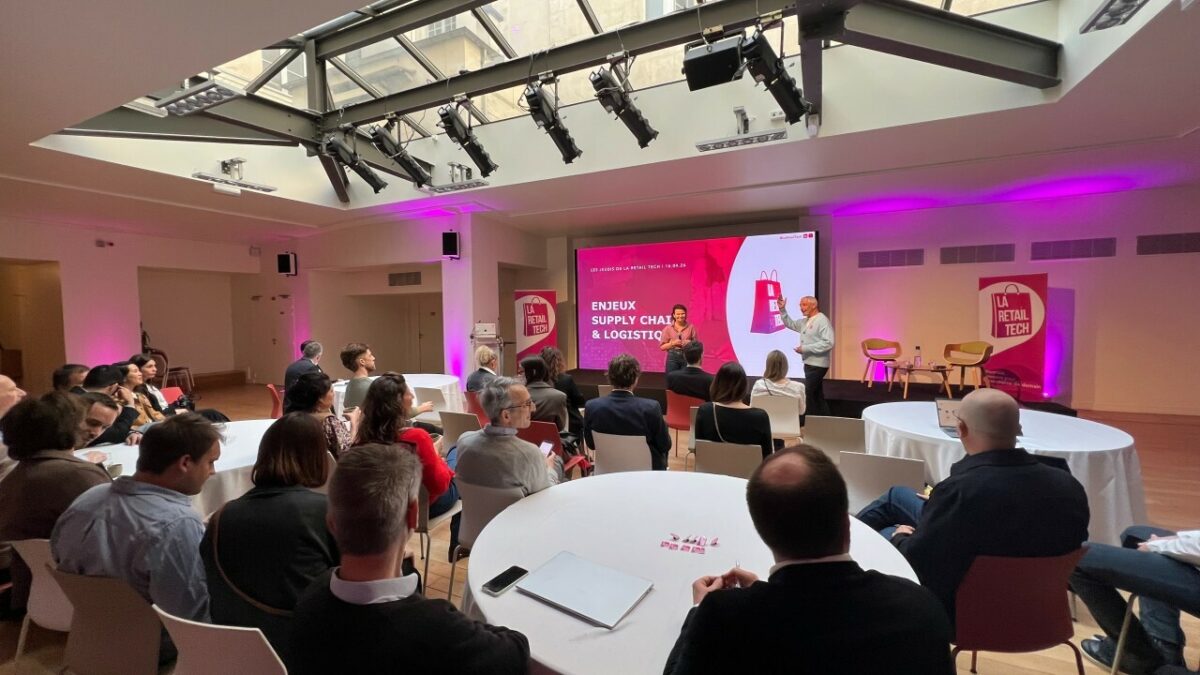
After a “tile tour” on the Champs-Élysées, we returned to rue de Valois for the 35th edition of Les Jeudis de la Retail Tech, dedicated to supply chain and logistics issues. The atmosphere was more intimate than usual, but the discussions were rich and fascinating, on a dimension of retail and e-commerce that is sometimes hidden, yet absolutely central to the performance of the customer experience.

Cdiscount: a transformation driven by the marketplace, AI and customer demands
During this talk, Thomas Métivier shared a very concrete vision of Cdiscount’s transformation, between the pivot of the business model, changes in managerial culture, the rise of AI and the defense of a French e-commerce model.
🛒 A major French player in e-commerce
Today, Cdiscount is France’s leading non-food e-commerce player. By 2025, the company will have achieved sales of close to 3 billion euros, with 19 million unique visitors and one in three French people visiting the platform every month.
The model is based on a very broad offering, with 20 million products and 10,000 sellers, who account for around 70% of business. At the same time, Cdiscount still does a third of its business directly.
This scale shows the scale of the challenge: offering a wide range of products, while maintaining the right level of product quality, price and service. As Thomas Métivier reminded us, a good marketplace depends first and foremost on good sellers, good products and good logistics.
Based in Bordeaux since its creation over 25 years ago, the company employs over 2,000 people. It also boasts its own logistics capabilities, with around a quarter of sales products dispatched via the company’s own logistics network.
🔄 Three years of transformation to boost momentum
On his arrival at the head of the company, in a post-Covid context deemed complicated, Thomas Métivier launched a transformation plan built around three major axes.
The first was the transformation of the business model. Cdiscount has accelerated its pivot towards the marketplace, a model presented as more profitable and efficient than direct sales. This has meant working on vendor sourcing, quality, the tools made available to them and the services offered, particularly in logistics and retail media.
The second was to refocus direct sales on categories where the company already had solid positions and sufficiently strong relationships with brands. This move was accompanied by a rationalization of the assortment and adaptation of logistics resources.
The third focus was on customer-led sales relaunch. After 2023 was devoted to reorganizing and reorienting the model, 2024 marked a reacceleration on the customer side, with a new brand identity, a new logo and the return of television advertising.
The first results have been clearly highlighted: in 2025, there are 40% more new customers than in 2024, with growth outstripping that of the market, and a growth dynamic set to continue in 2026.

🧭 A cultural shift as important as commercial transformation
One of the most interesting contributions of this speech is undoubtedly the idea that transformation is not just a matter of business model or technology, but also of corporate culture.
In a generalist group like Cdiscount, the competitive realities differ greatly from one category to another. What makes for success in major household appliances is not the same as in telephony, DIY or toys. The same logic applies to technological bricks, such as payment, where the requirement is to be up to the best market standards.
To respond to this diversity, we need teams capable of making relevant decisions quickly, as close to the field as possible. Thomas Métivier explained that the company had previously operated with a more centralized model, marked by a high concentration of decision-making. The challenge was therefore to bring decision-making closer to the field, to listen more closely to customers and to change the role of management.
The idea is not to do away with management, but to change its posture: less order and control, more support, the challenge of reasoning and the ability to unblock teams. The approach is inspired by lean management, notably Toyota, as well as examples such as Aramis Auto.
This pivot is presented as a major cultural change. And, according to Thomas Métivier, it is producing very tangible effects: fewer battles between silos, more problem-solving, and a greater ability to deal with subjects that really create value.
🔎 Start with customer problems to act faster
The example of the search engine is a good illustration of this logic.
Starting from the field and customer feedback, the teams identified a simple but concrete problem: certain queries were not correctly categorized. From there, they were able to rework the categorization system and achieve between 0.5 and 1 additional conversion point in one month, on a volume of 1 billion monthly searches.
The message is clear: when you start with subjects that are too broad, you get into long cycles. On the other hand, when we start from a specific customer problem, solutions emerge more quickly and can be implemented rapidly.
🤖 At Cdiscount, AI is nothing new
Another highlight of the talk was Thomas Métivier’s way of placing AI within a longer history.
At Cdiscount, AI has been a concrete subject for some fifteen years. At the time, the focus was on data science, but the need was already there: when a site grows from a few tens of thousands of products to several million, traditional systems, notably the search engine, are no longer sufficient.
This accumulated experience has enabled the company to ride the current wave of generative AI more quickly. But this is not to say that this new generation of models replaces everything that came before. On the contrary, Thomas Métivier insists on a logic of pragmatic integration into systems already in place.
⚙️ AI used to do things better, faster and more efficiently
The first of these uses concerns the improvement of existing systems, in particular product categorization.
When GPT-3 arrived, the teams tested the idea of completely replacing their machine learning model. The result was inconclusive. On the other hand, using the model only on uncertain cases proved to be very effective. This approach halved the error rate, on volumes of up to 20 million new products per week.
And the business stakes are far from marginal: a well-categorized product sells 20-30% more.
The company is gradually extending this logic to other bricks of its platform, from helping to better draft certain messages to automating part of the content generation process.
💬 AI that also transforms the customer and salesperson experience
AI isn’t just about optimizing what already exists: it’s also about changing the way people do business.
Cdiscount, for example, has developed its own chatbot, capable of helping customers with their searches, producing summaries of reviews, comparing products or translating a need expressed in natural language into usable technical criteria.
Today, usage is still limited to a few percent, but the shared observation is clear: customers who use this channel convert better than those who only use the classic route.
On the sales side, the impact is just as tangible. Where product creation used to involve time-consuming manual work – with 7,000 categories, data models to select and mappings to perform – automation now enables this work to be handled from a simple, raw Excel file.
The shared result is very tangible: more than a million euros in additional sales were generated in 2025 thanks to automatically created products.

🧠 Transforming the way teams work
The third use of AI mentioned by Thomas Métivier concerns the very way in which teams work.
The example given is that of offer teams, who have to identify missing products, understand what competitors are selling, spot price discrepancies, detect content problems and identify which vendors to contact. Much of this work, historically very manual, can now be accelerated by tools capable of cross-referencing external and internal data to provide useful signals.
He also cites the acceleration effect produced by the arrival of Claude and coworking-type practices.
Finally, the subject extends to IT development. Since early December 2025, certain teams have been putting 100% agent-developed code into production, with human validation at key stages. Complete autonomy has not yet been achieved, but the direction is clear: build forms ofagentic code factories capable of greatly accelerating certain projects, particularly on legacy systems.
With, in passing, a very apt phrase: “AI is not a palliative for incompetence.”
🌐 Agentique trade: vigilance on visibility, not questioning the site
On agentic commerce, Thomas Métivier distinguishes three stages in the customer journey.
First, theexploration phase, where customers are still trying to define their needs precisely. Cdiscount is not yet very active in this area, but chatbots could play an increasingly important role.
Next, theoffer analysis phase, which is becoming a strategic visibility issue. The company has set up a dedicated team and tests 3,700 prompts every week on different platforms to measure its presence and understand what actions to take.
Finally, the transaction phase. On this point, our conviction is clear: in the short to medium term, e-commerce sites will remain indispensable.
🇫🇷 A French player facing asymmetrical competition
The other key dimension of this intervention concerns the position of a French player in a highly unbalanced competitive environment.
Thomas Métivier stressed the importance of sovereignty, which in his view has already been undermined, and the need to be naïve in the face of certain players who do not play by the same rules as European players.
In particular, he cites the case of Shein, which is said to have crossed the threshold of 2 billion euros in annual business volume by being non-compliant with the RGPD over a given period.
He also criticizes the logic of certain public responses, such as the 2 euro tax, deemed ineffective in practice. In his view, flows are simply reorganized elsewhere, notably via Antwerp, which creates neither better protection nor real benefits for the French economy.
While he acknowledges the growing awareness of these issues, he also points to the slowness of European procedures, with delays of 3 to 5 years for certain dossiers, and the risk that the regulatory pile-up will end up benefiting the biggest global players, who are better equipped to absorb this complexity.
❤️ Customer loyalty as the best life insurance
Basically, Cdiscount’s response is not limited to asking for better regulation. The real battle remains that of customer relations.
Thomas Métivier points out that almost 80% of our business is with customers who have already purchased on the platform. The key issue is therefore the quality of the first experience, followed by the ability to continuously improve the value and quality delivered.
This is particularly true in high-commitment categories such as major household appliances, telephony and certain home and garden equipment, where trust is a determining factor.
With this in mind, the best protection against competition remains the same: offering choice, price and quality of service.
📌 In conclusion
What emerges from this presentation is that Cdiscount’s transformation is not simply a shift to a marketplace, or an AI strategy.
It is based on a coherent whole:
- a refocusing of the business model,
- a profound change in management,
- a pragmatic approach to AI,
- and a constant focus on the quality of the customer experience.
In other words, a transformation in which technology plays an important role, but always at the service of a more fundamental objective: to better serve the customer, in a market where competition is intense and loyalty remains the true judge of peace.

E-commerce supply chain: what the French really want
Frédéric MICHEAU (DGA OpinionWay) shared a very enlightening study on the expectations of the French in terms of delivery.
The facts are clear: the supply chain has become a central element of the customer experience, with expectations that are increasingly high… but also increasingly precise.
🚚 Price remains the number 1 criterion
First finding: 94% of French people consider low delivery costs to be important.
This is the strongest criterion, and even the only one where an absolute majority(54%) considers it very important.
As Frédéric Micheau points out, this is also a stable indicator over time, with an increase of +2 points in 18 months.
👉 The message is clear: price remains the basis of the decision.
🔁 Flexibility and reinsurance are no longer options
Second key finding: 91% of consumers expect flexible return and exchange policies.
And above all: “it’s no longer an option, it’s now clearly expected”.
The same logic applies to information:
👉 88% want to track their delivery in real time, up +7 points
We’re no longer just talking about delivery, but continuous reassurance throughout the entire process.

📦 The rise of personalized delivery
This is the key figure in the study: 85% of French people want to be able to choose the day of delivery, with a spectacular increase of +15 points in 18 months.
Frédéric Micheau insists on this point: it reflects a strong demand for customization and flexibility.
In other words, delivery must adapt to the customer, not the other way around.
⚡ Speed becomes a standard
Interesting fact: 80% of French people consider speed to be important.
But contrary to popular belief: “it’s not the number one determinant”.
In fact, it’s the only criterion that remains stable over time.
👉 Speed is now a given, no longer a differentiating factor.
🌱 The environment is making progress… but remains secondary
65% of French people attach importance to environmentally-friendly delivery
Although this figure is up(+6 points), Frédéric Micheau describes it as “falling behind” other expectations.
👉 Green delivery counts… but remains a lower priority than price, flexibility or reliability.
📊 Overall confidence high… but not total
On the reliability of information:
- 89% trust product availability (“in stock”)
- 78% trust delivery times
But behind these high figures lies an important nuance:
👉 22% of French people do not trust advertised deadlines
Frédéric Micheau explains: probably linked to disappointing past experiences
Also noteworthy: the under-35s and the working classes are even more confident than the average.
🤖 AI seen as a credible solution
Last key point of the study: 61% of French people believe that AI can improve the reliability of information
In detail :
- 16%: much more reliable
- 45%: slightly more reliable
Frédéric Micheau insists: there is strong confidence in the potential of AI
And this perception is even more pronounced: up to 80% among younger people
The use cases described are very concrete:
- better inventory forecasting
- better anticipate lead times
- provide information in the event of delays or unavailability
👉 AI is therefore seen as a lever for reliability and transparency.
🎯 Things to remember
The study reveals a clear hierarchy of expectations:
- Price (still dominant)
- Flexibility (returns, choice of day)
- Transparency (tracking, reliable information)
- Speed (now standard)
- Environment (important but secondary)
With one key point: the real battle is now over the quality of the delivery experience.
💬 Conclusion
Supply chain is no longer just a logistics issue.
It is becoming a strategic lever for the customer experience, where expectations are rapidly evolving:
- more control
- more customization
- greater reliability
And in this context: AI appears to be a key gas pedal for delivering on the customer promise.

Supply chain: the age of orchestration has begun
In his “expert’s eye”, Mike Hadjadj 🛍️ offered a dense panorama of international supply chain innovations.
The key point is simple: for a long time, the supply chain was primarily designed to deliver faster and cheaper. Today, the logic is changing.
👉 It’s no longer just about optimizing costs. 👉 It’s about better forecasting, better allocation, better execution and better delivery.
In other words, we’re moving from a cost logic to an orchestration logic.
📊 A rocker already visible
A few figures sum up the movement:
- 2 out of 3 retail executives plan to reconfigure their supply chain if costs rise
- 30% are already using AI on certain links
- 41% could use it by 12 months
- 59% expect ROI within 12 months
- 51% cite efficiency as #1 priority
The subject is no longer experimental. AI is becoming an operational lever.
🧠 Three verbs structure the transformation
Mike Hadjadj sums up this transformation in three parts:
- Anticipate
- Automate
- Orchestrate
With three very concrete priorities in mind:
- make better use of data
- launch targeted automation
- implement governance capable of moving from pilot to scale
The idea is not to transform everything at once, but to start where the ROI is quick and visible.

🔮 Forecasting: from forecast to real-time signal
This is undoubtedly one of the strongest shifts.
At Amazon, with Chronos, demand forecasting integrates a multitude of signals, including external ones such as weather, calendar and events.
At JD.comthe logic goes as far as planning by SKU, by zone and by period, with dynamic stock allocation.
At Walmart, FreshSync AI enables store-wide management of fresh produce, with the promise of reduced waste and improved margins.
But the most striking case is undoubtedly Shein.
Where retail functioned according to the sequence: I plan → I produce → I sell,
Shein switches to: I test → I measure → I adapt.
The company analyzes millions of signals in real time, launches micro-series, immediately observes clicks, conversions, basket additions or returns, then decides whether to stop or accelerate.
👉 We no longer simply predict demand. We measure it in real time.

📦 Storage: making storage intelligent
Another pillar is stock visibility.
Zara remains a benchmark with RFID, which has enabled us to track each product with a high degree of precision, then unify in-store and online stock. The result: the store becomes a logistics link in its own right.
Walmart is also pushing the visibility envelope with its pallet-mounted Bluetooth sensors, for tracking location, temperature and humidity.
And Lowe’s is showing another way with its in-store digital twin: 3D modeling, merchandising simulation, detection of out-of-stock items or placement errors.
👉 Stock is no longer just a volume. It’s data that can be managed in real time.

🎯 Allocate: put the right product in the right place
Planning is not enough. It’s even more important to place inventory correctly.
H&M is already working on assortments adapted to each point of sale, thanks to continuous analysis of receipts, returns, sales and loyalty data.
Alibaba takes this logic to the next level with intelligent routing of inventory between hubs, including cross-border.
Amazon goes even further with its predictive supply chain: certain products begin to approach the customer even before the order is placed.
And at Target, the algorithm constantly arbitrates between demand, promotions, seasonality, speed and logistics costs.
👉 It’s no longer just about having stock. It’s about having the right stock, in the right place, at the right time.

🤖 Robotizing: AI changes scale
Robotization is nothing new. But AI is profoundly changing its scope.
At JD.comwarehousing, sorting and delivery are driven on a massive scale by data and AI.
At Amazon, several bricks complement each other:
- Sequoia to bring products to operators
- DeepFleet to orchestrate robots like an air traffic controller
- and the new, much more robotized “next gen” fulfillment centers
At Decathlon, with Exotec, the robots climb to the top, greatly reducing the need for operators to move around.
At Tesco and Albert Heijn, micro-fulfillment and partial or total automation speed up local preparation.
👉 Robotization is no longer just about increasing productivity. It is transforming the very structure of execution.

📍 Getting closer: the store becomes a hub
The other strong trend is to get closer to the consumer.
Walmart, Target, Carrefour and Ikea are all converging on the same idea: the store is no longer just a point of sale, it’s also a local logistics hub.
At Target, 95% of online orders are already prepared in-store. At Ikea, stores also become urban preparation and dispatch centers. And at Zalando, even partner stores become logistics execution points.
👉 Omnichannel is no longer just a marketing issue. It has become a supply architecture

🚀 Touch: from the last mile to the last centimeter
Last but not least: last-mile delivery… or rather, last-meter delivery.
Mike Hadjadj points out that in France, these uses are still not very visible. But elsewhere, they are already very real:
- delivery robots on campus or in urban neighborhoods
- autonomous delivery vehicles
- drones for meals, parcels or local products
- massive development in Asia and the United States
China is pushing this logic particularly hard, with commercial drone routes already active and delivery costs now lower than human costs in some cases.
Walmart, for its part, is also strongly developing drone delivery in several American metropolises.
👉 What still looks like a demonstration here is already an operational model elsewhere.

🦾 What’s next? Humanoid robots and dark factories
At the end of his talk, Mike Hadjadj opens up an even more radical perspective:
- robots capable of learning by observing humans
- robots resistant to all environments
- factories without light, heating or human presence
- 24-hour autonomous production over several days
This may sound extreme, but the idea is clear: some supply chain bricks are already moving towards far greater automation than was imagined until recently.
💬 Things to remember
The real lesson here is that supply chain is no longer just a logistics issue.
It becomes :
- a decision-making system
- a steering system
- an execution system
- and, above all, a competitive advantage
Tomorrow’s top performers won’t just be those who deliver fast or cheap.
They will be the ones who know how to forecast better, allocate more accurately, automate intelligently and orchestrate everything in real time.

AI and supply chain: very concrete uses, between forecasting, collaboration and operational excellence
Speakers: Arthur Caron: Supply Chain Director – Monoprix and Julien-Pierre Renier: CFO – Carel
At this roundtable dedicated to AI for an ever more resilient and efficient supply chain, the exchanges between Arthur Caron and Julien-Pierre Renier highlighted a simple reality: AI is already transforming the supply chain, but it’s only worthwhile if it’s part of a solid organization, real operational discipline and strengthened collaboration with the entire ecosystem.
Behind all the talk about tech, we’re actually talking about very concrete issues: better forecasting, better replenishment, better collaboration, better customer service.
🏬 Two companies, two scales, one challenge: gaining in accuracy
At Monoprix, the supply chain operates on a very large scale:
- over 600 stores
- 15,000 employees
- 600,000 customers a day
- 4 billion euros in sales by 2025
In the food sector, the company offers 41,000 products online. E-commerce preparation is based on Ocado technology, with some 2,500 orders prepared daily by robots. On the non-food side, growth is also achieved through warehouse preparation with Exotec in the Paris region.
At Carel, the scale is different, but the complexity is real. The 75-year-old brand produces 40,000 to 50,000 pairs a year. Each model is available in several materials, colors and sizes, generating a very large number of SKUs. In recent years, the company has therefore sought to bring back simplicity, streamlining collections and reorienting its model more towards B2C.
🤖 AI as a decision support tool, not autopilot
One of the most interesting messages to come out of this roundtable is that neither Monoprix nor Carel are presenting AI as a magic wand.
At Carel, Julien-Pierre Renier explains very clearly that the right formula relies on a human + AI combo. The tool can detect weak signals, and propose recommendations for restocking or reallocation, but the decision remains discussed, challenged and validated by the teams.
The same logic applies at Monoprix. Arthur Caron insists on one essential point: before tools, you need processes, organization and structured teams. Technology can only accelerate what is already built on solid foundations.
📈 Carel: gain agility, reduce inventory, better manage collections
For an SME like Carel, the supply chain has become central because it touches on three critical issues: cash, margin and risk.
With Autone, the brand has been working for several years on a much more refined forecasting, restocking and rebalancing logic. The tool identifies, at a very detailed level, signals concerning a model, color, size or reference. Teams then decide whether or not to follow up, adjust or restock.
The result is significant: with identical sales, Carel has managed to reduce its inventory by 18%.
Another major change is that, whereas the company used to commit around 80% of its purchases to campaigns, it has now reduced this to 50%, giving it greater agility to adjust its decisions during the season.
The next step has already been identified: making even greater use of data and AI right from the start of the collection, to help assess a model’s probability of success, based on its shape, color, market context or observed trends. Not to replace the collection manager, but to enrich his or her decision.

🛒 Monoprix: better forecasting for better sourcing
At Monoprix, the supply chain is also a function of advanced observation of customer behavior.
Because it is directly connected to sales, it is often quick to detect signals that other functions are less sensitive to: the rise of certain categories, changes in purchasing patterns, the shift of sales to Sundays, or the increasing fragmentation of shopping into smaller, more frequent purchases.
In response, Monoprix is already using machine learning models to anticipate future sales based on :
- sales history
- weather forecast
- local events
- school vacations
- consumer trends
These forecasts are then fed into the store replenishment algorithms.
Today’s challenge is not just to have high-performance models, but also models that are easier to explain, and better able to justify their recommendations to operational teams and stores.

🤝 Supplier collaboration, a blind spot that has become a priority
Another key point raised by Arthur Caron is that the supply chain can no longer be thought of solely from within the company.
To improve efficiency, we need to work more closely with suppliers: better anticipate a break, better understand a delay, better share information on a commercial operation or unavailability.
Monoprix has already tested a number of different approaches, and has come to the clear conclusion that simply making data available is not always enough. What counts is to offer tools that can actually be used.
With this in mind, a supplier portal has been set up to streamline exchanges with both small suppliers and major manufacturers. And the next project is to integrate AI agents to automate some of the interactions and reduce the weight of e-mails, which are still omnipresent in daily exchanges.
🏪 The store remains an integral part of the supply chain
At Monoprix, the supply chain doesn’t stop at the store door. It goes right down to the shelf.
That’s why we’re working on the store’s digital twin, which aggregates various performance data and makes them visible in the morning brief. Thanks to a heatmap-style visual display, teams can better understand where breaks, tensions or opportunities are concentrated.
The aim is twofold:
- better control in-store execution
- give more meaning to teams by better linking field operations and business performance
👠 At Carel, tech doesn’t replace customer care
Carel’s testimonial also reminds us that supply performance is not just about procurement.
With a return rate of 12%, considered low for footwear, the brand is focusing on two levers:
- extensive work on sizing, with detailed guides
- a highly committed customer service team, present before and after the purchase
Here again, the logic remains the same: tech helps, but it’s the human + tool combo that makes the difference.
📌 Things to remember
This round table shows that AI applied to the supply chain is no longer a concept.
It is already producing very tangible results:
- better forecasting
- more accurate restocking
- better stock control
- smoother supplier collaboration
- more precise store management
- faster decisions
But it only really works when it’s based on :
- clear organization
- robust processes
- real business insight
- and human expertise capable of challenging the tool
In short: AI doesn’t erase the supply chain, it makes it clearer, more responsive and more efficient.

Collab’ of the month: Motoblouz x Boa Concept
Speakers : Christophe Dautel: Supply Chain & CSR Director – Motoblouz and Franck Girard, Sales Director – Boa Concept
We often talk about innovation… but more rarely about collaborations that last and evolve over time. That’s what Motoblouz x Boa Concept’s experience feedback is all about: a collaboration built up over more than 10 years, in step with the growth of the French leader in motorcycle equipment.
🏍️ Game-changing growth
Motoblouz is today:
- 600,000 orders shipped per year (vs. 400,000 previously)
- up to 7,000 parcels/day at peak times
- and an offer soon to reach 300,000 products
👉 Behind these figures: a demanding logistics reality Technical, high-value products (PPE), marked seasonality… Impossible to be content with a fixed logistics model.

⚙️ The real challenge: automation… without rigidity
The key to this collaboration: reconciling mechanization and flexibility
Thanks to a modular approach (scalable conveyors), Motoblouz was able to :
- upgrade your warehouse without starting from scratch
- absorb growth gradually
- adapt flows over time
📈 Very concrete results
- Productivity increased from 20 to 37-38 parcels/hour
- Current capacity: up to 13,000 orders/day
- Major roll-out completed in less than a month
- No downtime (even in the run-up to Black Friday)

🤝 What makes the difference
This collaboration shows one essential thing: automation is not a one-shot deal. It’s a continuous process of adaptation
With 3 keys:
- think scalability from the outset
- integrate field constraints (ergonomics, fatigue)
- guarantee business continuity
💡 To remember
✔️ Automate, yes… but not at the expense of flexibility
✔️ Logistics must keep pace with business
✔️ The best projects are those that last… and adapt.