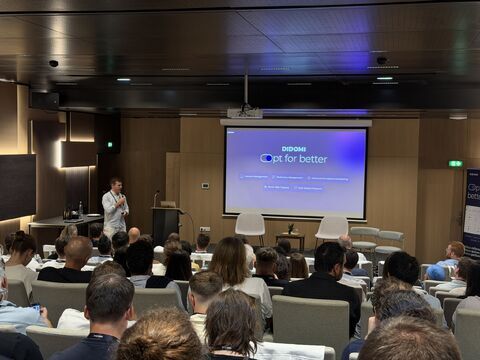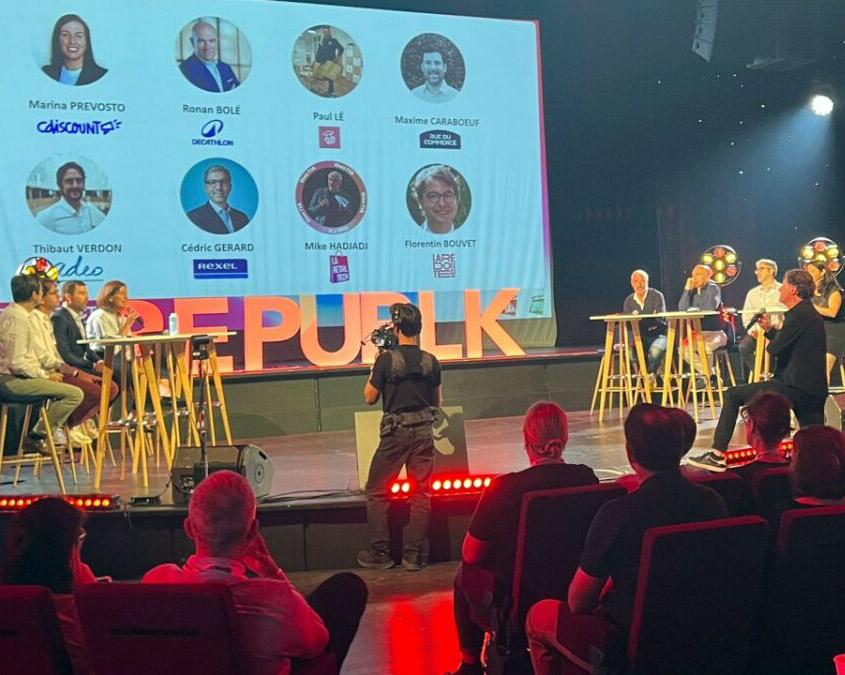

On Thursday March 19, 2026, we had the pleasure of being invited to the first “retail performance” morning co-organized by our Lille-based colleague Fourseeds, alongside their partners ShopiShopa and COD4IS, in a setting ideally located opposite the Gare Saint-Lazare in Paris.
On the agenda for this morning: a subject at the heart of today’s challenges – retail performance in 2026. Around the table, a panel of speakers with complementary expertise, sharing their visions and feedback on the changes taking place in the sector.
As Olivier Guillouzouic, CEO of Fourseeds, pointed out, the objective was clear: “to open up the chakras”. And the exchanges lived up to their promise, to say the least…

🛍️ Shopify POS: the unified retail revolution is underway
Christophe Davy (General Manager ShopiShopa Consulting) shared a particularly rich intervention around Shopify POS, with, as a bonus, some exclusive roadmap elements.
An opportunity to take a look at a solution that is still emerging in France, but already well established internationally, and which perfectly illustrates the changes underway in the retail sector.
Launched in 2018, Shopify POS is a continuation of the Shopify ecosystem, with a strong promise: to natively unify e-commerce and retail. Here, no complex integration between systems: the point of sale is directly connected to the Shopify back-office, with the same customer, product and order data.
In concrete terms, the solution is based on a mobile application available on iOS and Android, which is easy to deploy and learn. This “tablet-first ” approach profoundly transforms the in-store experience: streamlined ergonomics, rapid team onboarding, and the ability to operate on the move, with configurations ranging from 100% Bluetooth to more traditional setups via the new POS Hub.

But beyond technology, a paradigm shift is taking shape.
Shopify POS has a vision in which :
- omnichannel is native, not reconstructed after the fact;
- technical complexity is replaced by usage;
- and the application ecosystem becomes a major lever for functional extension.
With nearly 10,000 applications available on Shopify, including around a hundred already dedicated to POS, the momentum is clearly underway, particularly in areas such as inventory management, scheduling and in-store sales experience.
Today, the French market is still in the early stages of adoption. Shopify POS is following a trajectory reminiscent of that of Shopify e-commerce some ten years ago: first adopted by digital native brands, before wider distribution to more established retailers.
Players such as Cabaïa, with 60 stores, and Oh My Cream, with around 50 outlets, are already illustrating this rise, while more traditional brands are also beginning to take the plunge.
However, a number of challenges remain:
- complex inventory and flow management, often supported by third-party applications;
- data migration for customers, orders and discounts;
- integration with finance/accounting systems;
- and, of course, adaptation to local conditions, particularly in terms of taxation and NF525 certification.
These challenges remind us of one essential thing: no matter how attractive the technological promise, a POS project is first and foremost a transformation project.
Shopify POS is no longer simply a solution to be observed. It’s now a strategic issue to be anticipated by all brands that want to reconcile operational efficiency, ease of use and omnichannel experience.

🎯 Customer loyalty: another key driver of retail performance
Feedback from Émilie Baraibar (digital & CRM director ARTHUR) and Olivier Guillouzouic (CEO Fourseeds ) then highlighted a subject that has become unavoidable: customer loyalty in an omnichannel environment.
Through the case ofArthur, a 40-year-old French brand known for its everyday essentials, the subject was tackled in a very concrete way, with a particularly interesting angle on structuring customer data in a Shopify ecosystem.
Today, Arthur has some forty stores in France, an e-commerce business, a small marketplace, and a historically retail model. But behind this well-established presence, the challenges remain highly topical: better performance management, better use of customer data, and better articulation of loyalty, CRM and omnichannel.
First lesson: performance can no longer be read at a single level.
Arthur’s analysis is based on :
- a channel vision, with a comparison between retail and digital ;
- an e-commerce vision, based on traffic, conversion and average basket;
- a customer vision, with tracking of recurrent customers versus acquisition ;
- and a product vision, with sales analysis by season, line and best-seller.
What emerges very clearly is that the customer’s vision is becoming a central steering point, in particular to better arbitrate acquisition investments.

Another interesting topic is the choice of technology.
In a Shopify environment, the first logical step is to take advantage of the plug and play applications available. However, this approach has its limits when it comes to more complex issues, particularly in the omnichannel arena.
As Arthur is not equipped with Shopify POS, but with another POS system, the junction between store data and e-commerce data becomes a real issue. This is where Fourseeds comes in, with the implementation of a RCU (unique customer repository) and a loyalty engine in the Shopify environment.
The challenge here is simple: to reconstitute reliable, clean and centralized customer data.
This involves several very concrete building blocks:
- merging and deduplicating customer files;
- RGPD compliant;
- customized dashboards for CRM and retail teams;
- and a connection with Klaviyo for marketing activation.
One point was rightly made: we mustn ‘t confuse RCU and CDP.
The RCU provides a basis for governance and control of customer data. The CDP, on the other hand, responds to a CRM activation and segmentation logic.
This is an important distinction, because it shows that performance is not just a question of activation tools, but first and foremost of having a robust data base.
It’s also what allows loyalty to change dimension.
At Arthur, the subject is now much better managed than before. Where loyalty program data used to be fragmented between stores and digital, there is now a consolidated view, with reading possible down to channel or even store granularity.
It changes a lot of things.
Firstly, because it makes it easier to measure the actual use of the program. And secondly, because it provides concrete arguments for getting retail teams on board, particularly in one key area: in-store email collection.
And this is undoubtedly one of the most interesting lessons to be learned from this speech: loyalty only becomes a structuring lever when it is objectified by data.
Without reliable indicators, it’s hard to convince, align teams or change practices. With the right KPIs, loyalty becomes a measurable, controllable issue, increasingly integrated into store objectives.
Finally, several performance levers for 2026-2027 were mentioned.
On the digital side, Arthur is working in particular on CRO issues, with a clear challenge: to better convert growing traffic. And of course, AI is also part of the roadmap, whether for site localization, the production of e-commerce visuals or performance analysis via Sidekick in Shopify.
In the end, this feedback reminds us of one essential thing: customer loyalty is no longer just a CRM issue. It’s a retail performance issue in its own right.
And for it to really generate value, you need more than a program: you need reliable data, a shared understanding of the issues, and a real link between retail, digital and activation.

🔧 Integration & execution: a decisive but often underestimated lever for retail performance
To round off the morning, a round-table discussion moderated by Anne Charlotte LE DIOT with Eric Duong and Jerémy Jazat from COD4IS put the spotlight back on a subject that is as strategic as it is sometimes misunderstood: integration and execution.
A subject less visible than others, no doubt, but nonetheless fundamental. Behind every omnichannel ambition, every new solution, every promise of fluidity or real time, there is a very concrete reality: making systems, data, business constraints and organizations work together.
The first lesson to be learned from this sequence is that there is still a real perception gap between what business teams imagine an integration project to be and what this type of project actually entails.
Certain phrases are often used. For example: “You’re the experts.”
Behind this formula, which may seem to give freedom, lie several well-known difficulties:
- interconnection problems between solutions;
- technical constraints discovered too late;
- a lack of business involvement;
- time, budget and team availability;
- and sometimes a choice of solution made before even checking whether the whole is really technically feasible.
In this type of context, the integrator often finds himself having to deal with what already exists, delving into the successive layers of an already complex ecosystem, and implementing solutions that enable progress to be made without always being able to rebuild properly.
And that’s where a well-known risk comes in: the more patches you add to an already fragmented system, the more technical debt you create.

Another preconceived idea discussed during the round table: “It’s easy, it’ll be quick, it’s standard.”
Here too, feedback is very clear.
Yes, there are standard connectors. But in reality, the standard never completely covers the real need.
Why? Because integration isn’t just about connecting two tools. It also involves ensuring that both solutions :
- talk about the same objects;
- give the same meaning to the data;
- manage the same attributes;
- and can support the same levels of demand.
In other words, the standard does not eliminate complexity. It may even mask some of it from the outset.
This is particularly true when it comes to data.
The round table showed that data refactoring remains an often underestimated task. When you change your solution, it’s not enough to simply “take back the data”.
You also have to manage :
- attributes that no longer exist;
- additional fields;
- limited field sizes;
- differences in structure;
- and sometimes very different processes depending on the subsidiary or entity.
These are all points that are not always well anticipated when a project is launched, even though they can have a major impact on its success.
With this in mind, the question ofETL naturally arose.
The answer is clear: it becomes relevant as soon as possible.
With the rise of best-of-breed approaches, companies are multiplying the number of specialized tools. And the more bricks are connected, the more useful it becomes to have a base capable of simplifying adaptations, better managing flows and preserving a readable architecture over time.
This is also in line with another key idea raised during the discussions: the governance and sovereignty of data are becoming increasingly important issues.
The discussion also served as a reminder that there is no good universal solution.
A good solution always depends on :
- of the budget;
- customer context;
- volumes;
- prerequisites;
- business constraints;
- and the level of requirements expected, particularly in terms of real time.
In omnichannel projects, data is increasingly required almost instantaneously. And this requirement creates real technical challenges, which not all solutions can absorb in the same way.
In this context, the integrator’s role goes far beyond mere technical execution.
This is undoubtedly one of the most interesting points of this talk: the integrator is also a facilitator.
Facilitator :
- between craft and technology;
- between customer and partners ;
- between solutions that share neither the same logic nor the same definition of data ;
- and between the constraints of the present and the need to build something viable for the long term.
Their value also lies in their cross-functional position: working in a variety of environments, with several customers and several stacks, enables us to identify classic errors, recurring incompatibilities and the most realistic trade-offs more quickly.
Finally, the round table opened on the evolution of the profession withAI.
The shared observation is not that the role of integrator is disappearing, but that the profession is gradually being transformed.
Integrators are increasingly becoming orchestrators:
- able to rely on agents for documentation,
- flow control,
- analysis,
- support,
- or decision support.
But there was also a clear message of caution: this may not happen as quickly as we think.
These new uses still require :
- expertise ;
- supervision ;
- well-designed scenarios ;
- and real vigilance on issues of governance, data ownership and sovereignty.
At the end of the day, this feedback reminds us of one essential thing: integration is not just a technical issue.
It’s a question of alignment between business, IT and partners. It’s about data quality. It’s about method, arbitration and long-term vision.
And in a context where retail ecosystems are becoming ever more complex, performance depends not just on the tools you choose, but on how you actually make them work together.
Many thanks to all the speakers for a very interesting morning!