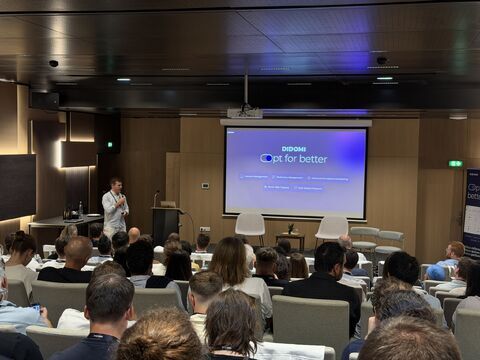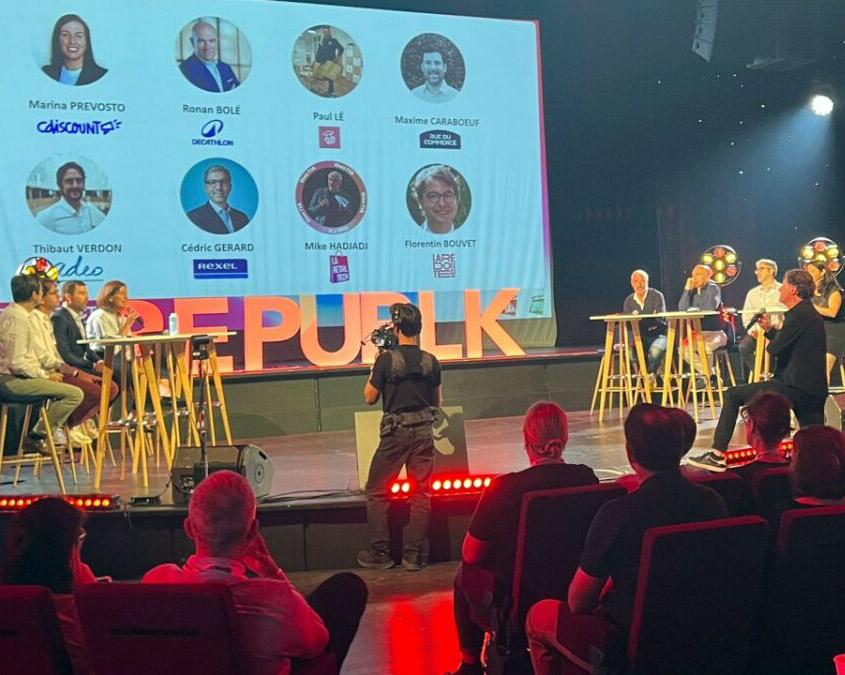
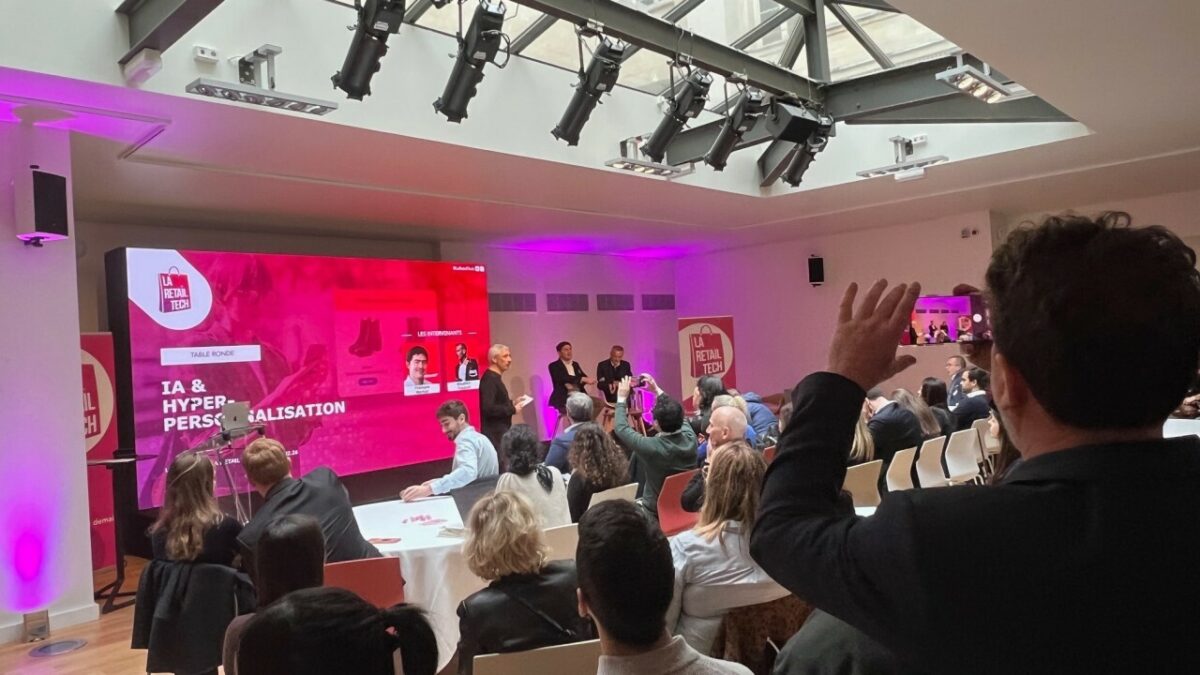
For the 33ᵉ edition of Retail Tech Thursdays, Barbara SARRE-DEROUBAIX and Mike Hadjadj 🛍️ had imagined a special program around AI and hyperpersonalization.
Even if a similar theme had already been addressed last November, notably around agentic commerce, it’s clear just how much the market has changed in just a few months: technologies are maturing fast and, above all, use cases are becoming much more concrete and deployable.

🎙️ CEO’s Vision: Jérôme Tacquard, Chairman of Fauchon, tells his story.
In CEO’s Vision, Jérome TACQUARD, President of Fauchon, looks back on a brand that everyone knows – without always knowing its history – and on the transformation undertaken as the house celebrates its 140th anniversary.
🕰️ 140 years of history: the birth of Place de la Madeleine, at the heart of a Paris under construction
It all began in 1886, when Auguste Fauchon, a young man from Normandy, set up shop on Place de la Madeleine. Paris was changing, the city was on the move, landmarks were evolving. His ambition was both simple and ambitious: to bring the best products to Parisians.
Early on, the company built a DNA of exceptional products and vision.
🍰☕ Early markers: patisserie, tea room and pioneering spirit
Auguste Fauchon quickly developed his pastry business and expanded his offer beyond delicatessen.
In 1900, the company opened an English-inspired Five O’Clock Tea, designed as a place where women could meet, at a time when such spaces were rare.
In 1906, another symbol: a major Parisian cellar, presented as the second largest in Paris behind the Tour d’Argent, with nearly 800,000 bottles.

🧭 An observation at the time of the takeover: a brand that had become distant from the product and the customer
Over time, the brand developed and declined, but a distance was established. Jérôme Tacquard describes a period when Fauchon sometimes functioned as a “support” brand, with licensed products far removed from its gastronomic DNA.
One point comes back like a trigger: starting in 2012, the company decided to outsource its flagship products (notably macaroons). He recalls exchanges with former employees of the brand, and the testimony of a pastry chef at the time, who explained that he had been asked to outsource products that had made Fauchon a success.
🏢 May 2024: takeover by Galapagos, a logic of brands and territorial roots
In May 2024, Fauchon was taken over by the family-owned Galapagos Group, based in Brittany. The group includes cookie brands such as Gavottes and Traou Mad.
The common thread presented: stories, brands and territorial roots, with an attachment to recipes and strong identities. Fauchon becomes a relaunch project: an iconic brand, known beyond Paris, but in need of realignment.
🔁 Get back to basics: put the product back at the center, reinternalize
The priority is to put the product back in the range, to restore the place of know-how and consistency.
A specific project is mentioned: the reinternalization of macaroons, with a view to verticalization and synergies within the group. The brand also assumes its identity as a generalist gastronomy house, with universes that coexist (patisserie, tea, wine, exceptional products), rather than seeking to become too specialized.
🗼 Paris: preserve the Madeleine anchoring point, without seeking to mesh at all costs
The Paris of today is not the same as it was yesterday: rents, changing neighborhoods, consumer habits. Jérôme Tacquard describes an intensely competitive environment, with historic houses and entrants already well established.
The logic became pragmatic: consolidate the Parisian anchorage around the Madeleine and work on a more demonstrative location, capable of carrying the brand universe.

🧁☕ The flagship as experience: coffee shop, sit-down, open kitchen, modularity
The concept is built around current uses:
- a coffee-shop-oriented offering (takeaway coffee)
- an emphasis on the pastry/confectionery dimension
- a seated experience with a Parisian brasserie-style menu
- an open kitchen visible to customers
- modular spaces for events, privatizations and masterclasses
A place designed as a testing ground, where we show what we can do.
🌍 International: a strong image and planned openings
Fauchon remains a Parisian brand, but the model has branched out towards an international clientele. Jérôme Tacquard mentions a very good image in the United States, the Middle East and Japan.
An opening is also planned for Saudi Arabia in 2027.
🏨✨ The gourmet hotel: extending Fauchon from check-in to check-out
The Fauchon universe also extends to hotels, with the aim of creating a coherent experience from start to finish.
Rituals are mentioned: a welcome in a lounge, Fauchon tea and pastries/macaroons, then an extended in-room universe (dedicated bar/cupboard, designed elements) so that the brand is experienced, not just consumed.
📲🎁 Digital and data: CRM, newsletter and gift personalization
E-commerce is estimated at around 10%. The priority is to strengthen customer relations.
The axes mentioned :
- expand CRM database
- keep in touch via newsletter
- develop online personalization, in particular through gift packages that can be configured to suit specific occasions
- move towards a 360° approach to customer experience
🧩 Summary: reaffirming identity for a better future
This CEO’s Vision sets out a clear course:
- back to the gastronomic heart of Fauchon
- realign the brand with its historical DNA
- consolidate Parisian roots without dispersion
- capitalize on a strong international image
- enriching the experience through personalization and data
After 140 years of existence, the challenge is not to reinvent Fauchon, but to re-anchor it in what has made it strong: the product, the experience and a certain idea of Parisian refinement.

🤖 AI & personalization: the French are more lucid, more demanding… and more cautious
Frédéric MICHEAU (DGA OpinionWay) presented an exclusive OpinionWay x La Retail Tech study on “The French and the personalization of the shopping experience”, conducted among 1,090 French people (aged 18 and over).
📉 From fantasy to reality: expectations slowing down
Some 64% of French people cite at least one expected improvement thanks to AI, but the level is down on last year. The idea is that we are moving from a sometimes “fantasized” AI to one that is perceived more realistically, after disappointments over certain benefits that are still not very visible.
The areas where the gap between promise and reality is most marked :
- time savings (product search)
- real-time availability
- returns management, which remains a difficult irritant to resolve
🚀 Young people remain ultra enthusiastic
The generational contrast is clear: among 18-24 year-olds, support remains very strong, with 91% expressing at least one expectation of improvement via AI. They appear to be the audience most ready to project themselves into advanced uses.
🎯 What the French expect as a priority: 3 major blocks
✅ 1) More relevant
- Relevant personalized offers/promotions: 28
- More relevant recommendations: 22
The message is simple: less noise, more precision.
⏱️ 2) More speed (less effort)
- Reduce time spent looking for a product: 24%.
- Reduce waiting time for payment: 9% (less of a priority, but seen as a source of progress)
🧑💻 3) Better customer service
- 24/7 customer support: 21
- More accurate delivery tracking: 19% (highly anticipated by younger customers)
- Managing a return/refund: 18
Basically, AI is needed where the experience becomes fragmented: assistance, delivery, returns.

🔐 Personal data: caution on the rise, two exceptions
A striking trend: the French are less inclined overall to share their data for personalization purposes.
Two exceptions stand out:
- Purchasing preferences: 55
- Household composition: 53
Then we see a drop-off:
- History of in-store purchases: 48
- Online purchase history: 40% (significant difference, indicating sensitivity to digital traceability)
- Credit card payment history: 22% (strong lock)
🛍️ Where customization is most desired
The French want personalization that is both useful and economical:
- Offers & promotions: 48% (well ahead, consistent with the purchasing power context)
- Delivery tracking: 31
- Product recommendations: 30% discount
- Customer service: 27
- Product customization: 23
Conversely, personalization of the “experience” in the sense of interface/ambiance remains in the minority:
- Online experience: 15% of sales
- In-store experience: 9% of sales
🧩 Summary: AI is expected to improve efficiency… subject to conditions of trust
This study shows an interesting shift: AI is still desired, but less to make people dream than to save time, increase relevance and improve service. At the same time, personalization now has to deal with a strong requirement: earning trust, as data sharing becomes more cautious.

🤖 AI & retail personalization: data first, agentic next
There’s a lot of talk about AI as a gas pedal. The keynote by Christophe Boucreux (HUB Institute) reminds us of a less spectacular but decisive point: there can be no high-performance personalization without controlled data. Governance, quality, unification, reliable inventories, consistent product repositories… Without this foundation, AI doesn’t optimize the experience: it amplifies inconsistencies.
🌍 The end of mass marketing
Mass marketing is gradually giving way to individualized experiences. Two people side by side, same Google query, different results. Same moment, same platform, but a response adapted to each profile.
This is already the norm with Google, Amazon and Netflix. The trajectory is clear: we’re moving from one-to-many to one-to-one. But this precision comes at a cost: more data, more content, more orchestration.
🧩 Omnichannel: structural complexity
Commerce is no longer linear. TikTok commerce, marketplaces, e-commerce sites, apps, stores, pick-ups, deliveries… the pathways are multiplying.
This implies :
- A consolidated view of data on all touchpoints.
- A consistent experience between digital and physical.
- The ability to produce continuous content (“365 marketing”).
Personalization no longer takes place on an isolated channel, but across the entire ecosystem.

💬 Customer relations: automation and growth
Chatbots, voicebots and conversational agents provide immediacy and 24/7 availability. They also serve to strengthen teams by facilitating access to information and reducing repetitive tasks.
But the human-human relationship remains central. Emotion, trust and quality of advice cannot be replaced. Technology is becoming a driver of efficiency; the human being remains the guarantor of the experience.
📩 CRM and email: personalization or fatigue
In CRM, the pressure is on. Poorly personalized campaigns can generate disengagement and unsubscribing. In an RGPD context and a scarcity of usable data, every contact point counts.
Personalization must be relevant, contextualized and aligned with the brand’s DNA.
🎬 GenAI: accelerating creation
Advertising content generation is becoming faster, cheaper and more flexible. Some major brands are already experimenting with AI-assisted production, with significant gains in terms of time and cost.
However, final quality always depends on human skill. The same tool can produce very different results depending on the visual, narrative and strategic culture of the person using it. Training teams is just as strategic as investing in technology.
🧭 From personas to individual scenarios
Traditional personas are showing their limitations. Two similar socio-demographic profiles can have radically different purchasing behaviors and intentions.
Personalization is evolving towards a logic of :
- Detection of weak signals,
- Behavioral analysis,
- Understanding the purchasing cycle.
The aim is no longer to target a category, but to respond to a precise intention in a given context.
🛒 Generative AI vs Agentic AI
The distinction is structuring:
- Generative AI: information retrieval, synthesis, recommendation.
- Agentic AI: taking action (shopping cart creation, payment, path orchestration).
The agent becomes a “super concierge” capable of managing the entire purchasing process. Eventually, consumer agents could interact directly with brand agents.
This implies new thinking: being visible and relevant not only to a human, but also to an agent.
🏬 The store: frictionless or experiential
Two models coexist:
- Frictionless: order via app, quick pick-up, simplified route.
- Experiential: immersion, advice, enhanced human interaction.
Intelligent devices (augmented shopping carts, dynamic pricing, in-store recommendations) enhance the experience and optimize the use of real-time data.
🔎 Conclusion
Personalization isn’t just another layer of technology. It’s a structural transformation:
- Structure data before automating.
- Orchestrate omnichannel with consistency.
- Increase teams rather than replace them.
- Measuring the profitability of devices.
Technology is advancing fast. The real strategic question is how to create sustainable value by combining technological efficiency and human intelligence.

🤖 AI & hyperpersonalization: from buzz to use, from “perso” to hypercontext
The round table between François Marical (Chief Data & AI Officer, Cdiscount) and Thierry Pierre ( Principal AI, ML & GenAI Sales Specialist, AWS)set out a very concrete framework: personalization is not a “new subject”. It comes back in cycles. With each technological wave, a revolution is promised (data, rules-based chatbots, generative AI…), then real adoption takes time, stabilizes, and ends up transforming certain uses – often in a less spectacular way than announced, but more structuring over the long term.
There was consensus on one point: much of the progress made is invisible to the consumer. Improving a search engine, after-sales routing or marketplace execution requires a great deal of effort… but is only tangible when it breaks down. And when the back-office doesn’t work (delivery, returns, refunds), the experience immediately becomes catastrophic.
🧩 Hyperpersonalization: a catchword… that needs to be “personalized”.
For François Marical, hyper-personalization “means everything and nothing” if we don’t redefine it according to the realities of each retailer.
Use cases, expected value and even the level of complexity vary from sector to sector:
- Luxury/beauty can take the “person” approach very far (intimate purchases, advice, repetition, relationships).
- Thefood sector (very high frequency) has other challenges: getting people to come back, simplifying, avoiding irritants, without necessarily requiring extreme sophistication.
- And some needs are simple: you don’t need the same support to buy an “obvious” product as you do for a complex or highly contextualized purchase.

🧠 Cdiscount: from “search” to “expression of need
At Cdiscount, the challenge is not just to push “more personalization”, but to better respond to very different intentions.
François Marical insists on an observed reality: we often have a very direct search (“I want X”), but we’re moving towards an era where the user formulates a situation rather than a product (“I want a phone that’s not too expensive for my mother”, “I’m looking for a wine to go with…”). The aim then becomes to adapt the response to the context, not just to a history.
He employs a key idea: hyperpersonalization is often more like “hypercontextualization”. And for a multi-category platform, context can be more useful than the “persona”: the example given speaks for itself – having bought a burgundy doesn’t necessarily help to recommend a washing machine. In this type of universe, anything done “around the person” may be less useful than anything done “around the context”.
🧑💻 Marketplace: two customers, and the real wall… it’s the post-purchase.
Cdiscount (like Amazon) manages two types of customer:
- buyers
- the sellers
For sales staff, personalization is also expressed through tools that facilitate onboarding, product showcasing and day-to-day management.
On the buyer’s side, the heart of the problem often lies after the purchase, especially in the marketplace: delivery, messages, returns, understanding the steps involved. Customers can be lost in the customer area, unable to categorize their requests, and end up exchanging numerous messages before resolving an incident.
The ambition described is very concrete: to shorten. Helping customers to formulate their question correctly (“my machine is broken”), suggesting that they add a photo, directing them to the right path (refund, after-sales service…), injecting the right context (order, status, conversation history) to avoid friction and speed up resolution.
In this logic, AI doesn’t “solve everything”, but it does save time – and that’s a direct vector of satisfaction.
One figure quoted during the exchange illustrates the adoption of these “little helpers”: 67% of customers accepted the AI agent’s reformulation of their request.
🔁 Agentic: perceived value, gradual deployment
On agentic, the position is cautious: nobody has yet “clarified” what the perfect shopping experience is, and it will probably remain a mix of interfaces. In mobile, space is limited; switching to an entirely agentic world implies rethinking the historical pillars of online commerce (sales animation, retail media, etc.) and may disrupt an economic equilibrium.
The course is nevertheless clear: agentic has real value, but we’ll get there as we go along, with learning phases for operational teams too (boosting a product, orchestrating a showcase, etc.).

☁️ AWS / Amazon: personalization is already “commonplace”… and we’re changing scale
Thierry Pierre puts the subject back on an industrial trajectory: product recommendation has become a standard, integrated “by default” into many e-commerce solutions – to the point where there is sometimes no longer any question of personalization.
The real difference lies in :
- extension to new types of interaction (conversational)
- data convergence (transactional, navigation, product, support, content, etc.)
- and the ability to offer a contextualized experience throughout the cycle (before / during / after purchase).
He also emphasizes an angle that is often overlooked: consent. The more explicit and understood consent is, the finer we can go. He points to a tension: refusing “in principle”, accepting “in practice”, sometimes without reading – a subject that has a direct impact on personalization.
🧭 Rufus: proof of use… without total search replacement
On Amazon’s side, Rufus is presented as a conversational experience built on purchase cycle history and data. Figures are shared:
- 250 million customers have purchased via Rufus since its launch
- 10 billion in incremental sales over about 18 months
- 60% higher conversion rate than traditional browsing
However, traditional search has not been “replaced” everywhere: we are still in a phase where the majority of users are still using traditional navigation. The switchover will depend on habit and acceptance of interfaces.
🎥 Retail media & content: native contextualization and generative creatives
Retail media is described as already hyper-contextualized by construction. Personalization is native (context, intention, placement), and generative AI opens up a new layer: producing adapted content (e.g. short advertising videos) according to context.
Another lever mentioned was to capture upstream signals (“centers of interest”) using multimodality (text, images) to suggest products and services – a personalization that takes place even before a purchase need is expressed.
🧩 Summary: less promise, more context, more continuity
This round table shows a clear evolution:
- Personalization comes back in waves, and generative AI puts the subject back at the center with new capabilities.
- The real leap is not “more data on the person”, but more context: intention, situation, moment, post-purchase, order status.
- Critical irritants (delivery, returns, after-sales marketplace) are where AI creates the most value, even if it’s less “visible” than window-dressing effects.
- The future will probably be hybrid: search + conversation, classic interfaces + agentic bricks, traditional AI + generative AI (complementary rather than substitutive).
- The limiting factor remains trust/consent, an essential condition for moving towards more refined experiments.

🤝 Tech collaboration of the month: Actionable x Carrefour
A start-up launched just over two years ago, Actionable, co-founded by Nicolas Rieuland a major retail player, Carrefour, represented by Aude Bouzard (Drive, Home Delivery & BI Director).
At the heart of this collaboration is a seemingly simple, yet structuring challenge for modern retail – to move from reactive customer experience management to a predictive and proactive approach.

📉 The starting point: customer silence
Two key findings:
- 95% of customers do not express dissatisfaction.
- In B2C, only 5% respond to satisfaction surveys.
Traditional methods (NPS, post-purchase surveys, verbatims) therefore capture a minority. And in a context like that of the drive-thru – with almost 1,000 stores in France, operated either directly or with partners – understanding the reality on the ground store by store becomes a major challenge.
At Carrefour, the problem is particularly acute with first-time buyers. An unsuccessful first experience leads to very high churn. After a first purchase, detractors show 20 points more churn in 3 months than those who had a good first experience.
In other words: a bad first impression… and the customer leaves in silence.
🧠 From raw data to predicted satisfaction
Actionable’s approach is based on a clear architecture:
- Leverage existing data lakes and CDPs
- Setting up structured data sharing
- Creation of a vertical, standardized and documented data model
- Launch of prediction algorithms for tabular and granular data
In the case of the Carrefour drive, this includes, for example:
- the number of missing products,
- waiting time,
- claims processing times,
- and hundreds of other operational variables.
The aim: to establish a scientific link between operational experience, satisfaction, re-purchase and churn.

🔎 Concrete, actionable inflection points
The analysis enables precise thresholds to be identified, which are easy to understand and manage in-store.
🛒 Order compliance
A customer orders 35 to 40 items. Going from 1 to 2 missing products results in -18 satisfaction points.
Impact varies according to category: a missing product in baby food weighs more than fruit or pasta.
It’s a clear operational lever, store by store.
⏱ Waiting time at the drive
Key threshold identified: 6 minutes.
- Below: majority of developers.
- Above: -18 satisfaction points.
Each additional minute progressively degrades the experience, with a noticeable acceleration beyond 13-14 minutes.
This makes it possible to set a simple standard: aim for 5-6 minutes. There’s no point in over-investing to get down to 1 minute; the marginal impact would be small.
📞 Claims processing time
Initially off the operational radar.
Threshold identified: 11 hours. Handling a claim in less than 11 hours generates +13 NPS points.
This psychological threshold has been highlighted through data analysis, revealing a powerful and concrete lever.
🎯 A new era for CRM
Thanks to the predictive model, Carrefour can now assign a predictive satisfaction score to 82-90% of customers, even if they don’t respond to surveys.
This opens up a radically different CRM logic:
- Isolating silent detractors
- Adjusting commercial generosity to the probability of churn
- Prioritizing relationship paths
- Targeted activation for at-risk first-time buyers
Initial tests show significant results: 👉 up to x7 in additional sales on certain targeted activations.
🚀 Predict… then act in store
The next step goes even further.
Predictive information can be integrated directly into store team tools:
- The preparer knows the customer’s predictive score
- It identifies a risk of churn
- He adapts his speech or pays special attention
A simple, contextualized human exchange – “Sorry about the wait last time” – can be enough to recreate attachment.
Data thus becomes a lever for action in the field, not just an analytical tool.
🔎 What this collaboration shows
- Satisfaction is not limited to surveys.
- Operational data is a strategic asset.
- Prediction helps prioritize and allocate resources intelligently.
- The human factor remains central to activation.
We’re no longer just talking about measuring the customer experience. We’re talking about managing it in real time, store by store, customer by customer.
The real breakthrough is not technological. It lies in the shift from reactive to proactive.