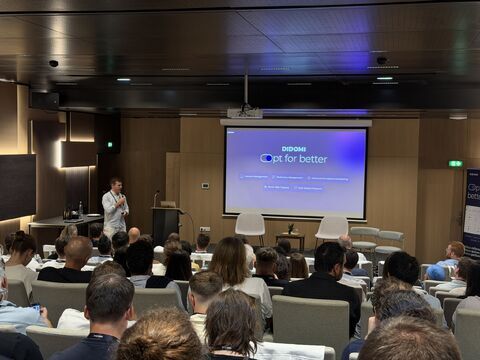
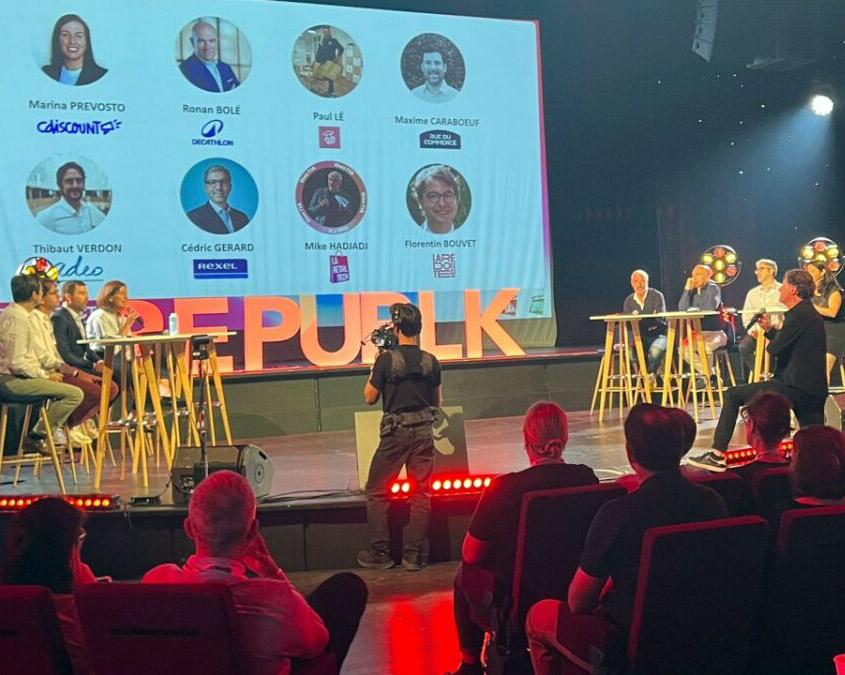
After a first day filled with lively discussions, which continued with a VIP dinner featuring a fascinating presentation byEdouard Dequeker, full professor of Urban Economics at ESSEC and co-author of “Command Never Sleeps: Transform or Perish”, the second day of Connect Lille 2026 confirmed a fundamental trend: artificial intelligence is gradually moving beyond the realm of promise to bring about concrete transformation in the retail industry.
From GEO strategies to new conversational shopping journeys, from customer experience to the supply chain, and from circularity to logistics, the speakers shared very concrete insights centered on a common goal: creating more value for the customer while improving business performance.
Here are the key takeaways from this second day.

Kantar: With AI, brands must now win over consumers… and machines
One of the most memorable presentations on the second day was undoubtedly the one by Anne-Lise Toursel, CEO of Kantar.
His message is clear: artificial intelligence isn’t just changing the way consumers search for products; it’s redefining the very rules of brand visibility.
💬 LLMs are becoming second nature
Figures presented by Kantar show that conversational AI is already in widespread use.
Today, six out of ten French people regularly use an LLM such as ChatGPT, Gemini, or other AI assistants.
Even more significantly, one-third of them already use it to prepare for or facilitate their purchasing decisions.
AI is now involved at every stage of the process:
- look for ideas;
- compare brands;
- get personalized recommendations;
- Plan purchases in advance.
🔍 From keyword searches to expressing a need
For years, internet users would type a few keywords into Google.
Tomorrow, they will have a conversation with an AI.
Instead of searching for “hotel Vienna, ” they’ll ask:
“I’m looking for a quiet hotel in Vienna for three nights, with a budget of 200 €, and close to the city center.”
This development is profoundly changing marketing strategies.
The goal is no longer simply to rank highly in search results, but to be the answer chosen by artificial intelligence

🎯 Brands now have two audiences
Companies must now convince:
- their customers;
- artificial intelligence models.
However, the criteria are not exactly the same.
AI systems prioritize certain types of information:
- reliable;
- structured;
- consistent;
- corroborated by several sources.
Digital credibility thus becomes a strategic asset.
🌐 Understanding the Sources of AI
Not all LLMs rely on the same sources.
Some people prefer brand websites, while others prefer news outlets, Reddit, specialized forums, or government websites.
Companies will need to gradually understand where each AI source gets its information in order to adapt their visibility strategy.
❤️ The brand remains more important than ever
Despite this revolution, Anne-Lise Toursel highlights a key point: brand strength continues to play a decisive role.
Even when an AI recommends a product, the preferences consumers have developed still influence the final decision.
Emotion, trust, and reputation therefore remain major competitive advantages.
💡 Key Takeaways
- LLMs are becoming a major player in the customer journey.
- Consumers now express their needs rather than using keywords.
- Brands must win over both consumers and AI systems.
- Content quality, reputation, and credibility are becoming essential criteria.
- The brand remains a key competitive advantage.

Cdiscount: A Rethought Search Strategy in the Age of AI Agents and GEO
The emergence of conversational AI is fundamentally changing the rules of search engine optimization. With ChatGPT, Gemini, and Google’s AI Overviews, brands are no longer just aiming to appear in search results—they now need to be recommended by artificial intelligence.
At Connect Lille, Gaëtan Delorme, Head of Product SEO/GEO at Cdiscount, presented the GEO (Generative Engine Optimization) strategy developed by the company.
📉 Search Is Entering a New Era
At Cdiscount, traffic from generative AI has already quadrupled in just a few months.
With the arrival of AI Overviews in Europe, some studies predict a significant decline in traditional SEO traffic. In this context, the real challenge now is to understand how LLMs select the brands they recommend.
📊 Measure before optimizing
To manage this new visibility, Cdiscount has developed its own GEO barometer.
Every day, more than 12,000 prompts are run on several AI models to measure the brand’s visibility.
The prompts are based on actual searches conducted by customers on Cdiscount’s internal search engine to ensure that the results are reliable, reproducible, and representative of actual usage.

🧪 Test to learn
Once the measure is in place, it’s time to experiment.
One of the first initiatives was to publish detailed content on after-sales service and logistics in sources regularly consulted by LLMs.
In less than 24 hours, Cdiscount was already seeing a measurable improvement in its visibility in AI-generated responses.
For Gaëtan Delorme, GEO remains a field still in the early stages of development, where the “test and learn ” approach is still the best one.
💡 Key Takeaways
- GEO is becoming a new strategic driver with the rise of AI agents.
- SEO remains the essential foundation of any visibility strategy.
- Measurement is a prerequisite for any optimization.
- Companies must continually experiment to understand the criteria that drive LLM recommendations.

SEO, GEO, and YouTube: The Winning Trio for Influencing the Pre-Purchase Journey
For Fabrice ALIZON, President and Founder of PIXALIONE, GEO does not replace SEO: it is its natural evolution.
Visibility in AI still depends on the quality of content, to which a strong conversational element is now added.
🚀 SEO remains the foundation
Companies must continue to produce rich, reliable, and well-structured content.
LLMs rely on this content to generate their recommendations. Without a solid foundation, it’s impossible to hope to stand out in the responses from conversational AI systems.
✍️ AI speeds up production… with discernment
Artificial intelligence facilitates the creation of content on a large scale.
But not all content lends itself to the same level of automation.
Product listings can largely be generated using AI, while category pages and editorial content still require significant human input to stand out in competitive search results.
🎬 Video Takes on a New Dimension
Another key takeaway: YouTube is becoming a strategic asset.
Video content simultaneously enhances SEO, GEO, and the user experience, while strengthening brands’ presence throughout the decision-making journey.
💡 Key Takeaways
- GEO and SEO are based on the same fundamentals.
- AI speeds up content creation without replacing human expertise.
- Content should be tailored to the level of competition.
- Video is becoming a major factor influencing pre-purchase decisions.

ghd: A Paid Strategy for Sustainable Growth
How can you boost sales while building a strong, lasting brand?
Julien Roussel, E-commerce Director for France and Benelux at ghd, presented a paid media strategy built around a full-funnel approach that goes well beyond short-term performance alone.
🎯 Supporting the consumer at every step
Paid Social, Search, YouTube, influencer marketing, retargeting…
Each strategy comes into play at a specific point in the customer journey to gradually build brand preference before driving conversion.
This approach benefits both the e-commerce site and the distribution network.
🎥 Focus on authenticity
Despite the advent of generative AI, ghd maintains a very cautious approach to its creative content.
For a premium brand, nothing can yet replace real product demonstrations and authentic content that build trust.
📊 Results Already Visible
The repositioning effort launched about eighteen months ago is paying off.
The brand posted nearly 35% growth during its main sales period before going on to achieve another year of double-digit growth.
💡 Key Takeaways
- A successful paid advertising strategy is based on a full-funnel approach.
- Video plays a central role in attracting new customers.
- Authenticity remains a key differentiator.
- It remains essential to continuously test audiences, creative content, and platforms.

Shopify: Agent-Based Commerce Transforms Product Discovery
According to Alexandre Chaumien, Head of Revenue for Southern Europe at Shopify, AI agents already represent a new acquisition channel.
Consumers are no longer just looking for products; they now turn to artificial intelligence to recommend the best solutions.
🤖 AI is becoming a new audience
Companies no longer target only consumers.
They must now convince the AI systems that will select the products shown to users.

🔍 GEO complements SEO
Traditional search engine optimization remains essential.
But LLMs also analyze reviews, social media, influencers, Reddit, and product catalogs before recommending just a few brands.
⭐ Trust is becoming a key factor
AI systems prioritize brands known for their reputation, the quality of their data, their customer reviews, and their credibility.
Visibility therefore depends as much on the digital ecosystem as it does on the brand’s website itself.
💡 Key Takeaways
- AI agents represent a new acquisition channel.
- GEO now complements SEO.
- Signals of trust are becoming increasingly important.
- Product catalogs must be adapted for new conversational use cases.

Recommerce Group: Agent-Based Commerce Opens a New Sales Channel
What if, starting tomorrow, buying or selling a refurbished smartphone could be done directly through ChatGPT?
This is the vision of Recommerce Group, presented by Gautier FELDHead of Marketing.
🤖 Replace forms with a conversation
The app developed in ChatGPT allows consumers to describe their smartphones in a natural way.
The information collected is much more accurate than that obtained from a traditional form, thereby improving the quality of recovery estimates.
📱 Reassure buyers
Customers can also ask any questions they may have about the phone’s condition, the battery, or warranties.
This conversation helps build trust, which remains essential in the refurbished market.

🏪 Technologies that are already well-established in stores
Partner stores are now using an AI agent capable of objectively assessing the condition of a smartphone based on photos.
This standardization improves the quality of diagnoses while reducing disputes.
💡 Key Takeaways
- Agent-based commerce opens up a new acquisition channel.
- Conversations provide more detailed information than forms.
- AI simultaneously improves both the customer experience and field operations.
- Trust remains a key factor in the refurbished market.

Opinion Pieces: Agent-Based Commerce—An Inevitable Revolution or a New Challenge for Retailers?
Agent-based commerce is gradually establishing itself as the next major transformation in e-commerce. While its applications are still in their early stages, one thing became clear during this roundtable discussion: AI agents will profoundly change the way consumers search for, compare, and purchase products.
The columnists exchanged views on the opportunities, risks, and conditions for success associated with this development.
🚀 A New Shopping Experience
Chatbots greatly simplify the consumer experience.
In just a few seconds, they summarize product features, compare offers, and make personalized recommendations, saving customers the trouble of sifting through dozens of product listings.
For retailers, the stakes have taken on a whole new dimension: it’s no longer just about being visible on Google, but about becoming a go-to source for the various large language models (LLMs) that will guide future purchasing decisions.

⚠️ New addictions
This development also raises several questions.
Speakers specifically mentioned the risk of disintermediation: consumers could gradually begin to rely more on AI assistants than on e-commerce sites themselves.
Another area to watch: acquisition costs. The new channels are still largely free, but monetizing them seems inevitable in the medium term.
⭐ The brand remains a decisive advantage
In a world where AI will recommend only a limited number of solutions, brand strength becomes more strategic than ever.
Trust, reputation, data quality, editorial content, and expertise will all serve as signals that enable AI to select one brand over another.
🔄 Test quickly to learn faster
Finally, all the participants emphasized one point: no one has the final rules yet.
Companies will need to conduct more experiments, measure results, and continuously adjust their strategies as AI models evolve.
💡 Key Takeaways
- Agent-based commerce is ushering in a new chapter in e-commerce.
- Retailers will need to focus on building their visibility with LLMs just as much as they do on traditional search engine optimization.
- Brand, trust, and data quality are becoming strategic assets.
- Agility and “test and learn” will make all the difference.

Decathlon France: With Visio Store, Human Expertise Is Amplified
At a time when many retailers are automating their customer relations, Decathlon is taking the opposite approach: using digital technology to make human expertise more accessible.
Ludovic Haultcoeur , Sales Director at Decathlon France, discussed Visio Store’s initial results.
🏪 Recreate the store… remotely
From a product page, customers can schedule an appointment with a sales expert.
For about 30 minutes, the sales representative presents the products, answers questions, and assists the customer just as they would in a store.
This approach is particularly well-suited to technical products or those that require a high level of engagement.
🌐 Connecting Brick-and-Mortar Stores and E-Commerce
The program also benefits retail outlets.
When a product is not available locally, salespeople can offer a video consultation to showcase a much wider selection than what is on display in the store.

📈 A premium experience that drives conversions
The initial results are particularly encouraging.
One out of every two Visio meetings results in a sale, with an average order value exceeding €2,000.
The service also attracts new customers and provides valuable real-world feedback that helps improve products and digital experiences.
💡 Key Takeaways
- Video puts human expertise back at the heart of e-commerce.
- Brick-and-mortar stores and digital channels are becoming fully complementary.
- One out of every two appointments results in a sale.
- Feedback also contributes to the continuous improvement of products.

eBay Live: When Shopping Becomes an Event Again
With eBay Live, the marketplace aims to bring back what is often missing from online shopping: interaction, emotion, and trust.
Alexandre Boissenot , Head of eBay Live, presented this new experience, which is now available in France.
🎥 An experience above all else
Live shopping goes far beyond a simple product presentation.
Buyers interact directly with sellers, explore products from different angles, and enjoy exclusive offers in a much more immersive experience.
❤️ Focus on communities
The program primarily targets fields where passion and expertise play a major role: collectibles, Pokémon cards, art, luxury goods, fashion, and gardening.
Live streaming brings these communities together around unique events.

📈 Already Remarkable Performance
The initial results show great potential.
Some sellers have doubled their revenue thanks to eBay Live, while several events have recorded average cart values significantly higher than those seen on the traditional marketplace.
💡 Key Takeaways
- Live shopping transforms the product into a true experience.
- Communities are becoming a powerful driver of engagement.
- Initial results show a significant business impact.
- Trust remains at the heart of the system.

Leroy Merlin x b.connect: Reducing Forgotten Passwords… and Abandoned Shopping Carts
Every day, thousands of sales are lost because of a forgotten password or a login process that’s too complicated.
Tim Van Wijck (Leroy Merlin) and Stéphane MAVEL (b.connect) presented a solution that turns authentication into a real driver of conversion.
🚪 Simplify the login process
Backed by five major French banking groups, b.connect allows consumers to create an account or log in without a password using their banking credentials.
The goal is twofold: to eliminate a major friction point in the purchase funnel while ensuring a high level of security.

🛒 A Response to New Behaviors
Consumers today manage dozens of accounts.
At Leroy Merlin, this complexity led to many abandoned carts, particularly for small shopping carts, where every additional second increases the risk of abandonment.
⚡ A better experience… without losing customer data
Unlike Guest Checkout, this approach maintains a defined customer journey and helps ensure high-quality CRM data while significantly streamlining the user experience.
💡 Key Takeaways
- Passwords remain a major obstacle to conversion.
- Banking identity simplifies the experience while enhancing security.
- Verified customer data also provides value to CRM teams.
- Reducing friction directly improves e-commerce performance.

FLOA: Pay in 4 installments and trade in old equipment—where financing and the circular economy meet
Combining installment payments with the trade-in of old equipment simplifies product replacement while promoting the circular economy.
Christophe Prevost, Director of Development and Strategic Partnerships for France at FLOA, presented this approach, which has already been implemented with several partners.
🔄 Include the refund directly in the payment
When purchasing a new device, the customer can trade in their old device directly during the checkout process.
Its trade-in value is estimated immediately and then deducted from the financed amount.
The merchant is paid for the entire order, while the customer benefits from a reduced remaining balance.
♻️ Facilitate the replacement of equipment
Ultimately, FLOA hopes to go even further.
Depending on the product category, consumers may be contacted again after several months with a guaranteed trade-in offer to make it easier for them to upgrade their equipment.
Financing thus becomes a key driver of circularity.

🤝 Creating value for everyone
This approach benefits the following at the same time:
- for consumers, thanks to a simpler process;
- to merchants, who improve conversion rates and customer loyalty;
- to the reuse sector, which recovers more devices for a second life.
💡 Key Takeaways
- Installment payments are becoming a driver of the circular economy.
- Incorporating the pickup option into the customer journey improves the customer experience.
- Conversion, customer retention, and reuse are all increasing simultaneously.
- The model could gradually be expanded to other product categories.

Amoobi: Understanding In-Store Journeys to Improve Conversion
Brick-and-mortar stores have a wealth of sales data… but often remain in the dark about everything that happens before a purchase.
Olivier Delangre, co-founder and CEOof Amoobi, demonstrated how retailers such as Walmart and Carrefour use customer journeys to optimize their store layouts.
👣 Observe actual behaviors
Using sensors installed on the ceiling, Amoobi anonymously tracks visitors’ movements, where they stop, where they look, and the paths they take.
As a result, the store benefits from a level of analytics comparable to that of e-commerce.

📊 Understanding the barriers to conversion
By cross-referencing this data with sales figures, retailers can pinpoint exactly which sections attract customers, which ones lead to purchases… and which ones cause customers to hesitate.
The goal is no longer simply to record performance, but to understand the reasons behind it.
🧪 Test before rolling out widely
Pilot stores serve as testing grounds for experimenting with different store layouts before rolling them out on a large scale.
This approach helps ensure that merchandising decisions are made objectively.
💡 Key Takeaways
- The store is becoming just as measurable as an e-commerce site.
- Behavioral data greatly enhances conversion analysis.
- Pilot store tests help mitigate risks before rolling out the program on a larger scale.
- Merchandising decisions are becoming much more data-driven.

Leroy Merlin: “5-Star Repairs”—Transforming After-Sales Service into a Driver of Circularity
What if customer service became a real driver of growth?
Through its “5-Star Repair” program, Leroy Merlin is gradually transforming its workshops to support the repair, refurbishment, rental, and reuse of products.
Bastien Hild, Manager of Repairs, Refurbishment, and Customer Service, presented this transformation.
🔄 Turn After-Sales Service into a Hub for Circularity
Workshops are no longer just for handling returns.
They are gradually becoming centers capable of repairing, maintaining, refurbishing, and supporting the new models of the circular economy.
The goal is for every French person to have access to a repair or upcycling service within thirty minutes of their home.

👥 A profound transformation of professions
This transformation also relies on a new organizational structure.
Customer-facing teams focus on customer relations, while specialized technicians develop their expertise in diagnostics, repairs, and refurbishment.
The company is investing heavily in employee training and in modernizing its workshops.
📈 Scale up through industrialization
The goal now is to handle ever-increasing volumes without proportionally increasing the workforce.
This growth should make it possible to gradually build a sustainable business model.
💡 Key Takeaways
- After-sales service is becoming a pillar of the circular economy.
- Transformation depends as much on skills as it does on investment.
- Industrialization is essential to achieving profitability.
- In the future, the stores could carry products from other brands.

Sans Complexe Lingerie: Turning Returns into Opportunities to Build Customer Loyalty
In the world of lingerie, returns are a natural part of the shopping experience.
Rather than simply putting up with them, Sans Complexe Lingerie has chosen to use them as a tool to build customer loyalty.
Ana Ramírez Ríos, Chief Digital Officer at Wolf Lingerie, presented this transformation.
🌍 Tailor the customer journey to each market
Return policies vary greatly from country to country.
While some markets are seeing returns of around 10%, others are well over 60%. The brand has therefore tailored its approach to local conditions.
🔄 Prioritize communication
Reimbursement is no longer the preferred option.
Customers can now exchange their items, get sizing recommendations, change colors, or receive assistance from a stylist during a shopping appointment.
This strategy has already made it possible to convert nearly 20% of French returns into exchanges.

❤️ Focus on personalized support
Even with relatively modest shopping baskets, these shopping events prove to be effective.
They not only help improve conversion rates but also provide a better understanding of customers’ expectations.
💡 Key Takeaways
- Returns are becoming a process to be optimized rather than just a cost.
- Exchanges preserve more revenue than refunds.
- Personalized advice significantly improves conversion rates.
- Data is gradually helping to personalize recommendations.

Boulanger: Reusable Packaging Is Being Scaled Up
With nearly one billion packages shipped each year in France, packaging is a major challenge.
Arcindo CORUCHO , Director of Last Mile Delivery at Boulanger, presented the rollout of reusable packaging designed to integrate with existing logistics processes.
♻️ Give a package a second life
The goal is no longer simply to recycle packaging, but to reuse it dozens of times.
Packaging thus becomes a true resource integrated into a logistics loop.

🚚 Seamless integration
The solution was designed to work with existing infrastructure.
After use, the packaging is collected, inspected, and then returned to circulation.
👥 The main challenge remains the human factor
Early findings indicate that consumer adoption is now the main challenge.
Making it a habit to return packaging will take time and guidance.
💡 Key Takeaways
- Reuse goes beyond recycling.
- The solution integrates with existing processes.
- Consumer acceptance remains the main challenge.
- Collaboration among stakeholders will be essential to achieving greater scale.

Cocorico: A Local Supply Chain Designed to Enhance the Customer Experience
“Made in France” is often presented as an environmental commitment or a matter of national sovereignty. For Cocorico, it is above all a powerful driver of operational performance.
By bringing its production closer to its customers, the brand has built a supply chain capable of delivering faster, reducing inventory, and accelerating the launch of new products.
Arthur Charle , co-founder of Cocorico, shared the key elements of this strategy.
⚡ Produce Locally to Gain Agility
Since 2018, Cocorico has been developing a line of clothing manufactured entirely in France, working with some 40 industrial partners located throughout the country.
This proximity allows us to operate on a just-in-time basis, with weekly restocking that minimizes excess inventory and unsold merchandise while improving responsiveness.
📈 Adjust production to meet demand
Unlike very long supply chains, this structure makes it possible to quickly adjust volumes based on sales or market conditions.
New collections can be launched in small batches and then quickly scaled up if they prove successful.
This agility directly improves product availability and reduces inventory-related risks.
🏭 Automate to Stay Competitive
To further strengthen this competitive edge, Cocorico has opened its own highly automated factory.
The goal is to restore productivity levels in France that are comparable to those of outsourced production, while retaining the benefits of “Made in France”: proximity, flexibility, and quality control.
Today, the brand claims to have 850,000 active customers, more than one million items sold in 2025, and 48-hour delivery.
💡 Key Takeaways
- “Made in France” can become a real driver of performance.
- Having suppliers nearby greatly improves agility.
- Automation enhances the competitiveness of local production.
- An efficient supply chain directly improves the customer experience.

Urbantz: AI Transforms the Last Mile
Delivery is one of the final defining moments of the customer experience.
Melanie Applincourt, co-founder and CEOof Urbantz, explained how AI makes it possible to anticipate incidents rather than simply react to them.
🚛 Moving from reactive logistics to predictive logistics
Using traffic data, delivery histories, and customer preferences, the platform anticipates risks before they occur.
The goal is to solve problems… before they even arise.
🤖 Milo, an AI co-pilot
The AI agent Milo monitors delivery routes, detects anomalies, suggests corrective actions, and automates some of the interactions with customers.
This allows operational teams to focus on the most complex situations.
🌱 Performance, Satisfaction, and Sustainability
Better orchestration simultaneously improves:
- customer satisfaction;
- operational profitability;
- a reduction in the number of kilometers traveled.
💡 Key Takeaways
- AI makes logistics predictive.
- Teams save time on repetitive tasks.
- Economic and environmental performance are improving simultaneously.
- Humans continue to play a vital role in complex situations.

Insights from Columnists: How Can We Get Teams On Board with AI Transformation?
Artificial intelligence is no longer just a technological issue. The real challenge is now a human one: How can we support employees, address their concerns, and help their roles evolve?
This roundtable brought together several retail decision-makers who shared a common belief: the success of an AI project depends above all on its adoption by the teams.
👥 Adoption isn’t something that can be mandated
Initial feedback suggests that it is more effective to gradually guide employees than to impose new tools on them.
At Cdiscount, teams have been gradually equipped with solutions such as ChatGPT and Claude, along with training and real-world use cases. Early adopters naturally become advocates who inspire the rest of the organization.
🎯 The Crucial Role of Managers
The main obstacles are not always technological.
Managers play a crucial role in articulating the vision, reassuring teams, recognizing successes, and encouraging experimentation. Without this support, projects often struggle to move beyond the pilot phase.
🛡️ Experiment in a safe environment
All the speakers emphasized the need to strike the right balance between freedom and governance.
Employees must be able to experiment with new ways of working while adhering to a clear framework regarding sensitive data, authorized tools, and best practices.
💬 Human expertise remains irreplaceable
AI speeds up analysis, automates certain tasks, and facilitates decision-making.
But it does not replace professional knowledge, critical thinking, or the ability to make judgments in complex situations.
💡 Key Takeaways
- AI transformation is, above all, a human endeavor.
- Managers play a key role in adoption.
- Experimentation must take place within a safe environment.
- AI expands the workforce without replacing employees’ expertise.

Key Takeaways from the Second Day of Connect Lille
As the conferences progressed, one thing became clear: Artificial intelligence is no longer just an experimental field. It is gradually becoming a new layer of business.
But this transformation goes far beyond technology. Several major trends are evident in virtually all of the presentations.
🤖 1. AI agents are becoming a new acquisition channel
The presentations by Cdiscount, Shopify, Kantar, PIXALIONE, and Recommerce, as well as the roundtable discussion on agent-based commerce, all point to the same conclusion:
In the future, companies will have to win over not only their customers but also the artificial intelligence systems that will guide their purchasing decisions.
SEO is evolving toward GEO andAnswer Engine Optimization, where content quality, brand reputation, and data reliability are becoming key factors.
📊 2. Data is becoming the driving force behind all decisions
Whether it’s in-store customer journeys (Amoobi), inventory management (Optimix), logistics (Urbantz), the supply chain (Cocorico), or the customer experience (Decathlon), all organizations are now seeking to make better use of their data.
The difference will no longer lie in the volume of available information, but in the ability to quickly turn it into operational decisions.
❤️ 3. People Remain at the Heart of the Transformation
Contrary to popular belief, no conference presented AI as a substitute for employees.
At Decathlon, technology enhances the expertise of sales associates.
At Leroy Merlin, she is helping to drive the growth of new repair-related business lines.
At Urbantz, it automates repetitive tasks to leave more room for human decision-making.
AI enhances teams; it does not replace their expertise.
🚀 4. The customer experience is becoming increasingly seamless
Throughout the day, the examples kept coming:
- passwordless authentication (b.connect);
- recovery included in the financing (FLOA);
- conversational commerce (Recommerce);
- video guide (Decathlon);
- live shopping (eBay Live);
- Returns converted into exchanges (Sans Complexe Lingerie).
The goal is the same everywhere: to eliminate friction points and simplify the purchasing process.
🌍 5. Performance and sustainability now go hand in hand
The initiatives by Leroy Merlin, Boulanger, FLOA, Urbantz, and Cocorico show that circularity and sustainability are no longer just environmental issues.
They also serve as drivers of economic performance, customer loyalty, and differentiation.
⚡ 6. Speed of execution is becoming the true competitive advantage
That’s probably the common thread running through the 2026 edition.
Technology is evolving at an unprecedented pace.
The companies that will succeed will not necessarily be those with the best tools, but those that know how to test quickly, measure objectively, learn continuously, and adapt their organizations.
AI, agent-based commerce, circularity, and new shopping experiences are no longer just trends to watch—they are gradually becoming the new standards in commerce.
A huge thank you to the organizers of Connect Lille for these two particularly enriching days, as well as to all the speakers for the quality of their insights.
Above all, the 2026 edition has confirmed one thing: The real issue is no longer AI itself. It is companies’ ability to quickly turn it into value for their customers, their employees, and their performance.