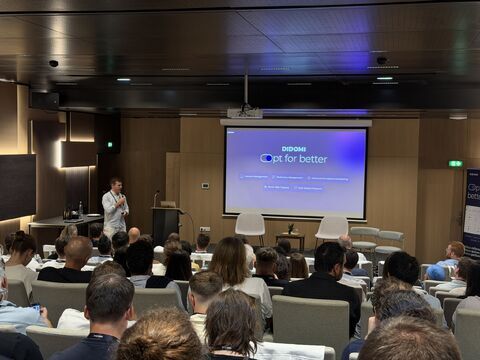

On May 19, 2026, we participated in DX Connections Paris, an event organized by Contentsquare that focused on an issue that has become central to all digital teams: turning insights into concrete business decisions.
On the agenda: trends from the 2026 Digital Experience Benchmark, data activation, artificial intelligence, digital performance optimization, hands-on workshops, and insights from leading brands.
It was an afternoon filled with lively discussion, centered on a strong conviction: data is valuable only when it enables us to act faster, more effectively, and with greater impact.

🤖 AI is already redefining the customer journey
One of the event’s strongest messages is clear: artificial intelligence is already transforming the customer journey.
The figures shared by Jean-Christophe Pitié, Chief Marketing Officer at Contentsquare, illustrate the scale of the trend:
- According to IDC, 64% of interactions couldbe handled by AI agents and answer engines by 2029;
- Traffic referred by conversational AIs increased by 623%, according tothe 2026 Digital Experience Benchmark;
- This traffic shows a 55% increase in the conversion rate;
- Traffic from AI sources has a conversion rate of 1.3%, compared with 0.7% for social media.
Even though these volumes are still in the minority, the trend is already evident: users are arriving at websites with more fragmented browsing paths, better informed, and often better prepared after conducting searches via ChatGPT, Claude, Gemini, or Copilot.
This transformation also has a direct impact on customer acquisition. With answers generated directly within search engines and AI assistants, organic traffic may decline, which automatically increases the pressure on paid acquisition costs.
Another key insight: Visitors coming from LLMs seem to have a stronger intent. Their decision-making processes are faster, and their traffic appears to be particularly high-quality.

🧠 A New Generation of Customer Experience Analytics
To address these new use cases, Clémence Varszegi, Senior Manager of Customer Marketing at Contentsquare, presented several updates to the platform designed to provide a more comprehensive view of the customer journey.
One of the highlights was Conversation Intelligence, a new solution capable of automatically analyzing chat and voice conversations to identify:
- recurring contact patterns;
- the causes of the reported problems;
- levels of dissatisfaction;
- workarounds used by customers or support teams.
The goal: to break down the silos between the e-commerce, support, and product teams in order to identify more quickly the friction points that impact conversion rates and customer satisfaction.
The demonstrations also showed how AI can now:
- automatically summarize session replays;
- generate ready-to-use analyses;
- send automated insights via email;
- Prioritize issues based on their business impact.
We are gradually shifting from a reporting-based approach to one focused on enhanced decision support.
🔎 New channels to include in the analysis
Contentsquare also announced that it now supports two new types of user journeys:
- analysis of interactions in applications integrated with ChatGPT;
- Tracking traffic referred from LLMs and conversational AI agents.
The goal is clear: to provide a more comprehensive view of user journeys, whether they come through a traditional search engine, a social media platform, or an AI assistant.
As the number of entry points increases, the analysis of the digital experience must also evolve.
📊 Toward the Democratization of Data
Another significant development: the platform’s expansion into corporate data and AI ecosystems.
Thanks to the MCP protocol and Data Connect’s new capabilities, Contentsquare data can now be used directly in tools such as Claude, Copilot, Jira, or data warehouses.
The goal is ambitious: to make insights accessible to as many people as possible, using natural language queries and AI assistants capable of automating part of the analysis.
This development marks an important milestone in the democratization of data within organizations.
💡 Three key takeaways to remember
Three key insights emerged during the event:
- All digital experiences will soon be supported or enhanced by AI;
- Interactions will gradually evolve toward “agent-to-agent” exchanges;
- Predictive models are finally becoming capable of anticipating user behavior in a concrete way.
A profound transformation is underway. It confirms that the fields of digital analytics and customer experience are entering a new phase: one that is more automated, more predictive, and more focused on business impact.

🏢 Microsoft and the Emergence of the “Agent-Based” Enterprise
Virginie Lagarde of Microsoft then shared the company’s vision for “Frontier Fir ms”: organizations led by humans, but in which an increasing portion of workflows will be orchestrated by AI agents.
Microsoft identifies three stages in this evolution:
- employees assisted by AI co-pilots;
- humans coordinating multiple specialized agents to perform specific tasks;
- agents capable of automating entire workflows and collaborating with one another.
According to IDC, 1.3 billion AI agents could be deployed by 2028.
This vision is no longer just a future prospect: it is already beginning to take shape within organizations.
⚙️ A transformation already evident in workflows
Microsoft is already seeing this trend at several major companies.
One example shared during the session involved the automation of marketing workflows, specifically the verification of content compliance prior to legal approval.
Another case study: Estée Lauder, which uses a tool called Consumer IQ that can identify emerging trends on social media and then automatically recommend products to feature based on inventory levels and the signals it detects.
These examples show that agent-based AI is not limited to the automation of simple tasks. It paves the way for a new way of orchestrating business processes.
🚧 Why Many Companies Get Stuck at the POC Stage
However, Microsoft’s Agent Readiness Framework study shows that the majority of companies are still struggling to scale their AI initiatives.
The main obstacles identified are:
- the difficulty of mapping business processes;
- problems with access to data;
- the lack of executive sponsorship;
- the difficulty of coordinating multiple agents with one another.
Today, only 32% of the companies surveyed believe they can truly scale their agent-based initiatives.
The issue, therefore, is not solely a technological one. It is also organizational, cultural, and strategic.
🧩 The 5 Pillars of the Most Advanced Companies
Microsoft identifies five common pillars among the most mature companies:
- alignment between AI strategy and business strategy;
- process mapping;
- a solid foundation in technology and data;
- team culture and skill development;
- security and governance.
The most advanced organizations, known as “Agentic Achievers,” stand out in particular for:
• AI KPIs directly linked to business objectives; • a platform-based approach to orchestrating agents; • modular and interoperable solutions; • strong cultural alignment among teams; • a “Secure by Design” approach.
These companies report that they deploy their AI agents up to 2.5 times faster than others.
The message is clear: the organizations that will succeed are those capable of aligning strategy, processes, data, governance, and business transformation.

💎 Sense Analyst: Accelerating Analytics Workflows in the Luxury Industry
Another highlight of the event was the insights shared by Vincent Bridier, Head of Digital Optimization at a luxury brand, and Laure Piednoir, Strategic Success Manager at Contentsquare, regarding Sense Analyst.
Sense Analyst is Contentsquare’s AI agent designed to accelerate digital analytics and the generation of actionable insights.
The speakers noted that, until recently, much of the work involved in analytics still relied on highly manual tasks:
• Extracting Excel files; • Cross-referencing traffic, engagement, sales, and conversion data; • Manually generating weekly reports.
Today, an initial layer of analysis can be delegated to Sense Analyst, allowing teams to save time on data collection, interpretation, and prioritizing insights.
✍️ Prompting is becoming a key skill
One of the most important messages from this session concerned the role of prompting.
To obtain relevant results, the teams emphasized the need to:
- precisely define the KPIs;
- provide context for the business situation;
- specify the expected deliverables;
- Provide as much context as possible.
Weekly reporting served as an initial testing ground for developing prompts that are truly usable, reproducible, and automatable.
In other words, the quality of the analysis also depends on the quality of the question asked.
🛠️ Concrete and actionable use cases
Several use cases were shared during the session:
- automatic generation of weekly reports;
- conversational analyses of key business moments;
- analysis of gifting pages with a high bounce rate;
- automation of user journey analysis;
- classification of visitors based on their intentions.
The goal is not merely to present data, but to formulate concrete, actionable recommendations.
This is where AI really comes into its own: not by replacing human expertise, but by speeding up access to the right insights so that teams can make better decisions.
🌱 A gradual and controlled adoption
The rollout of Sense Analyst was initially limited to a small group of users in order to:
- test the tool;
- create the first prompts;
- define best practices;
- Identify the most relevant use cases.
Prompting guidelines and templates tailored to each business function are then gradually rolled out to the teams.
The speakers also emphasized a key point: it is important to maintain a critical mindset. Hallucinations still exist, and results must be challenged, refined, and used in an iterative process.
The real benefit, therefore, isn’t just the time saved. Above all, it allows teams to delve deeper into certain topics, improve the accuracy of their analyses, and gain a broader perspective.

🛒 Retail, AI, and Customer Experience: Insights from the Contentsquare 2026 Benchmark Study
Jade David, Customer Experience Manager at Groupement Les Mousquetaires, shared her insights on using Contentsquare to optimize digital customer journeys in the home goods retail sector.
Lovisa de Mesnard, GTM Advisor at Contentsquare, outlined the key findings of the 2026 Digital Experience Benchmark, based on:
- 159 billion page views;
- 26 billion sessions;
- 71 countries;
- 10 retail sub-industries.
A comprehensive analysis that helps identify the major trends in the industry.
📉 Less traffic, but more complex routes
First observation: Overall, retail traffic continues to decline, while acquisition costs are rising.
In several sectors, more than half of retail traffic now comes from paid sources. Paid social media continues to grow strongly as well.
At the same time, traffic from conversational AI is beginning to emerge. Although it remains limited in volume, it is growing rapidly, and teams are closely monitoring the behavior of visitors coming from large language models (LLMs) and AI assistants.
As a result, customer journeys are becoming increasingly segmented based on acquisition sources.
🛍️ The product page is now the new homepage
One of the key findings of the benchmark study concerns changes in user journeys.
The product page is playing an increasingly central role:
- It is gradually becoming the new homepage;
- More than 40% of page views are now for product pages;
- However, these pages remain a major source of bounce rates.
In response to this trend, the teams have been working on:
- customized dashboards by business unit;
- specific analyses by traffic source;
- tours tailored to the visitors’ countries of origin;
- more visible cross-selling strategies.
One example cited involved visitors coming from Google Shopping, with personalized product listings designed to encourage product-to-product navigation and reduce bounce rates.
⚠️ Frustration remains a major issue
Even as the retail sector gradually reduces friction, several problems remain very much present:
- JavaScript errors;
- delays;
- API errors.
To detect them more effectively, the teams have implemented the following:
- automatic alerts on frustration KPIs;
- analyses of off-site shipments;
- session replays to quickly identify the causes of problems.
This approach makes it possible to detect anomalies that are sometimes invisible in traditional business KPIs, particularly during peak sales periods.
⚡ Sense as an analytics accelerator for retail teams
Another key topic: using Sense on a daily basis to speed up analyses.
In particular, the teams rely on:
- custom prompts tailored to specific job roles;
- contextualized dashboards;
- conversational analytics by segment or traffic source;
- analyses of frustration and user journeys.
The goal is to make analytics more accessible to acquisition, CRM, merchandising, and e-commerce teams without overwhelming them with complex dashboards.
As a result, analytics becomes more operational, more context-driven, and more directly linked to on-the-ground decisions.
🎯 Toward a More Personalized and Decision-Driven Retail Experience
Several key trends emerged from this session:
- the courses are becoming more complex;
- Users expect more personalized experiences;
- Retention and customer loyalty are becoming key drivers of performance;
- Analytics tools are evolving to support decision-making.
Ultimately, one of the most important messages of the event is this: Analytics should no longer just explain what happened. It should help teams decide what to do next.
🔥 Highlights from DX Connections Paris 2026
DX Connections Paris 2026 highlights a major transformation in the fields of digital, customer experience, and analytics.
AI is no longer limited to the realm of innovation or experimentation. It is gradually becoming a practical tool for:
- better understand customer journeys;
- identify bottlenecks more quickly;
- prioritize actions based on their business impact;
- democratize access to insights;
- automate some of the analysis workflows;
- bring data closer to the decision-making process.
The next step will not just be to collect more data. It will be to make better use of it.
And in this new context, the most successful companies will undoubtedly be those that can combine data, AI, business expertise, and governance to turn insights into concrete actions.