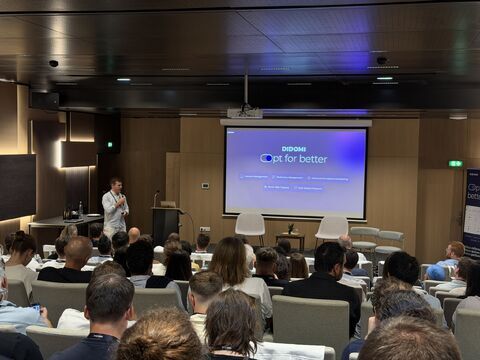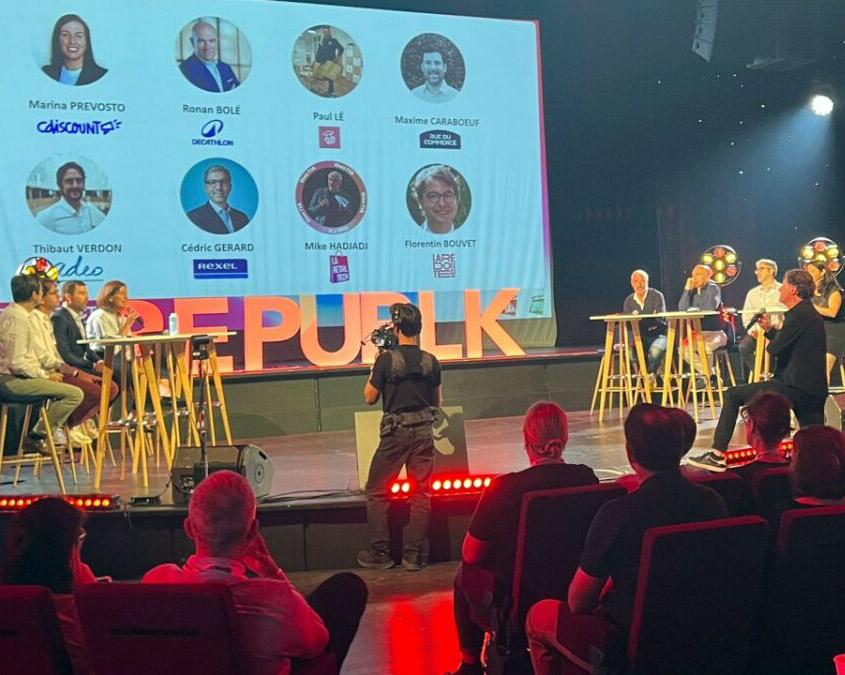
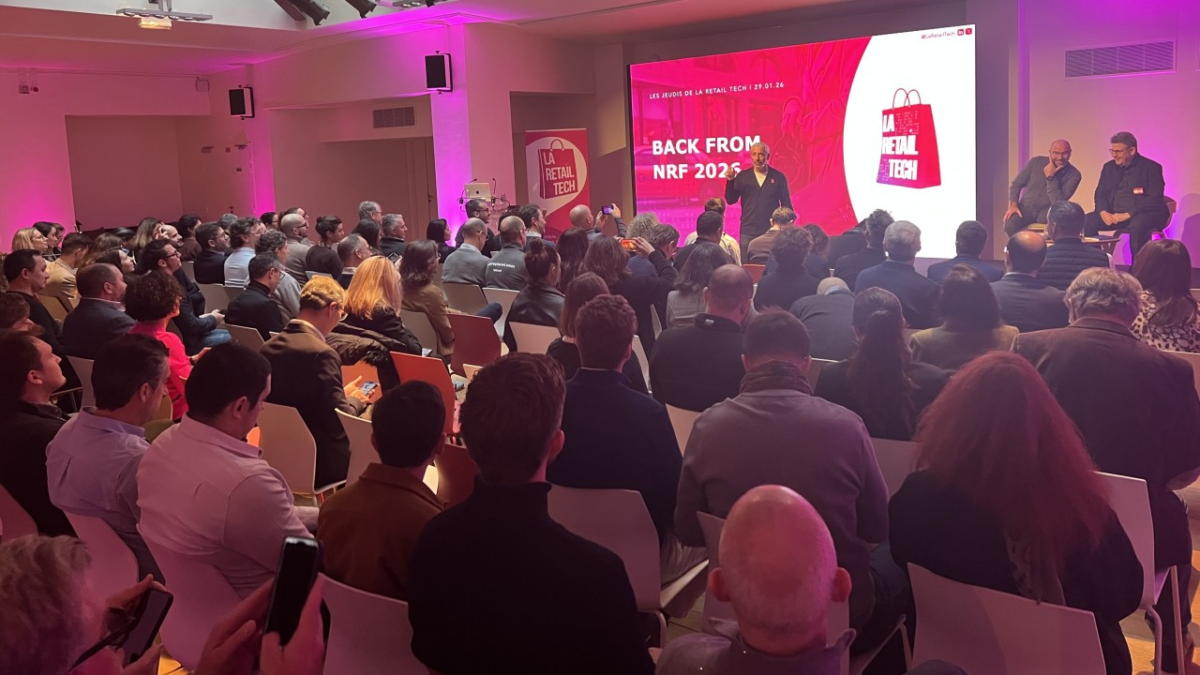
On January 29, 2026, Les Jeudis de la Retail Tech resumed its “Back from NRF” debrief – and the room was packed. For the occasion, Barbara SARRE-DEROUBAIX and Mike Hadjadj 🛍️ had assembled a particularly strong line-up of speakers to decipher the New York retail mecca. The aim was to take a step back, sort out the noise from the signal, and put into perspective the key trends at NRF 2026, which once again attracted over 40,000 visitors.

6-hand introduction
To open the morning, Nicolas Diacono 🤖🛍️, Frank Rosenthal and Mike Hadjadj 🛍️ set the scene with a six-handed, no-holds-barred look at the state of US retail, its paradoxes… and its opportunities.
📉 A lesser NRF edition… but still a structuring one.
Presented as a “record” edition, NRF 2026 is nevertheless taking place against a backdrop of declining attendance, particularly among international delegations – and France is no exception. The event remains massive (nearly a thousand exhibitors), but the signal is clear: fewer people, more “sorting” to be done, and a show that is as much about concrete examples as announcements.
🗽France still highly visible: pavilion, startups, collective energy
In this context, the France pavilion remains a strong brand:
- 29 startups
- 5 categories
- more than 100 representatives
Beyond the figures, the message is constant: French tech remains highly innovative, with solid positioning and discourse that “gets across” well. And as every year, NRF week is also a time to gather, meet new people and raise the profile of the French ecosystem.
🧭 US retail: a more robust dynamic than you might think
The state of the economy shared during the evening puts certain speeches into perspective. Several of the benchmarks quoted point in the same direction:
- income growth for a very large proportion of American households
- growth significantly higher than in Europe
- Holiday Season on the rise, with sectors such as sports and electronics showing strong growth (electronics cited at +6%)
Even with its high-profile bankruptcies, American retail is described as very dynamic, driven by investment, processes and players capable of rapid industrialization.
🤝 The digital paradox: more AI, more need for human connection
One point stands out: in the age of hyper-digitization (time spent online, AI uses), the need for social ties, communities and “real” is becoming even more central. Retail, when it performs well, no longer simply optimizes the transaction: it creates a reason to visit, a moment, an experience.

⚙️ Theme 1 – Efficiency: the store once again becomes a strategic hub
NRF 2026 confirms an operational shift: the store is once again a major asset.
- Hard-discount in urban mode: Lidl in Manhattan shows how to adapt a European format to a constrained environment, with a very assertive price image strategy.
- Walmart illustrates the power of the “store-as-a-hub” model: 680 bn in sales (2025), 120 bn in e-commerce, 2 million orders prepared every day from stores. Transformation requires a technological foundation (electronic labels, picking, industrial deployment rate) and massive use of AI (several major AIs + “small models” by vertical).
- Luckin Coffee takes efficiency to the extreme: 100% digital ordering, QR code, precise pick-up times, end of single line.
- In the field, AI is also becoming an HR tool (e.g. Kroger: planning, exchanges, info via voice mode), while smart glasses, automation and robotization are gaining in maturity (e.g. Ocado and distributed learning).
- And in the midst of all this, a simple reminder: sometimes, efficiency comes back… to basics, right down to the 1 m² micro-boutique that runs on sales execution.
➡️ Global reading: the store is no longer just a cost. It’s a hub, a logistical capacity, a support for services.

🎯 Theme 2 – Marketing: scenography, desirability and a return to roots
On the marketing side, the morning highlighted a retail sector that does much more than “communicate”: it scripts, teaches, collaborates and rebuilds the brand.
- Cybex illustrates an ultra-efficient staging, with customization and artistic collaborations, supported by salespeople capable of a very precise technical pitch.
- Dossier shows a “relaxed” approach to dupes, with in-store education and greater transparency in the American market.
- Fauchon “markets Paris in New York” with a strong visual storytelling and a format where sales coexist with a real living space (restaurant/tea room).
- New Balance provides an interesting counterpoint with a hybrid production (75% Asia / 25% US) set in story and stage.
- Gap is an emblematic example of “returning to basics”: revisiting history, reaffirming positioning (jeans, brand culture), reactivating content and collaborations to recreate desirability.
And generative AI is also making its way into marketing, with tools capable of producing content and visuals with an impressive level of finesse (face, body, hands).
➡️ Global reading: marketing becomes cultural, experiential and content-oriented at scale.

🛋️ Theme 3 – User Experience: stores as places to live
This is probably the most striking block: New York shows just how far retail can go when it takes on the experience.
- Buck Mason: a flagship designed as an apartment (café, sofas, bookshop), where you’ll want to stay.
- Printemps New York: an extraordinary experience (5,000 sq.m.), spectacular architecture, catering and lively merchandising that moves frequently.
- Lacoste on 5th Avenue: tennis heritage, dedicated capsules, strong staging and urban visibility.
- House of Dior: 4 floors, complete universes and a spa floor operated by the brand.
- Rough Trade: in-store concerts, permanent events.
- Dick’s House of Sport: sports practice, simulators, massive technical offering and local adaptation.
- Tecovas: “Texas in Soho” immersion, perfect staging, concert, bar, desire to stay.
The summary sums up the objective: coffee like Starbucks, music like Spotify, emotions like the NFL, personalization like Netflix, checkout like Amazon.
➡️ Global reading: the store becomes a place, not just a channel.

🧩 Theme 4 – Omnichannel & AI in stores: from gadget to reality
Omnichannel and AI move to a much more operational stage:
- Target Soho surprises with a very “concept store” first floor (inspiration, drop, beauty bar, photo area), while retaining a more “standard” basement.
- Generative AI improves uses that have been blocked for years: precise virtual fitting from a simple photo, 360° rendering, respect for corpulence.
- Voice feedback becomes directly usable material for feedback, employee training and continuous improvement.
- In e-commerce search, LLMs help to better identify products and optimize navigation – an increasingly critical issue.

🤖 Theme 5 – Data & AI: AR, subscriptions, conversational payment, sales coaching
Several examples illustrate the widespread use of AI:
- AR showroom (Meta Lab in Manhattan) designed for testing, experimenting and customizing ;
- subscription and service strategy (e.g. Walmart+) designed as an anti-Prime weapon;
- demonstrations of conversational payment via AI robot (payment integrated into the itinerary) ;
- live analysis of sales interaction (micro-coaching, insights manager, global management).
➡️ Global reading: data and AI are moving “into operations”, not just into slides.
🧠 Agentic commerce: “from discovery to delivery”.
Finally, NRF 2026 highlights the accelerating battle around agentic commerce: agents capable of accompanying discovery, decision, purchase… and delivery. The challenge is to standardize flows, simplify integration, and develop the role of merchant sites in this new value chain.
✅ Conclusion: retail is reinventing itself, faster and more radically
NRF 2026 confirms a profound transformation:
- a more cultural, more experiential, more useful store
- AI that’s now very real (content, fitting, feedback, search, coaching, payment)
- a model where performance and emotion no longer conflict: they reinforce each other
Retail isn’t going away. It changes its nature.
A book worth reading on these subjects: Game Changer – La différenciation absolue dans le retail by Franck Rosenthal.

🧠 Attendees Insights: what three experts have learned from NRF 2026 (and what it means in practice)
The “Attendees Insights” segment featured three speakers just back from New York: Hélène Labaume (Carrefour), Rudolph Chêne-Milleville (AWS) and Jérôme Hamrit (Vusion). The aim: to react on the spot, add to what we’ve learned and point out the issues that will (really) matter in the months to come.
The participants’ feedback converged on the same observation: NRF 2026 marks a turning point. Artificial intelligence is no longer a “separate” subject; it is becoming the invisible infrastructure of retail. But, paradoxically, the store has never been so central.

🛍️ The store, still at the heart of the game (and even stronger)
Despite the explosion in digital shopping, the store remains the key place for emotion, differentiation and reassurance. What’s striking is the quality of execution of some New York flagships, where everything has been thought through to the last detail: architecture, lighting, scenography, services.
Some concepts illustrate an assertive move upmarket, particularly in the second-hand luxury segment, which is sometimes better valued than in Europe. On the other hand, not all concepts meet with consensus: some attempts at “concept stores” or beauty areas still appear clumsy, even disappointing, despite good intentions.
The store is no longer limited to selling: it becomes a local logistics hub, a service point (returns, pick-ups, range extensions) and a key link in the omnichannel.
🔍 Discovery: an increasingly fragmented journey… and driven by AI.
The discovery phase has become considerably more complex. Consumers navigate between search engines, marketplaces, social networks, communities, conversational assistants… AI now plays a central role in helping, guiding and recommending.
In this context, content becomes strategic: it’s what drives AI models. The creation of AI-generated content is progressing rapidly, requiring new skills, new tools and a change of pace for marketing teams.

🤖 Agentique: promise, acceleration… and questions of disintermediation
Agentique is ubiquitous. Assistants capable of advising, comparing and buying are already in widespread use, with measurable impacts on adoption and conversion.
But behind this acceleration lies a major challenge: the disintermediation of brands. Who controls the customer relationship when the agent becomes the main interface? The answer seems to lie in a dual strategy:
- develop its own agents,
- while remaining compatible with external agents (engines, platforms, open ecosystems).
This logic requires us to rethink e-commerce platforms so that they can “dialogue” with these new intermediaries.
🏬 The store becomes an activatable data platform
One point on which there is consensus is that the store is being transformed into a highly operational connected platform. It is no longer just a showroom, but a data center that can be activated by AI: stock, prices, product location, assortments, performance…
An essential prerequisite is data reliability. Without clean, up-to-date and usable data, no AI use case will last. Advances in traceability (RFID, geolocation, computer vision) open up very concrete prospects, from assisted picking to the optimization of customer paths.

🚚 Logistics, robotics and new forms of work
Robotics are making rapid progress, particularly in warehouses, with a clear objective: to make picking more fluid, even for complex or fragile products. At the same time, stores are becoming more and more part of a local logistics logic, capable of absorbing range extensions or omnichannel orders in real time.
These developments are also transforming human work. Employees are becoming augmented workers, assisted by technology to improve efficiency, information and service quality. Even certain tasks historically reserved for in-house teams (such as picking) are now open to new models, strongly guided by tech.
🌐 Ecosystem: structuring choices for 5 to 10 years
A final key lesson: today’s decisions on store infrastructure (equipment, systems, data, media) are often made over several years, in a fast-changing environment.
The real challenge is no longer technological, but organizational and strategic:
- where to position yourself in the value chain?
- with which partners?
- and how open is its ecosystem?
👉 To sum up
NRF 2026 shows a retail sector in the throes of recomposition: more AI, more agents, more data, but also more store. A rethought, connected, emotional and activable store – provided we master our data and know how to work differently.

📊 Purchasing power and consumption in 2026: what the French say
OpinionWay survey – Anne-Laure Marchal
Carried out among 1,029 online respondents, the OpinionWay study presented by Anne-Laure Marchal gives a clear – and rather cautious – picture of French people’s expectations for 2026, both in terms of their purchasing power and their consumption behavior, in-store and online.
💶 Perceived purchasing power at half-mast, with no noticeable improvement
The first key finding is that expectations remain predominantly negative.
- 48% of French people believe their purchasing power will decline in 2026,
- a perception almost identical to that of January 2025, despite economic indicators deemed more favorable in 2025.
This concern is particularly pronounced among the over-65s:
- 66% of retirees anticipate a drop in their purchasing power,
- confirming that purchasing power remains a central daily concern, and even the number one worry for this population.
Conversely, the proportion of French people anticipating an increase in purchasing power remains very low (13%). There is one exception, however:
- younger people (18-24 and 25-34) are more optimistic,
- in particular because they are entering the workforce or at the start of their careers, with more favorable income prospects.
🛒 Consumption in 2026: stability above all else
This pessimism about purchasing power is directly reflected in consumption intentions.
- 57% of French people say they will consume neither more nor less, whether online or in-store.
Upside intentions remain limited:
- 13% plan to consume more online,
- 10% more in-store.
Here again, the youngest stand out:
- 33% of 18-24 year-olds anticipate an increase in their online purchases,
- 26% an in-store increase.
But this reading needs to be qualified: in these same age groups, a significant proportion also anticipate a drop in consumption. All in all, the balance remains negative, even among the very young.
👉 Conclusion: 2026 looks set to be a complicated year, for physical retail in particular, but also for online retail.

🏷️ What could really improve the shopping experience?
When asked what could improve their shopping experience – and potentially encourage them to consume more – the answer is unambiguous.
🔑 The three major levers
- More competitive prices
- More frequent promotions
- More advantageous loyalty programs
In other words: purchasing power comes before experience. Expectations are very much aligned between physical and online retailing.
ℹ️ Product information, customer service and returns: structuring expectations
Beyond price, other criteria emerge strongly:
- Product information is becoming a major determinant of trust and loyalty:
- In-store, the French expect a better quality of welcome and customer service, an expectation that is particularly marked among the younger generation.
- Online, ease of return and refund remains a key criterion, cited by nearly a quarter of respondents.
These expectations show that, even under budget constraints, the French remain attentive to the overall quality of the experience, as long as it is perceived as fair and transparent.
👵👴 Strong age-related sensitivities
The study highlights strong generational differences:
- people aged 50 and over, and especially those aged 65 and over, are extremely sensitive to price, promotions and loyalty programs;
- older people also have very high expectations regarding product transparency;
- younger customers are more demanding in terms of welcome and quality of in-store service.
📌 Summary
For 2026, the message is clear:
- budget constraints remain tight,
- consumption intentions are on a downward trend,
- and the priority levers for action remain, unsurprisingly :
👉 price, price… and price.
Many thanks to all the speakers for this inspiring and pragmatic morning!