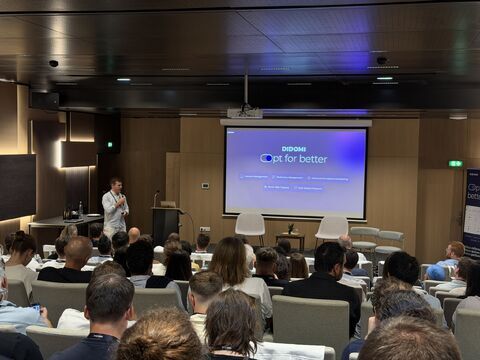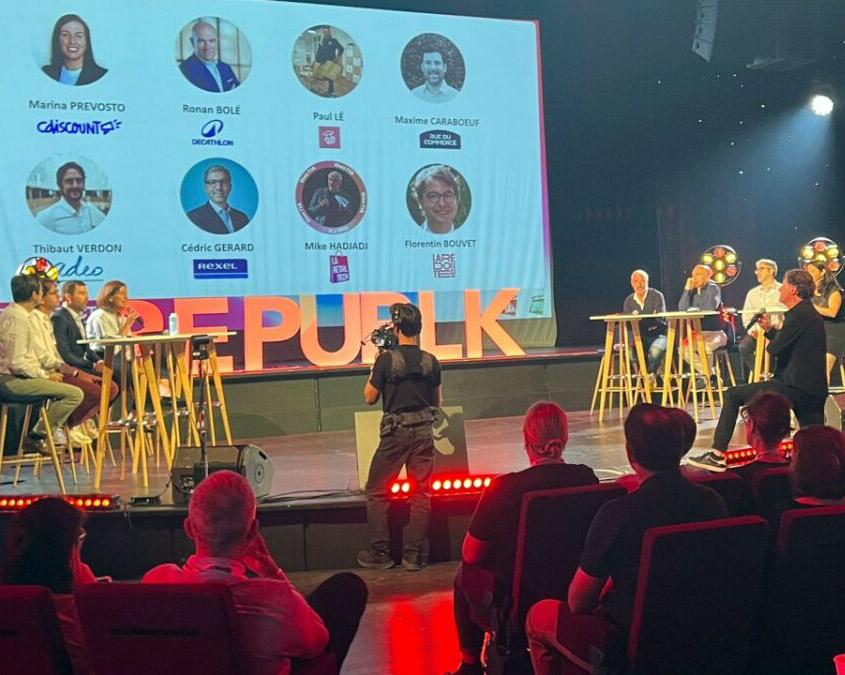

The 2026 edition of Connect Lille was held at the Casino Barrière in Lille on June 30 and July 1, bringing together more than 250 decision-makers to discuss key issues in e-commerce, retail, data, and artificial intelligence.
On the agenda: real-world case studies, use cases, operational transformations, and strategic vision.
One trend emerged throughout this first day:
Competitive advantage no longer comes from access to AI. It comes from companies’ ability to quickly integrate it into their business processes.
Here are the key takeaways.

Pocket Coach at Leroy Merlin: AI to Support Sales Associates
Speaker: Isma Hadjersi – Sales Director, Leroy Merlin France
At Leroy Merlin, AI is not intended to replace salespeople.
It helps them become better.
To address the accelerating obsolescence of skills, Leroy Merlin has developed Pocket Coach, a conversational training app created in partnership with Muchbetter and Twins.
The goal is simple: to build trust, enhance skills, and improve the quality of advice provided to clients.
📱 A virtual client to help you improve every week
Available directly on the smartphones of 9,200 sales consultants, Pocket Coach allows users to have a voice conversation with a virtual customer.
After each simulation, the app immediately provides:
- a personalized debrief;
- areas for improvement;
- specific recommendations.
Just a few weekly simulations are enough to improve sales skills, product knowledge, and upselling.
📈 Already Very Tangible Results
Tested for 4 months in 8 stores with more than 300 employees, the solution is already showing impressive results:
- +15 transformation points
- +9% in related sales
- +30% customer retention
- +21 NPS points
- Up to +90 € average order value on large orders
But the main benefit lies elsewhere.
Teams are noticing that advisors are more confident, more independent, and more at ease when dealing with clients.

👥 Adoption planned from the very beginning
Pocket Coach was developed in collaboration with the field teams.
This approach has helped address a common concern in AI projects: the tool is not a control system.
Above all, it is a tool designed to support and foster the development of both employees and managers.
✅ Key Takeaways
- AI enhances employees’ capabilities rather than replacing them.
- Training becomes ongoing thanks to conversational simulations.
- Adoption depends first and foremost on the teams’ trust.
- The impact can be seen both in terms of attitude and business results.

KIABI & Splio: How an AI Agent Is Transforming the Daily Work of CRM Teams
Speakers: Pierre-Emmanuel Halimi (Splio) & Julie Huguet-Macquart (KIABI)
Following predictive and generative models, a new generation of AI is making its way into businesses: specialized AI agents.
With Ask My CRM, developed by Splio using Tinyclues AI technologies, CRM teams can now interact directly with their data using natural language.
⚡ From several days… to just a few seconds
Before the AI agent was introduced, a simple request for an analysis involved several teams:
- CRM
- Data
- Product
- Customer Insight
Delays could last several days.
Today, a simple question provides an initial analysis in less than 30 seconds, after which you can continue the conversation to receive recommendations right away.
🚀 The Specific Case of Sales
The example given is particularly telling.
It used to take several days to develop the CRM plan for the four-week sales period:
- analyze previous campaigns;
- identify high-performing segments;
- set targets;
- adjust the marketing intensity.
With Ask My CRM, the teams simply asked the agent:
- to start over with the 2025 campaigns;
- to take the current context into account;
- to propose a new CRM plan.
The result: a job completed in just 30 minutes.

💡 AI is becoming a true co-pilot
Users quickly moved from simply requesting KPIs to engaging in genuine strategic discussions with the agent.
Thanks to the guidance and support from the Splio teams, the AI has become capable of:
- make recommendations;
- identify overlooked opportunities;
- identify underutilized customer segments.
The example given regarding customers who are not very responsive to promotions perfectly illustrates this trend.
✅ Key Takeaways
- AI agents directly connect business units with their data.
- Analyses now take just a few seconds instead of several days.
- AI no longer just provides KPIs—it also makes recommendations.
- CRM is entering a new era, driven by specialized chatbots.

Content Creation: Finding the Right Balance Between AI and Human Expertise
Speaker: Jean-Christophe Darcheville – CEO, Altavia Wetail
Artificial intelligence is profoundly transforming the creative professions.
But according to Jean-Christophe Darcheville, one idea keeps coming up throughout the conference:
AI speeds up the creative process. It does not replace creativity.
Marketing departments must now produce more content across more channels without a significant increase in budgets.
AI is therefore becoming a powerful driver of productivity.
🚀 Produce more… on the same budget
The goal is not to reduce costs.
The goal is to produce much more content with the same resources.
AI thus enables:
- to explore more creative avenues;
- to increase the number of variations;
- quickly adapt a campaign to multiple countries or formats;
- to personalize content on a large scale.
💡 Four applications that are already well-established
Today, AI delivers real value in four key areas:
- creative exploration;
- industrial content production;
- regulatory compliance;
- Support for creative teams provided by specialized staff.
This allows creative professionals to spend more time on design and much less time on repetitive tasks.

👨🎨 Value remains fundamentally human
Altavia emphasizes a key point.
AI can generate, suggest, accelerate, or enhance.
But it never replaces:
- creative vision;
- the intention;
- arbitrations;
- An artistic director’s perspective.
Humans are still the ones who set the direction.
AI then runs much faster.
✅ Key Takeaways
- AI boosts the productivity of creative teams.
- Value is shifting toward strategy, design, and management.
- Producing more does not mean producing lower-quality products.
- The right balance between AI and human expertise is becoming a competitive advantage.

Blancheporte & Veeton: How Generative AI Is Revolutionizing the Production of E-Commerce Visuals
Speakers: Flore Lestrade – Co-Founder & CEO, Veeton & Manuela Martin – Head of Marketing Communications, Blancheporte
E-commerce demands ever-increasing amounts of content: more visuals, more product variations, more personalization… but with tighter deadlines and budgets that aren’t growing.
Faced with this challenge, Blancheporte chose to completely transform its visual production pipeline using generative AI.
The goal isn’t just to produce faster.
The main goal is to produce much more content while maintaining the brand’s identity.
🚀 Scaling up creativity without losing its essence
Veeton is a French platform that specializes in generating fashion visuals using AI.
At Blancheporte, the decision was made to take a very different approach from generic tools.
The brand has created:
- its own virtual muses;
- her poses;
- its visual style;
- its visual codes.
As a result, the generated images remain immediately recognizable as Blancheporte visuals.
AI thus serves as a catalyst for creativity, without making the brand uniform.

👥 A transformation that also affects the teams
The project wasn’t just about rolling out a new tool.
We had to support our employees to help them learn to work differently.
Creative professionals have gradually embraced:
- prompting;
- the new workflows;
- validation methods.
The goal was never to replace the teams, but to enhance their creative capabilities.
The result speaks for itself.
In just a few months, Blancheporte grew from 2 users to about 20, capable of generating several thousand images.
⚖️ AI and Photography: A Clear Synergy
Blancheporte does not believe in 100% AI.
Photo shoots remain the preferred choice for:
- major campaigns;
- catalogs;
- premium visuals.
AI is primarily used for:
- enhance the product listings;
- quickly produce variations;
- adapt content for different uses.
Each technology is used where it creates the most value.
✅ Key Takeaways
- AI makes it possible to scale up creative production without sacrificing brand identity.
- Jobs are evolving more than they are disappearing.
- Photography and AI are becoming complementary.
- The real benefit lies in the ability to produce much more high-quality content.

Eden Park: When Unified Commerce Finally Replaces Silos
Speaker: Bastien BORGET – Director of Digital, Eden Park
For a long time, Eden Park’s brick-and-mortar stores and e-commerce site operated in two almost entirely separate worlds.
For Bastien Borget, this situation was no longer acceptable.
The brand has therefore launched an ambitious transformation to build a truly unified business, based on a single platform and a single data source.
🔄 One platform, one truth
Despite a new ERP system and a new point-of-sale system, much of the data remained siloed:
- customers;
- products;
- price;
- inventory.
The goal is now clear:
Have a single source of truth across stores, e-commerce, and headquarters.
To achieve this, Eden Park relies in particular on Shopify POS, which it already uses for its e-commerce business.

📱 Real-time data
The most dramatic improvement is in operational management.
Teams can now view the following in near real time:
- store sales;
- available inventory;
- the remaining sizes;
- best sellers;
- breaks.
The information is updated in less than two seconds.
Data is finally becoming usable in everyday life.
📈 Improved profitability
The first benefits are already becoming apparent in business operations.
Thanks to a unified view of inventory, Eden Park can adjust discounts much more precisely during sales.
The goal is simple: avoid discounting products that continue to sell well in order to maintain profit margins.
Data thus becomes a real driver of profitability.
✅ Key Takeaways
- Unified commerce goes far beyond omnichannel.
- A single platform simplifies all operations.
- Real-time data significantly improves control.
- Unified data helps optimize both margins and the customer experience.

Carrefour: Accelerating Omnichannel Strategy Through Mobile, Data, and AI
Speaker: Karim Dali – Director of E-commerce, Carrefour
For Carrefour, online grocery shopping is entering a new phase of growth.
The priority is no longer simply to grow online sales.
The goal is to create a truly omnichannel experience where the store and digital channels function as a single ecosystem.
📈 A Market That’s Picking Up Speed
Today, e-commerce already accounts for 11% of the consumer goods market.
Its growth is nearly three times that of brick-and-mortar retail.
Carrefour aims to strengthen its position in the curbside pickup market while significantly accelerating home delivery.
👥 Omnichannel customers create more value
One of the most interesting insights concerns customer profitability.
At Carrefour: An omnichannel customer spends about twice as much as a single-channel customer.
The challenge, therefore, is to create more bridges between the various channels.
📱 The app is becoming the new entry point
The Carrefour app now plays a central role.
Today, it comprises:
- 63% of e-commerce revenue;
- 8 million downloads;
- 4 million monthly users.
In addition to personalized promotions, it also makes in-store shopping easier through product geolocation.
🤖 AI Now Helps with Shopping Trips
With Hopla Plus, which is based on Gemini, Carrefour is gradually introducing generative AI into the shopping experience.
There are many uses:
- preparing for the races;
- recipe ideas;
- answers to customer questions.
Initial results show that users of the AI assistant are adding more items to their carts.
Carrefour is also testing its first conversational commerce scenarios with ChatGPT.

🏪 The store is becoming a logistics center
Another major development: nearly 60% of e-commerce orders are now fulfilled directly from stores.
This structure allows for:
- faster deliveries;
- improved product availability;
- a smoother service.
The store is gradually becoming a true local logistics hub.
✅ Key Takeaways
- Omnichannel customers generate more value.
- The app is becoming the centerpiece of customer relations.
- AI is gradually enhancing the shopping experience.
- Physical stores now play a central role in online grocery shopping.

CABAIA: Why Hypergrowth Starts with Team Alignment
Speaker: François D. – Head of Transformation, CABAIA
When sales double or triple, the real challenge is no longer a sales issue.
It is becoming operational.
According to François Danel, growth can only be sustainable if purchasing, marketing, the supply chain, logistics, and operations all move forward at the same pace.
🔮 Plan several months in advance
At CABAIA, certain decisions must be made nearly ten months before a product is launched.
Enter:
- supplier lead times;
- Chinese New Year;
- industrial capacity;
- sales forecasts,
Every decision directly influences future performance.
AI now makes it possible to build simulations and scenarios more quickly, particularly with the help of Python.
📦 Sales are useless… if you can’t deliver
During peak periods, such as Christmas, volumes can increase three- or fourfold.
However, logistical capacity remains limited.
Increasing marketing spending without being able to ship orders is counterproductive.
Collaboration between procurement, marketing, and the supply chain is therefore essential.
⚖️ Building Structure Without Losing Agility
Growing up also involves more processes.
But François Danel points out that they must never hinder innovation.
On the contrary.
Well-designed processes make it possible to anticipate problems more quickly and maintain agility.

⚠️ The Risks of Hypergrowth
Very rapid growth also magnifies errors:
- inappropriately sized inventories;
- insufficient capacity;
- tools that are too fragile;
- cash flow under strain.
That is why it is important to quickly surround yourself with experienced professionals and reliable partners.
✅ Key Takeaways
- Growth must be aligned with operational capacity.
- Marketing can no longer operate independently of the supply chain.
- AI improves planning but does not replace business decisions.
- People remain at the heart of operational execution.

Orange Business & imagino: Data Sovereignty Becomes a Driver of Performance
Speakers: Jean-Philippe LECHÊNE, Imagino Expert, Orange Business & Quentin Barrat, Sales Director, Imagino
Artificial intelligence is the topic of every discussion these days. Yet one message came up repeatedly during this conference:
The performance of AI depends first and foremost on the quality of the data it is fed.
Without reliable, well-managed, and accessible data, even the best AI models remain limited.
For Orange Business and imagino, the priority is therefore to regain control of their data assets before expanding the range of AI use cases.
🧱 Data Quality Before Artificial Intelligence
In many companies, customer data is still scattered across multiple tools.
This fragmentation leads to:
- high infrastructure costs;
- inconsistencies;
- operational difficulties;
- significant delays in launching marketing campaigns.
The goal, therefore, is to build a single platform capable of centralizing, validating, and enriching all customer data.
High-performance AI always starts with high-quality data.

⚙️ Simplify the architecture to increase agility
Over the years, companies have piled up solutions.
Result:
- more maintenance;
- more costs;
- more addictions.
imagino advocates a much simpler approach.
A single platform allows you to:
- connect the various sources;
- standardize the data;
- manage marketing campaigns;
- accelerate future AI use cases.
Less complexity, faster execution.
🛡️ Sovereignty Is Becoming a Competitive Advantage
Long reserved for IT departments, the issue of sovereignty is now becoming a strategic one.
Companies want to know:
- where their data is stored;
- who can access it;
- how to maintain their technological independence.
Orange Business points out that the sovereign cloud now makes it possible to address these challenges while ensuring security and governance.
With AI, mastering your data becomes a competitive advantage.
🔌 Focus on open architectures
Another particularly interesting topic: MCP (Model Context Protocol) connectors .
Rather than relying on a single AI provider, these architectures make it easy to connect multiple models.
This allows the company to maintain its freedom of choice as technologies evolve.
✅ Key Takeaways
- Data quality remains the most important factor in the success of AI projects.
- Centralizing data simplifies architectures and reduces costs.
- Sovereignty is becoming a real business issue.
- Open architectures provide greater agility in the face of rapidly evolving AI models.

Saint-Gobain: When Data Finally Becomes Accessible to All Business Units
Speaker: Simoh-Mohammed LABDOUI – Director of Data, Saint-Gobain
At Saint-Gobain, the issue is no longer simply about making data available.
It’s already everywhere.
The real challenge now is to make it understandable, usable, and useful for all business units.
The Data Marketplace developed by the group is specifically designed to meet this goal.
🌍 Moving from “Data for All” to “Data by All”
For a long time, the promise was to provide access to data.
Today, the goal is much more ambitious: to enable business units to generate value themselves through data.
Marketing, sales, finance, supply chain, and operations must gradually become self-sufficient in their analyses.
Data is no longer a topic reserved for experts.
🧭 Provide context rather than tables
Raw data alone is not enough.
To be used, it must be understood.
Saint-Gobain is therefore investing heavily in semantic models capable of providing a common language for the entire organization.
What is a customer?
What is a product?
What is a sale?
These definitions are shared across all entities in the group.
Speaking the same language is the first step toward democratizing data.

🏛️ Governance Before AI
Artificial intelligence opens up immense possibilities.
But it cannot function properly without strong governance.
For Simoh-Mohammed Labdoui, the priority remains:
- quality;
- structuring;
- documentation;
- governance.
AI then accelerates the adoption of these applications.
It is never a substitute for well-structured data.
👥 A Transformation That Is, Above All, About People
Technology is only one part of the project.
Success depends primarily on supporting the teams.
Data experts need to learn to understand business needs.
Business units must gradually take ownership of their data.
The transformation is, first and foremost, a cultural one.
✅ Key Takeaways
- Data creates value only when it is used by business units.
- Semantic models facilitate widespread adoption.
- Governance remains the essential foundation of AI.
- Success depends just as much on human support as it does on technology.

Bamboo Rose: How AI Is Transforming Supply Chain Forecasting
Speaker: Clement Guillon – CEO, Bamboo Rose
Can we really predict the unpredictable?
Between weather, promotions, supply disruptions, and changes in consumer behavior, supply chain teams are working in an increasingly unstable environment.
For Bamboo Rose, the goal is no longer to produce perfect forecasts.
The goal is to produce forecasts that are reliable enough to support better decision-making.
🎯 Truly actionable forecasts
The example given involving a French gourmet food brand perfectly illustrates this approach.
The models must include:
- several hundred stores;
- thousands of items;
- weather conditions;
- special offers;
- very different seasonal patterns.
All of this with a time frame of up to 18 months.
🤖 AI for the Entire Company
Forecasts aren’t just for the supply chain.
They also contribute to:
- production;
- purchases;
- marketing;
- finance;
- operations.
Simulations make it possible, in particular, to anticipate the effects of a promotion even before it is launched.
Some retailers are already seeing up to 10 additional points of accuracy.
🌦️ AI is constantly learning
The weather remains unpredictable.
On the other hand, AI learns extremely quickly.
After an initial heat wave, the models automatically reassess the weight of the weather factor to improve subsequent forecasts.
The goal is not to eliminate uncertainty but to adapt to it more quickly.

🔍 Transparent AI
Another key point: trust.
Unlike many approaches considered “black boxes,” Bamboo Rose explains the factors that led to each prediction.
Users can also manually adjust the results when they have on-site information.
This transparency greatly facilitates adoption.
✅ Key Takeaways
- It’s impossible to plan perfectly. Making decisions quickly is essential.
- AI improves forecasts while making business simulations easier.
- Models learn quickly from exceptional events.
- Transparency remains essential to building trust.

Lyreco Group: When Automation Becomes a Driver of Overall Performance
Speaker: Benoît Bocquet – Director of Supply Chain for France, Lyreco Group
At Lyreco, automation isn’t just about increasing productivity.
It is fundamentally transforming logistics operations.
The goal is twofold:
simultaneously improve operational performance and working conditions.
🚀 Turning a Challenge into an Opportunity
After 35 years of operation, the legacy system was reaching the end of its life cycle.
Rather than replicating the existing setup, Lyreco chose to completely redesign its warehouse around Exotec robots.
There were many ambitions:
- reduce the physical strain;
- improve the quality of preparation;
- optimize the last mile;
- support future growth.
📦 Automation designed with operators in mind
The project is not solely aimed at automation.
It also improves ergonomics.
Operators now work at a constant height.
Heavy loads are handled much less frequently.
Pallets are automatically assembled in the correct order to ensure safe transport.
Technology improves both working conditions and productivity.
📈 Spectacular gains
The results presented are impressive:
- productivity tripled;
- significant reduction in sorting errors;
- a reduction from 8,000 m² to 1,800 m² for the same business activity;
- 105 robots;
- 20,000 storage spaces.
Beyond the immediate benefits, the new system also paves the way for future phases of growth.

💰 A Wealth Management Perspective
The project represents an investment of 24 million euros.
A family-owned business for five generations, Lyreco has not focused solely on return on investment.
This approach is part of a long-term strategy.
Invest today to remain competitive for decades to come.
✅ Key Takeaways
- Automation improves both ergonomics and productivity.
- Automation significantly reduces errors while paving the way for growth.
- The last kilometer now begins in the warehouse.
- The best logistics projects are part of a long-term vision.
🎯 Key takeaways from this first day
If I had to sum up this first day of Connect Lille in one sentence, it would probably be this:
The real issue isn’t AI anymore. It’s execution speed.
All conferences, regardless of industry or field, come to the same conclusions:
- AI is moving out of the lab and into operational processes.
- Data quality is becoming the key factor for success.
- Companies are now looking for measurable results, not technology demonstrations.
- Jobs are changing, but people remain at the heart of decision-making.
- Organizations that can act quickly will gain a competitive edge.
This is undoubtedly the most striking message from this first day: innovation is no longer a matter of technology, but of the ability to bring about tangible change in organizations.