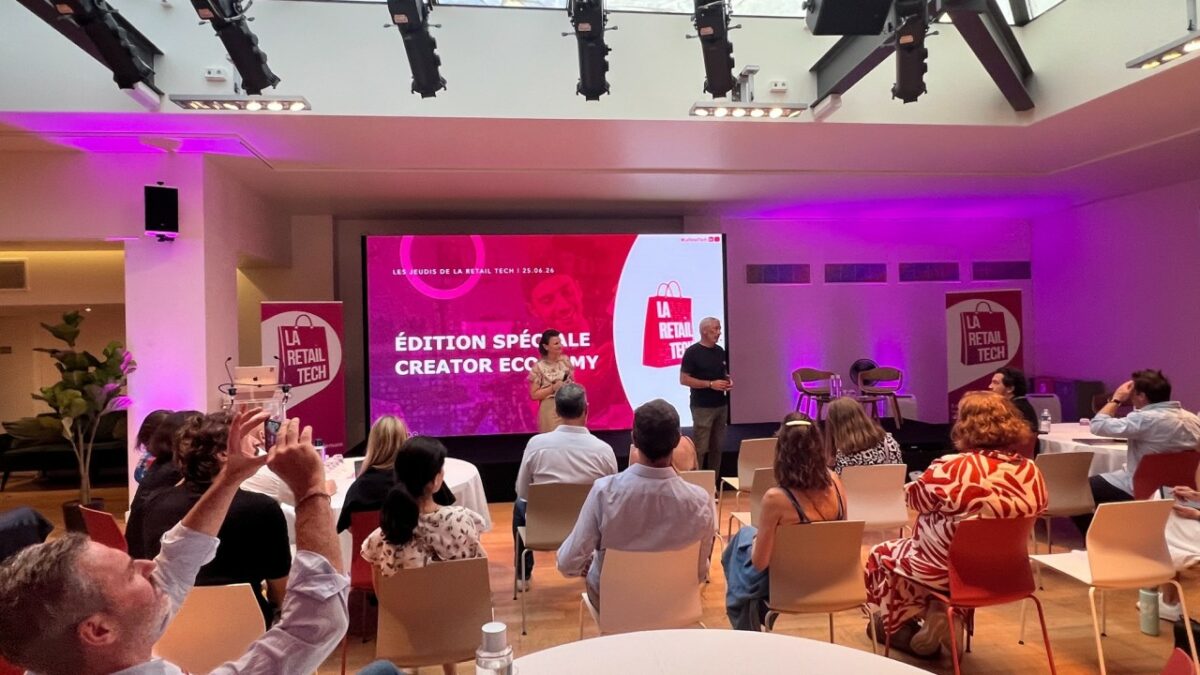
For the 37th edition of Retail Tech Thursdays, Mike Hadjadj 🛍️ and Barbara SARRE-DEROUBAIX chose to explore a topic that is as original as it is strategic: the Creator Economy, retail’s new superpower.
Despite the heat wave and transportation disruptions, the discussions were, as always, of high quality.
One thing is clear: the Creator Economy is rewriting the rules of distribution. Creators are no longer limited to recommending or representing a brand— they design it, launch it, and bring it to life within their community.
For their part, retailers contribute their market clout, retail expertise, and network to amplify these initiatives, reach new target audiences, and create new sources of growth.

How can we build a truly win-win model, preserve creators’ freedom, and avoid the risks of market saturation or cannibalization? These are just some of the questions we’ve explored with influencers, creators, and retailers in the food, fashion, home, and cleaning industries.

📊 The French and Creator Brands: Already Well-Known Among Young People, but Trust Still Needs to Be Built
Anne-Laure Marchal, Director of the Corporate Business Unit at OpinionWay, presented this month’s consumer data on creator brands.
The study focuses on products that are entirely created and marketed by a celebrity or influencer. To avoid any confusion, respondents were given a clear definition: these are not simply one-off collaborations in which a public figure lends their image, but rather products worn, created, and marketed by public figures or influencers.
Among the examples cited: Tibo Inshape’s Inshape Nutrition line, Snoop Dogg’s Dr. Bombay ice cream, Mister V’s Pizza Delamama, Bigflo & Oli’s Matécito drinks, Bgin’s cleaning products, MrBeast’s Feastables chocolate, and EnjoyPhoenix’s Leaves & Clouds Skincare products.

📈 Nearly one in two French people are already familiar with creator brands
Key takeaway #1: Creator brands already enjoy significant brand recognition in France.
47% of French people say they have heard of products created and marketed by a celebrity or influencer. Specifically, 12% have already purchased such products, and 35% have heard of them but have not purchased them.
This familiarity is particularly strong among younger generations. Among 18- to 24-year-olds, 89% are familiar with this type of product, and 39% have already purchased one. Among 25- to 34-year-olds, 70% have heard of it, and 30% have already purchased one.
Conversely, brand awareness declines with age: it stands at 53% among 35- to 49-year-olds, 36% among 50- to 64-year-olds, and 23% among those 65 and older. Purchasing follows the same trend, with only 1% of those aged 65 and older having ever purchased this type of product.
🛒 Purchase potential that exceeds past purchases
While 12% of French people have already purchased a product of this type, 38% say they would be likely to buy at least one product category if it were created and marketed by a celebrity or influencer.
This figure indicates growth potential beyond the current customer base. On average, interested respondents cite three types of products they might purchase.
The top categories are food and beverages, cited by 15% of French people, followed by clothing at 14%, home goods and decor at 14%, beauty and cosmetic products at 13%, and cultural and entertainment products at 12%.
Other categories appear less attractive at this stage: sports and recreational equipment, household appliances, pet products, gardening and outdoor maintenance products, electronics and high-tech products, as well as products for babies and children.
Once again, younger generations stand out clearly. 85% of 18- to 24-year-olds would be likely to buy at least one type of product promoted by a celebrity or influencer. This rate rises to 66% among 25- to 34-year-olds, compared with 39% among 35- to 49-year-olds, 28% among 50- to 64-year-olds, and 11% among those 65 and older.
Among 18- to 24-year-olds, three categories stand out in particular: clothing, cited by 45 percent; food and beverages, at 43 percent; and beauty and cosmetic products, at 43 percent. Among 25- to 34-year-olds, beauty and cosmetic products account for 28%, food and beverages 27%, followed by clothing and home and decor products at 22% each.

🧠 Products perceived primarily as marketing campaigns
Despite this name recognition and purchasing power, the overall perception of creator brands remains cautious among the French public as a whole.
80% believe that these products are often more about marketing than genuine innovation. 77% believe that product quality is more important than the personality promoting it.
The French therefore do not seem to automatically trust these products simply because they are associated with a celebrity or influencer. 78% say that the fact that a celebrity or influencer associates their image with a product does not reassure them about its quality. 81% do not trust this type of product any more than they do traditional brands. Finally, 82% are not willing to pay more for this type of product.
The appeal also remains limited among the general population: 73% of French people do not want to see more of these types of products on store shelves, 73% say they do not attract their attention any more than other products, and 75% indicate that the celebrity or influencer does not make them any more likely to buy the product.
👥 Young people: aware of marketing, but much more receptive
The contrast is striking among the younger generations.
People aged 18–24 are also aware of the marketing aspect of these products: 83% believe that they are often more marketing campaigns than genuine innovations. Furthermore, 85% believe that product quality is more important than the personality promoting it.
Yet their attitude toward these products is much more positive than that of the French population as a whole.
57% of 18- to 24-year-olds would like to see more of these types of products on store shelves. 60% say these products catch their attention more than others. 56% say that a celebrity or influencer makes them more likely to buy the product.
Trust is also higher in this age group: 50% of 18- to 24-year-olds say that when a celebrity or influencer associates their image with a product, it reassures them of its quality. 39% trust this type of product more than traditional brands.
Finally, 37% of 18- to 24-year-olds say they are willing to pay more for this type of product.
Among 25- to 34-year-olds, engagement levels are also high: 51% would like to see more of these types of products in stores, 51% say they catch their attention more, 55% say that the personality or influencer makes them more likely to buy, and 42% are willing to pay more.

🎯 A generational market, where affinity meets high standards for quality
The study’s findings reveal a very clear generational divide.
Among the French public as a whole, creator brands are still viewed with caution. They are primarily associated with marketing campaigns and, at this stage, do not enjoy a trust advantage over traditional brands.
Among young people, however, these products generate more attention, desire, and a sense of connection. People aged 18–24 and 25–34 are well aware of the marketing aspect, but they are much more open to the idea of buying these products, seeing them on store shelves, and—for some of them—paying a higher price.
Creator brands thus appear to be products closely tied to the affinity consumers feel toward the personalities who endorse them. Their success, however, hinges on one key factor: product quality, which the French rank far above the fame of the personality or influencer.

📱 Influencers in France: From a Platform for Personal Expression to a Full-Fledged Economy
As part of the “L’Œil de l’Expert” series, Myriam Roche, founder of the media outlet Les Gens d’Internet, discussed the history of influence in France and the gradual development of the Creator Economy.
Founded in 2020, Les Gens d’Internet is a media outlet dedicated to professionals in the fields of influencer marketing, social media, the creator economy, and social networks. It is aimed at those who want to stay up to date on trends, developments, and transformations in a constantly evolving industry.

💶 An established economy
The Creator Economy is now a major sector in France. According to estimates shared during the presentation, there are between 150,000 and 200,000 influencers and content creators in France.
Advertisers’ budgets are also on the rise. By 2025, an estimated 586 million euros will have been invested in this industry, helping to fund collaborations, co-creations, and project launches.
However, despite this significant amount, the market is still far from being fully embraced by all brands. Only 18% of national advertisers are reported to have a budget specifically dedicated to influencer marketing today.
The sectors with the strongest presence include fashion and accessories, retail chains, and e-commerce, as well as services.

✍️ The Origins: Blogs and the First Generation of Influencers
Contrary to the notion that the Creator Economy emerged with TikTok or with the social media platforms of the 2020s, Myriam Roche points out that the influencer phenomenon in France took root much earlier.
Its emergence dates back to 2005–2010, with the advent of the first blogs. At that time, internet users began speaking out on topics they were passionate about: fashion, beauty, culture, technology, sports, and lifestyle.
These early blogs gradually evolved into community spaces. Audiences began to form around these figures who had emerged with the advent of the Internet. Bloggers did not yet see themselves as professional influencers. Most started their blogs out of a desire to express themselves, out of passion, or as a personal challenge.
No one could have imagined at the time thata new economy would emerge around these public statements.
🤝 When Agencies and Brands Discover Bloggers
At this time, communications and public relations agencies are looking to increase their presence in digital spaces. However, there are still relatively few online media outlets in France.
Agencies are therefore turning to bloggers, some of whom already have audiences comparable to those of more traditional media outlets, particularly in the fashion and beauty sectors.
The first press invitations are starting to arrive. Bloggers are invited to events, receive products, and are invited to attend alongside journalists. They then share these experiences with their communities through articles, photos, and detailed content on their blogs.
This first phase marks the beginning of a new relationship between brands, agencies, and content creators.
🎥 The Golden Age of Influence: YouTube and Instagram
A second phase began with the emergence and rise of YouTube and Instagram, particularly between 2010 and 2015.
With blogs, it was difficult to accurately measure the impact of content. Audience metrics were not very visible, with the exception of certain indicators such as comments.
YouTube and Instagram are a game-changer. The metrics are now visible: number of subscribers, views, comments, shares, and engagement rates. Brands and agencies can then better analyze the impact of their campaigns and more easily link an investment to a result.
This visibility of metrics significantly accelerates the growth of influence. Some campaigns conducted with creators achieve results comparable to a television appearance, but with much smaller budgets.
The example cited during the presentation illustrates this period: platforms like iGraal have partnered with beauty YouTubers by including affiliate links in video descriptions. These initiatives, which are still very rudimentary, have allowed brands to directly measure the impact of these communities.
Gradually, these collaborations are becoming more professional. Creators are realizing that their audience can be a source of income, while brands are becoming aware of the potential of these new influencers.
📏 The Need for Tools and Measurement
As the number of campaigns increases, a new need arises: the need for reporting and impact analysis.
Brands want to better understand the results generated by their investments. Agencies must structure their initiatives, compare performance, track metrics, and demonstrate the impact of their collaborations.
It is against this backdrop that platforms, technological solutions, and tools dedicated to analyzing influencer campaigns are being developed.
The Creator Economy is therefore no longer limited to creators and brands. It is gradually evolving into a broader ecosystem that includes influencers, agents, agencies, platforms, measurement solutions, and technology companies.
🚀 2020: Market Growth and Consolidation
The COVID-19 crisis marks a new phase. Starting in 2020, investment in digital technology and influencer marketing skyrocketed. For several years, through 2023, budgets allocated to these areas grew significantly.
It was also during this period that a wider audience became aware of the impact of influencers. Collaborations multiplied, public statements became more visible, and the industry’s excesses drew greater attention.
Certain practices—particularly those involving frequent or inadequately regulated product placements—raise questions. This makes the need for regulation all the more pressing.
⚖️ The Act of June 9, 2023, and the Creation of the UMICC
Structuring the sector requires a more specific regulatory framework. The law of June 9, 2023, establishes guidelines for commercial influence and addresses the abuses that have been observed.
At the same time, the sector is seeking to organize itself more effectively as a whole. It is in this context that the UMICC—the Union of Influence Professionals and Content Creators—was founded.
This organization brings together various stakeholders in the ecosystem: agencies, creators, platforms, and industry professionals. Its goal is to grow this economy, improve its structure, and have a greater influence in discussions with government authorities.

🗺️ A constantly evolving landscape of stakeholders
Today, the influencer ecosystem remains very broad and can sometimes be difficult to map out precisely.
First and foremost are influencers and content creators, who are at the heart of the relationship with communities.
Agents of various types revolve around them: traditional agents, specialized agencies, talent representation firms, and hybrid agencies.
Agencies also play a central role. Some specialize in influencer marketing, while others are communications, strategy, or consulting firms that have developed specialized expertise in this area.
Finally, technology platforms and solutions make it possible to better manage campaigns, identify target audiences, analyze performance, and measure the impact of the actions taken.
This sector is constantly evolving. New agencies are being established, influencer teams are expanding within existing organizations, and new players are emerging on a regular basis.
🌟 Creators, Expertise, and Communities
The presentation also provided an opportunity to address the relationship between personality, expertise, and credibility.
Personality remains a central element of influence. People often follow a creator because they make them laugh, because they share emotions, because they allow people to relate to them, or because they forge a special bond with their community.
But other forms of influence are emerging, particularly in the B2B sector. In this context, audiences are more likely to follow profiles for their analysis, expertise, or ability to share useful information in a professional setting.
Credibility also depends on how collaborations are chosen. Some creators turn down many proposals to preserve their independence and maintain the trust of their community. Visible collaborations therefore represent only a fraction of the requests they receive.
🔮 What does the future hold for the Creator Economy?
The Creator Economy continues to evolve. According to Myriam Roche, many creators are now looking to go beyond traditional collaborations with brands.
Some people want to create real-world projects: events, stores, gatherings, or community experiences. Others want to launch their own brands—sometimes separate from their public personas—so that these brands can exist and endure without relying solely on their image.
This trend shows that the Creator Economy truly lives up to its name: it is no longer just about influence or visibility, but rather a structured economy made up of creators, brands, agencies, platforms, tools, and communities.
Originating from personal platforms for self-expression in the mid-2000s, influencer marketing in France has, over the past twenty years, become a full-fledged economic sector. It is still a young, evolving sector, but one that is now essential to understanding the transformations taking place in marketing, media, and the relationship between brands and their audiences.

🛒 From the Screen to the Shelves: How Do Designers Create Their Products?
During the roundtable discussion titled “The Creators’ Perspective—From Screen to Shelf: How Do They Design Their Products?,” Donatien Bozon, founder of Le Bon Moment, and Marion Pourché, brand and media manager at Burger King, shared their vision of the Creator Economy as it applies to retail. The discussion provided insight into how an idea born in the world of creators can be transformed into a product available on store shelves or on a restaurant’s menu.

🏗️ Le Bon Moment: Structuring Designer Brands
Founded 18 months ago, Le Bon Moment helps creators launch consumer brands and products. Donatien Bozon describes himself as a veteran of the Creator Economy: he started at Dailymotion in 2006, before moving on to YouTube and then Snapchat. It was during this time that he met Kyan Khojandi, with whom he co-founded Le Bon Moment.
The basic idea is simple: many designers want to launch their own brand, but few actually take action. And when they do, the execution is often limited. Retail is a profession in its own right, with its own constraints, areas of expertise, supplier networks, financing needs, and challenges related to production, quality, distribution, and negotiations with retailers.
For Donatien Bozon, three elements are essential for turning an idea into a product: industry expertise, content, and funding. This is precisely what Le Bon Moment provides to creators. The studio operates as a holding company, with a team of experts dedicated to the project. The creator retains a majority stake, as the goal is to build creator-led brands—not simply ambassador programs.
According to Donatien Bozon, there are currently fewer than five designer brand studios in France. The market is therefore still in its infancy.

⏳ Nine months from concept to store shelf
The creation process is lengthy. Le Bon Moment estimates it takes about nine months from the approval of a product category to its arrival on store shelves. This timeframe includes project planning, sourcing suppliers, product development, testing, production, and negotiations with retailers.
The first step is the casting process. It’s not enough to have an audience; you also have to make sure the creator has an entrepreneurial profile. According to Donatien Bozon, some highly artistic individuals may lose interest quickly because they’re used to short-term projects. But creating a brand of consumer goods requires thinking three, five, seven, or ten years ahead.
Once the profile has been approved, the next step is to choose a category. Le Bon Moment isn’t necessarily looking for the “sexiest” categories, but rather those that offer business value and innovation potential. Donatien Bozon cites the example of kombucha with Squeezie, in a category that has yet to be fully explored by major players.
🍦 Dr. Bombay: Adapting an American Brand to the French Market
Le Bon Moment’s first project was Dr. Bombay, Snoop Dogg’s ice cream brand, which had already been launched in the United States. For Europe, it wasn’t simply a matter of importing the American recipes.
The U.S. recipes were tested on French consumers. The result: French palates weren’t ready for American tastes, and some ingredients didn’t meet European standards. Le Bon Moment therefore relocated production to eastern France, to a family-owned manufacturer with significant production capacity.
This project required several months of R&D. Carrefour then hosted a preview of the project, positioning itself as a pioneer in this type of launch. Dr. Bombay was thus offered exclusively at Carrefour for the first summer season .
For Donatien Bozon, this type of launch shows thata designer brand cannot rely solely on buzz. It must also be based on a good product, high-quality craftsmanship, and a well-tailored distribution strategy.

🍔 Burger King: Co-creating with Communities
Marion Pourché presented another approach: that of an established brand that collaborates with designers to create new products. Burger King is set to officially launch a burger created in collaboration with Loris.
The initiative arose from a conversation about one of Loris’s events at Bercy. Burger King agreed to support the project, but with the idea of going beyond simple sponsorship. The brand proposed that Loris co-create a product offering, involving his community in the process.
The recipe, product name, and logo were chosen through a participatory process. During the event, the audience used a decibel meter to vote on the ingredients.
⚡ Authenticity, creativity, and risk-taking
For Marion Pourché, Burger King’s DNA is rooted in authenticity, creativity, and boldness. These elements enable the brand to take risks, particularly when it collaborates with creators.
Loris is an attractive prospect for Burger King because he does very few collaborations. This rarity adds value to the campaign. But beyond the creator’s personality, the brand is also looking for the ability to collaborate. The challenge is to balance the community’s expectations, the technical constraints of the restaurants, and the brand’s vision.
Burger King obviously tracks sales and foot traffic in its restaurants, but that’s not all. The brand also monitors changes in its image, reactions on social media, consumer feedback, and engagement metrics generated by the campaign.
👨🍳 An approach already tested with Michelin-starred chefs
Since 2023, Burger King has also been working with Michelin-starred chefs. The brand has collaborated with Michel Sarran, among others, and plans to introduce new recipes. These initiatives allow Burger King to build greater credibility in the realm of culinary excellence.
Once again, this approach involves significant technical constraints. Recipes developed in collaboration with chefs may require new ingredients, new sauces, specific types of bread, or preparations that are not typically found in Burger King kitchens. Each innovation must therefore be evaluated based on its operational feasibility.
For Marion Pourché, these collaborations allow Burger King to expand its brand reach while remaining true to its positioning.
🌱 Creator brands: a market that’s still in its infancy
Both speakers agree on one point: designer brands in the French retail sector are still very new. Most have been around for less than 18 months. The current selection focuses mainly on food, beverages, and beauty products.
Donatien Bozon points out that, aside from a few specific cases, the French creator brand market is still in its infancy. This explains the current trial-and-error approach to distribution models: exclusivity with a retail chain, previews, national launches, short-form content, or a more sustainable strategy.
Exclusivity can provide visibility and better support, particularly through a distributor’s sales force. But it also limits the product’s accessibility. Conversely, broader distribution can create availability issues and the risk of stockouts, which are not always desirable and can even result in penalties in the mass retail sector.

🧱 From Buzz to Building a Real Brand
This roundtable discussion shows that the transition from the screen to store shelves is about more than just putting a well-known name on a product. Success depends on several factors: product quality, alignment between the creator and the product category, the ability to engage a community, as well as manufacturing execution, distribution, and longevity.
For designers, retail opens up new entrepreneurial opportunities. But it also requires a shift in scale and timeframe. We’re no longer talking about a marketing campaign lasting a few weeks, but rather a brand initiative that can span several years.
For brands and retailers, the Creator Economy is becoming a driver of innovation, engagement, and differentiation—provided they do not reduce creators to mere audiences, but rather view them as true design partners.
A designer product, therefore, cannot simply be a product “endorsed” by a celebrity. It must be designed, tested, adapted, distributed, and evaluated just like any other retail product. Only then can it move beyond the hype and achieve lasting success.

🏬 Creator Economy: Distributors’ Perspective on a New Source of Growth
How can retailers adapt their business models in the face of the rise of designer brands? During a panel discussion focused on the retailers’ perspective, Carrefour, Monoprix, and Kiabi shared their experiences, lessons learned, and insights regarding these collaborations, which are gradually transforming store aisles, customer relationships, and product launch strategies.
From exclusive offerings, co-creation, customer communities, artistic collaborations, and affiliate programs, retailers are exploring new avenues for growth. But they all emphasize one point: success does not depend solely on the influence of an influencer or creator. It also depends on product quality, operational excellence, the ability to mobilize internal teams, and consistent communication after launch.

🛒 Carrefour: Exclusivity as a Driver of Collaboration and Performance
For Corentin Charrier at Carrefour, exclusivity plays a central role in launches related to the Creator Economy. It helps establish a different kind of relationship with brands and manufacturers, while also ensuring more reliable supply volumes and minimizing the risk of stockouts.
In this type of collaboration, the distributor does more than simply list a product. The distributor must work much more closely with the manufacturer or designer to anticipate demand, prepare the necessary quantities, and ensure a successful launch. This approach is particularly important when the product has strong viral potential.
The example of Ciao Kombucha illustrates this ability to drive actual purchases in a category that is still not widely consumed. With the arrival of a creator with a large following, the product doesn’t just add to an existing lineup—it can help introduce consumers to the category and generate new demand.
Carrefour also emphasizes the importance of communities. The retailer’s community club, in particular, allows it to gather product reviews. But the initiative isn’t limited to customers: employees are also involved in product launches. Stores can promote these campaigns on their own social media channels, create local engagement, and help bring the retailer closer to its customers.
This internal mobilization becomes a source of influence in its own right. Store teams contribute to the success of the launch, especially when it has a strong community focus.

🎨 Monoprix: Creative Collaborations That Are Deeply Integrated Into the Retail Business
At Monoprix, Hélène Thomas points out that a collaboration of this kind involves a wide range of internal departments: supply chain, merchandising, communications, product teams, manufacturing, stores, and more… Launching a product with a creator or designer is more than just a public relations campaign. It’s a cross-functional project that requires a high degree of coordination.
Monoprix already has extensive experience collaborating with artists and designers. The brand carries out about 8 to 10 collaborations per year, sometimes in the form of limited editions, and sometimes as part of a longer-term strategy.
The goal is to make beautiful and high-quality products accessible, while respecting the designer’s vision. The process can start with a very specific idea, a simple sketch, or a blank canvas. In-house teams then oversee product development, prototyping, quality adjustments, manufacturing, and placement on store shelves.
Some collaborations have been spectacularly successful. Hélène Thomas cites, in particular, the example of stools that sold 10,000 units in a single day. Success can also be measured in other ways: when products are later resold on Artcurial or on specialized platforms, this attests to their desirability and rarity.
Monoprix has also recently launched a presence on TikTok. The retailer has established a detailed set of guidelines to screen the influencers and creators it wants to work with. This upfront selection process is essential for protecting the brand’s image and avoiding content that doesn’t align with its positioning.
The challenge for Monoprix is also to win over store owners and franchisees. A product designed by a creator cannot succeed solely on the strength of the designer’s reputation: it must find its place in stores, win over staff, and benefit from genuine commitment on the ground.

👗 Kiabi: Customer Influence as a Driver of Authenticity
Nadia Asse, at Kiabi, offers a different perspective. Here, influencers aren’t necessarily well-known to the general public. The brand focuses more on micro- and nano-influencers, whose small communities are considered more authentic.
Kiabi distinguishes this approach from that of major influencers. The brand focuses on the base of the influence pyramid, particularly on accounts with up to 30,000 followers. In the market, nano- and micro-influencers can have up to 50,000 followers, but Kiabi prefers smaller, more engaged communities.
This approach is based on a customer community: the Kiabi Community, which has 300, 000 members, primarily women, mothers, new parents, and plus-size customers.
This community enables the co-creation of products with customers. In particular, Kiabi uses flash polls among its members to help designers and stylists make decisions: choosing prints, adjusting fits, gathering feedback on product needs, or testing ideas. The response rate is high, with thousands of responses received within 48 hours.
This approach allows Kiabi to directly incorporate customer feedback into the design process. When it comes to plus sizes, for example, feedback from the community has helped the company better address issues related to body shape, comfort, and usability.

🔗 Kiabi Link: Turning Customers into a High-Performance Sales Force
Kiabi has also developed Kiabi Link, a program that turns certain customers into performance-based sales representatives. The idea is to allow selected customers to recommend Kiabi products on their social media accounts using a personalized tracking link.
The program is based on a selection process at the time of enrollment. Participants must be customers, love fashion, have a public Instagram or Facebook account, and have fewer than a certain number of followers. Once accepted, they are free to create their own content, provided they adhere to the guidelines.
Kiabi also provides them with a platform, Kiabi Software, to help them better understand the products, present them more effectively, and grow their business on social media. Training modules may be offered to support them as they progress.
The positioning is clear: the goal is not to replace a primary source of income, but to provide a supplement. On average, participants earn about 200 euros per year. The stated goal is to boost purchasing power while creating a virtuous cycle for the brand: if customers make sales, they earn a commission; if they don’t, the brand doesn’t spend any money.

⚠️ The Risk of Market Saturation: Ensuring Every Launch Is a Success and Building Lasting Brands
The roundtable also addressed a key issue: How can we prevent saturation?
For Carrefour, every product launch must be a success. This requires transforming the relationship between retailers and manufacturers, as well as striving for operational excellence. It’s not enough to just generate buzz at launch: the product must be good, competitively priced, available, supported, and capable of standing the test of time.
The long-term viability of the Creator Economy on store shelves will depend on innovation and ongoing communication. A spectacular launch can create a sales spike, but it does not guarantee a lasting presence on store shelves. To establish a long-term presence, a creator brand must continue to innovate, develop new products, and maintain a strong connection with its community.
Monoprix, for its part, emphasizes the involvement of the designers themselves. Some artists and designers go out into the field, meet with store owners and franchisees, and play a direct role in convincing retail locations to carry their products. This commitment can make the difference between a one-time collaboration and a brand that establishes a lasting presence.
Kiabi, finally, shows that there is another way: onethat relies on a more discreet, community-focused approach, but one that is also more deeply rooted in customer relationships. By relying on its female customers, the brand seeks not so much massive buzz as authenticity, co-creation, and word-of-mouth recommendations.

✅ A new model to be built that bridges product, community, and operational excellence
This roundtable discussion shows that the Creator Economy is no longer just a marketing topic. For retailers, it now impacts the product, the supply chain, merchandising, customer relations, team training, and community engagement.
Successful collaborations are those that meet several criteria: a committed designer, a quality product, a reasonable price, controlled availability, consistent communication, and strong involvement from internal teams.
The Creator Economy can be a driver of growth and a way to reach new audiences. But it requires retailers to adapt their business models. Success depends not only on the creator’s popularity but also on the retailer’s ability to transform a community-driven impulse into a lasting shopping experience. Detailed descriptions on their blogs.
This first phase marks the beginning of a new relationship between brands, agencies, and content creators.