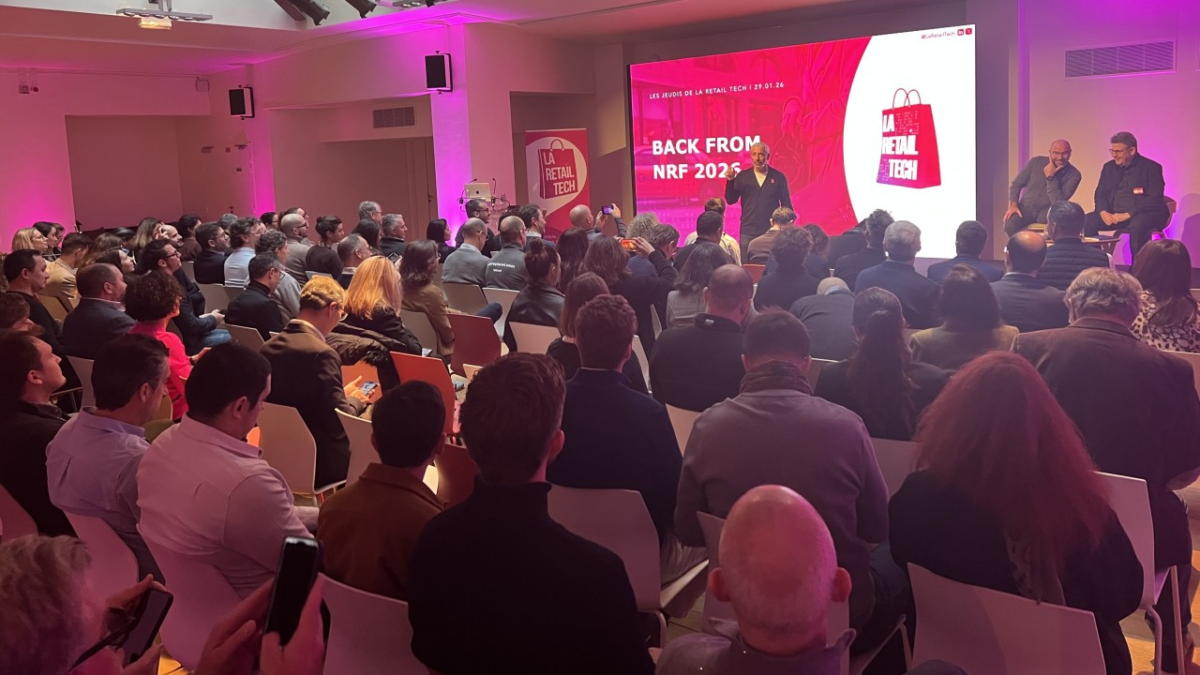
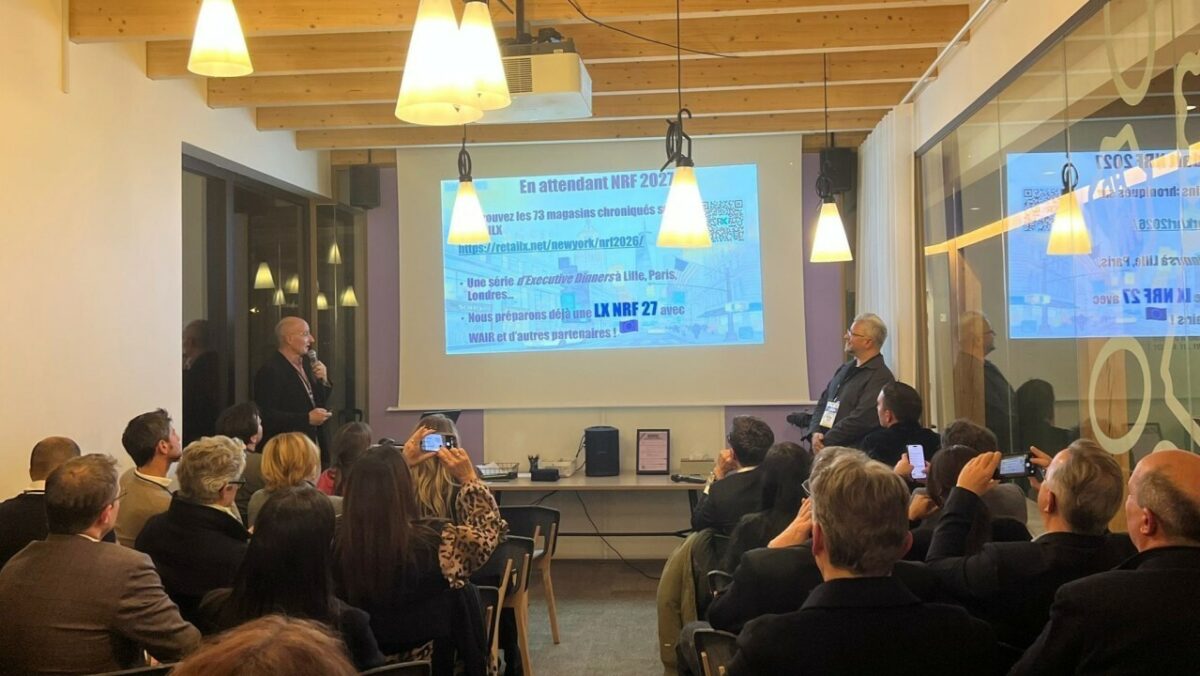
On January 20, 2026, the traditional Back from NRF was back with a completely revamped format. New organization team led by the bubbly Ilana Mahrouch, new speakers, and an evolution towards an afterwork format, extended by a VIP dinner.
One constant, however, was the loyal presence of Michel Koch, a veteran of distance selling, e-commerce and retail, who is as passionate as ever when it comes to sharing his discoveries from across the Atlantic. This year’s event was co-hosted in French and English by Ian Jindal of RetailX, a recognized British expert who brings an international and very concrete reading of trends.

The event brought together over 70 participants in Wasquehal, in the heart of the Lille metropolitan area, in the inspiring setting of the Maison des Bienheureux a manor house dating from 1925, former headquarters of La Redoute and then Promod, now a hybrid of boutique-hotel, cocktail bar, wine cellar and tea room.

📊 NRF 2026: the scale of the event
Before going into the background, a reminder of scale is in order. NRF 2026 represents 40,000 retail professionals and 6,000 brands, with a strong international dimension. The profiles present cover the entire value chain: management, operational teams, IT, digital, supply chain, merchandising.
This diversity is what makes the event so rich… but also so dense: three very intense days, which you need to prepare to get the maximum value out of.
🌍 Market & outlook: growth, but under pressure
Shared projections remain positive: global e-commerce is targeting $8,148 trillion in 2026, with an estimated growth trajectory of around +4% per year.
But the NRF also reminds us of a reality that is sometimes underestimated: the store remains at the heart of the reactor. Worldwide, 76% of sales are still made in physical stores.
🧠 Consumer trends: what US figures say
Several strong signals stand out on the U.S. side:
- holiday spending growth of around +4%.
- +18% in transactions
- an increase in spending per visit
Marketplaces continue to drive the market(+22%), driven in particular by TikTok Shop, used by a significant proportion of 18-24 year-olds.
When it comes to payment, BNPL is taking root: almost 45% of 18-39 year-olds use it, with double-digit growth. And unsurprisingly, mobile-first behavior is becoming the norm among younger generations.

🌍 Macro factors: increasingly asymmetrical consumption
Beyond digital, several structural factors are weighing on consumption.
The concept of the K-shaped economy illustrates a clear divide: a minority of consumers concentrate a major share of spending, particularly on luxury goods.
The impact of GLP-1 (appetite-suppressant drugs) is also mentioned, with effects already visible on grocery, catering and certain fast-food chains.
In this context, “doom spending” is emerging: emotional spending linked to economic anxiety and information saturation.
Finally, one risk has been identified as a potential tsunami: the evolution of electricity prices in the United States, likely to weigh heavily on purchasing power.
🗽 New York: when the terrain makes it all real
On site, the contrasts are striking: the free sale of cannabis in the middle of Manhattan, the hawking of luxury bags, the permanent cohabitation of innovation, economic tensions and creativity. New York remains an open-air laboratory.

🔥 The major announcement: Universal Commerce Protocol (UCP)
If there was only one announcement to be made at NRF 2026, it would be this one: the Universal Commerce Protocol (UCP).
Billed as the HTTP equivalent of the 90s web, UCP is an open protocol designed to standardize product descriptions and checkouts, making commerce readable and actionable by AI agents.
The partners announced are major: Google, Walmart, Carrefour, Shopify, Zalando. And the key point: no one owns the protocol, it’s developed collectively.
A very concrete example: Monos(https://www.monos.com/). Thanks to UCP-compliant product data, the brand is selected by the Google agent as a valid option, without any media purchase. The transaction remains handled by Monos, which retains the customer relationship and transactional data.
🤖 What UCP changes in concrete terms
In the future, the purchasing process could be structured as follows:
- merchants with machine-readable profiles
- agents able to compare, negotiate and choose
- a structured checkout executed directly in the AI interface
The first integrations are scheduled to go live in March 2026.

🛠️ Strategic projects to be launched
For retailers, the message is clear: the UCP means laying the foundations now (reliable data, compliance, technical stack), before tackling the relational and economic challenges of agentic commerce.
In the short term: making catalogs, prices and inventory reliable in real time, legal & compliance alignment (GDPR, DMA, DSA), upgrading e-commerce stacks. Medium-term: reinvention of CRM and loyalty, industrialization of CX agents, evolution of business models and anticipation of future agentic interfaces.
📈 Retail & AI: results, but maturity still limited
AI is already showing positive results in product research, personalization and customer segmentation. However, few retailers today have a truly structured AI strategy, suggesting strong potential… but also a gap to be bridged.
🧱 Frictionless vs. flight: a delicate balance
Increasing the number of anti-theft devices reduces shrinkage, but also the propensity to buy. An increasingly sensitive trade-off for retailers.
📺 Retail Media: when the supply chain becomes a media lever
In-store retail media appears to be a lever that is still largely under-monetized. Leveraging supply chain data (stocks, availability, lead times) can secure campaigns, improve targeting and generate significant additional revenues.

⚡Startups: applied AI, very concrete
The Tech Innovation Tour highlighted several particularly operational solutions:
- Envive – brand-safe AI agents with dedicated LLMs per retailer 👉 https://www.envive.ai/
- Ethosphere – analyzing sales conversations to train and coach field teams 👉 https://ethosphere.ai/
- Lumi AI – MOQ optimization and revelation of millions of dollars in unserved demand 👉 https://www.lumi-ai.com/
- Paper Weight AI – paper sensors for shelf tracking, predictive restocking and dynamic pricing 👉 https://www.paperweight.ai/
- Pipe17 – omnichannel order orchestration and real-time inventory synchronization 👉 https://pipe17.com/ai/
- ReFiBuy – preparation and optimization of product catalogs for GenAI agents and UCP 👉 https://www.refibuy.ai/

🏬 Store tours: New York as a sensory laboratory
Finally, the store tours confirm that retail is becoming more and more of an experience:
- Athletic Propulsion Labs – architecture, materials, light, fragrance: the awning becomes the brand 👉 https://www.athleticpropulsionlabs.com/
- Buck Mason – quiet branding, hospitality, coffee, books, vinyl: an assumed lifestyle experience 👉 https://www.buckmason.com/
- Crocs – the store as playground and customization platform 👉 https://www.crocs.com/
- Monos – a real-life demonstration of UCP-ready commerce 👉 https://www.monos.com/
- Meta Lab (5th Avenue) – immersive showroom and customization 👉 https://www.meta.com/fr/en/meta-lab/new-york-city/
- Printemps New York – a “quotation” of the Paris Printemps, very experiential, in the particular context of Wall Street 👉 https://us.printemps.com/
⚠️ To remember
One point was conspicuous by its absence: not a word about sustainability throughout NRF 2026. This silence was all the more striking given the importance of the subject in Europe.
🙏 A huge thank you to our two speakers, Michel Koch and Ian Jindal, and to our sponsors. WAIR (represented by Mitch van Deursen), Deloitte (represented by Julien Vigneau), Zipline (represented by Anthony Gavin ), for this exceptional evening, and to the fabulous Ilana Mahrouch for impeccable organization.
More content on the evening!
- See you tomorrow, Lille. 🔥Following the first edition of the WAIR Executive Dinner in November, we’ve decided to think even bigger to open the year where retail wants to be. . by Ilana Mahrouch
- NRF 2026: Was it really necessary to cross the Atlantic to understand the future of Retail? ✈️🗽Yesterday evening, at the Maison des Bienheureux, Michel Koch and Ian Jindal (in French and English please 😉 shared their back stories from NRF (40,000 visitors over 3 days in New York, 6,000 brands represented, 40 French start-ups present). by Chrystel Desproges
- Back From NRF 2026 – New York. Last night with Michel Koch and Ian Jindal 🙌👉 The topic is no longer the digitalization of retail, but its orchestration. by Marion Marescaux
- 𝐋𝐞 𝐍𝐑𝐅, 𝐜’𝐞𝐬𝐭 𝐛𝐢𝐞𝐧. 𝐔𝐧 𝐛𝐚𝐜𝐤 𝐟𝐫𝐨𝐦 𝐍𝐑𝐅 𝐚̀ 𝐋𝐢𝐥𝐥𝐞, 𝐞𝐧𝐭𝐫𝐞 𝐩𝐚𝐢𝐫𝐬, 𝐜’𝐞𝐬𝐭 𝐩𝐚𝐫𝐟𝐨𝐢𝐬 𝐦𝐢𝐞𝐮𝐱. Last night, at the Maison des Bienheureux, dense and enlightening feedback. par David Edouart
- Retail has two faces. The one that shines in magazines, and the one that cashes in. 🏪💸 by Aurélien Lepretre 🚀🤖✨
- 𝙐𝙣𝙚 𝙘𝙝𝙤𝙨𝙚 𝙚𝙨𝙩 𝙘𝙡𝙖𝙞𝙧𝙚 at 𝙧𝙚𝙩𝙚𝙣𝙞𝙧: retail is going through a phase of profound transformation, between counterfeiting, the rise of retail media and the gradual integration of AI. by Rami Salem
- Merci Lille – or more precisely, Merci Wasquehal! A reunited community, frank exchanges and the desire to do things differently! This edition of Back From NRF showed that a simple format, centered on the sharing of concrete experiences between retailers, immediately creates value. by Ilana Mahrouch