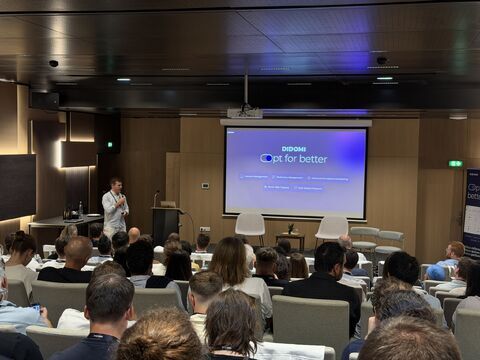
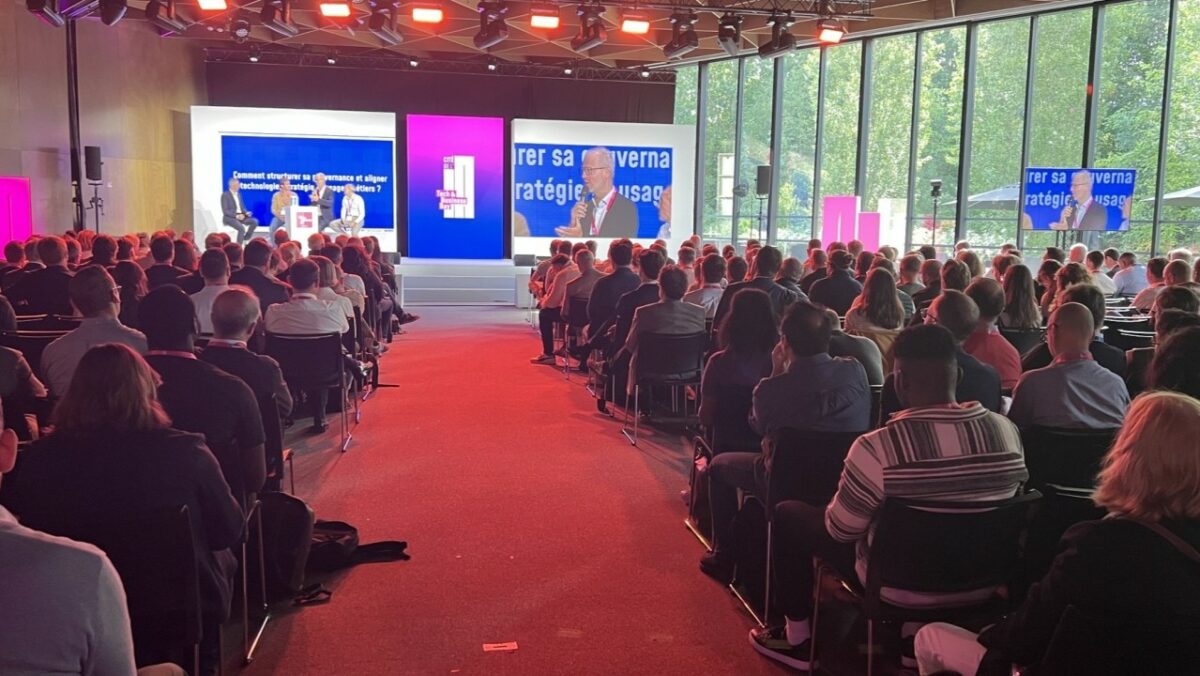
On June 15, 2026, Tech & Business Day was held at the Cité des Échanges in Marcq-en-Barœul. Organized by the Cité de l’IA and MEDEF Lille Métropole, the event drew more than 1,000 participants.

Optimal Ways was delighted to participate in this event to gain a deeper understanding of the challenges, best practices, and pitfalls associated with artificial intelligence.

The program was very comprehensive. We focused our summary on the main presentations about retail,e-commerce, data, and the future of work.

🏗️ Digital Strategy and AI at Jules and ADEO: Building Useful, Controlled, and Scaled AI
Artificial intelligence is already transforming the retail industry. The question is no longer whether it will change jobs, customer journeys, or organizations, but how to integrate it properly, on a large scale, without losing control over costs, data, security, and sovereignty.
During a discussion focused on digital strategy and AI, Dimitri Shotko, Global CDO at ADEO, and Jean-François Jouannais, Head of Data & AI Product at Jules, shared their perspectives on the transition from experimentation to industrialization.

🧱 Essential technological foundations
At ADEO, AI is part of a journey that began several years ago. The company has been working on these topics for eight to nine years, initially using more traditional machine learning approaches: classification, optimization, recommendations, product ranking, and anomaly detection.
These applications, which are sometimes not very noticeable, have made it possible to gradually integrate AI into digital products and business processes.
Today, ADEO can go even further thanks to its foundational technologies: data mesh, cloud-first, headless approach, API-first, and microservices architecture.
These pillars are not merely technical. They enable the integration of data, applications, and future AI agents into a complex information system. Agent-based AI can only succeed if it is built on an architecture capable of scaling, exposing the right data, and enabling agents to interact with enterprise tools.
At Jules, the logic is similar. Following a transformation initiative launched in 2023, technology has become a strategic pillar of the company’s turnaround. The creation of a data department reporting directly to the executive committee illustrates this commitment to placing data and AI at the heart of decision-making.
🎯 Real-world use cases that benefit various industries
ADEO has already implemented numerous AI use cases. Some of these focus on optimizing product quality: conducting fewer but more effective inspections by identifying quantity or quality discrepancies more efficiently.
Other applications rely on generative or agent-based AI. For example, ADEO uses agents to prepare for supplier negotiations. These agents analyze available data, historical records, sales figures, and negotiation parameters to propose scenarios and help buyers better prepare.
AI is also used to generate visual content. Using an AI content studio, ADEO can produce images tailored to different markets, styles, or countries more quickly. This reduces production time andspeeds up time-to-market.
👕 At Jules, two complementary approaches
At Jules, AI is approached from two angles.
The first involves transforming processes and business functions. AI must be integrated directly into tools and workflows to bring about tangible changes in the way we work.
The second aims to create an “augmented” employee capable of assisting teams with their day-to-day tasks: writing, summarizing, researching information, analyzing, exploring data, and automating repetitive tasks.
To support this adoption, Jules launched an internal platform called Julia. It allows employees to access various generative AI models in a secure environment. The goal is to encourage its use while managing data-related risks.
Adoption was rapid: within a few months, a significant portion of headquarters staff had used the platform, sending more than 15,000 messages. This momentum shows that generative AI meets very specific needs, particularly thanks to the simplicity of natural language.
🔐 Security, Agnosticism, and Sovereignty
Both companies emphasize the importance of not relying on a single model or supplier. Technologies evolve rapidly, performance levels change, and geopolitical and regulatory risks exist.
It is therefore essential to remain open-minded, to be able to test several models, and to switch to a different solution if necessary.
At Jules, the decision was not to immediately block external tools, but to offer an in-house alternative that is more secure, more collaborative, and better suited to the company’s needs. The goal isto steer users toward a controlled environment rather than abruptly curtailing their use of these tools.
📊 Data remains the foundation
Behind the visible demonstrations, a large part of the success rests on less spectacular elements: data quality, documentation, governance, APIs, knowledge bases, and cost control.
ADEO highlights the shift toward knowledge bases capable of consolidating both structured and unstructured data: documents, business expertise, images, videos, instructions, and historical records.
At Jules, AI is also used to improve data documentation. Solutions like Myriad automate much of the data warehouse documentation, with human validation of the remaining elements. This saves data teams a significant amount of time and helps business units become more self-sufficient.

📈 Measuring value without limiting yourself to immediate ROI
Measuring ROI remains a complex task. Some benefits are immediately apparent: reduced time to produce an analysis, faster content creation, better sales preparation, or improved productivity.
At Jules, a test that used to take three days can now be completed in half a day thanks to AI.
But other benefits are more subtle: time saved, better decision-making, greater autonomy for business units, and a reduction in day-to-day friction.
For ADEO, the focus shouldn’t be solely on exceptional use cases that immediately generate massive value. Transformation also comes from the accumulation of many small use cases. Taken individually, they may seem modest. But when deployed on a large scale, they profoundly transform the experiences of customers, employees, suppliers, and products.

🤝 A transformation that is, above all, about people
Despite the technological nature of the subject, the success of AI depends heavily on people: training, onboarding, change management, and adoption by teams.
At Jules, the transformation can be summed up as follows: 20% technology, 80% people.
The goal is not to replace employees, but to give them the right tools to create more value, save time, and focus on tasks that have a greater impact.
A good indicator of adoption is simple: would employees protest if the tool were taken offline? If the answer is yes, it means that AI has become truly useful in their day-to-day work.

🤝 A Successful Partnership Between a Startup and a Large Corporation: Two Real-World Examples in Retail
Artificial intelligence is already profoundly transforming commerce. But beyond the big technological announcements, it is often the partnerships between major corporations and startups that enable ideas to be quickly put into practice.
Two examples illustrate this particularly well: Carrefour Belgium with Mealz, focusing on agent-based commerce in grocery shopping, and Feu Vert with EKOO, focusing on voice AI to support salespeople and enhance customer engagement.

🛒 Carrefour Belgium and Mealz: Moving Toward Agent-Based Commerce in Grocery Shopping
For Carrefour Belgium and Mealz, the goal is clear: to simplify the grocery shopping experience using artificial intelligence.
Agent-based commerce marks a new phase in the customer journey. It’s no longer just about recommending a product or offering a promotion, but about guiding the customer through the entire process: preparing a meal, organizing their shopping, saving time, and buying the right products at the right time.
Jean-Philippe Blerot, Head of Digital & E-commerce Projects at Carrefour Belgium, and César Tonnoir, co-founder and CEO of Mealz, demonstrated how a specialized startup can help a major retailer make rapid progress on a very specific issue.
Mealz brings technological expertise and an agile approach, while Carrefour Belgium brings customer insight, scale, product offerings, and operational strength.
This collaboration is a good example of the value of a balanced partnership: the startup isn’t just selling a solution; it’s integrating into an existing ecosystem to address a real customer pain point.

🎙️ Feu Vert and EKOO: When Voice AI Gives Salespeople a Voice
The second example, presented by Feu Vert and EKOO, highlights another application of artificial intelligence: voice recognition.
Featuring Vincent Claisse, Director of Marketing, Communications, and Digital at Feu Vert France, and Emilie Brossier, co-founder of EKOO, the discussion focuses on the ability of voice AI to enhance customer engagement by leveraging sales representatives.
In a retail setting, salespeople possess valuable expertise. They know the products, understand customer needs, are familiar with common objections, and know which points to make to put customers at ease.
The challenge is to better capture this on-the-ground expertise and make it available throughout the digital journey.
In this context, voice AI helps bridge the gap between humans and the digital world. It literally gives salespeople a voice, highlighting their advice in formats that are more engaging, more personal, and closer to the in-store experience.
For Feu Vert, this helps build trust, humanize the customer relationship, and differentiate the online experience.

⚙️ A shared approach: combining agility with strong execution
These two cases show that the success of a partnership between a startup and a large corporation depends on several key factors.
The first is complementarity. The large corporation provides market access, customer insight, scale, and operational capabilities. The startup brings speed, specialization, and the ability to experiment quickly.
The second isgrounding the projectin a concrete use case. The most effective projects don’t start with technology alone, but with a clearly identified need: simplifying grocery shopping, providing better customer support, enhancing the value of sales advice, or improving customer engagement.
The third is the ability to move from experimentation to integration. An innovation is valuable only if it fits into existing workflows, is adopted by teams, and creates a measurable benefit.
🚀 AI as a Catalyst for Collaboration
Carrefour Belgium’s partnership with Mealz and Feu Vert’s collaboration with EKOO demonstrate that artificial intelligence is not just a technological issue. It is also about collaboration, organization, and transforming how things are done.
In both cases, the startup acts as a catalyst. It enables the large corporation to test ideas more quickly, explore new formats, and meet rapidly changing customer expectations.
This combination of entrepreneurial agility and industrial strength is undoubtedly one of the most promising drivers for the emergence of new applications of AI in retail.

🛍️ AI: An Accelerator of Retail Transformation
With the rise of LLMs, generative AI, and agent-based protocols, the retail industry is entering a new phase of transformation.
For retailers, the challenge is no longer just to experiment with artificial intelligence, but to understand how it is redefining their role in the value chain, their customer relationships, and their internal operations.
During her presentation, Marie Cappelaere, Chief Data & AI Officer at Boulanger, shared a very concrete vision of this transformation. One strong conviction emerged: AI is both a major strategic risk and a powerful driver of competitiveness.
⚡ A technological environment that is constantly evolving
The retail industry has been familiar with AI for a long time, particularly through data science and machine learning. These technologies are now mature, ready for large-scale deployment, and integrated into many business tools.
Generative AI and agent-based AI, however, open up a whole new range of possibilities. This new wave is characterized by the speed of its adoption, its technological instability, and its level of uncertainty.
For retailers, this uncertainty requires a mindset of continuous learning: experimenting, testing, sometimes making mistakes—but above all, not standing still.

🧭 The risk of disintermediation is a major concern
One of the major issues raised by Marie Cappelaere concerns disintermediation.
As consumers use large language models (LLMs) to compare, choose, or prepare for their purchases, the traditional role of the retailer may be undermined.
Tomorrow, if a chatbot recommends a brand or product, why would it direct the customer to a retailer rather than to the brand directly?
This question forces retailers to clarify their value proposition. For Boulanger, the answer is no longer limited to selling new products. It also encompasses services, installation, repairs, post-purchase support, the in-store experience, and distinctive expertise.

🛠️ Building useful AI rooted in domain expertise
At Boulanger, the approach is not to rely entirely on general-purpose AI systems. The company develops its own agents, drawing on its internal expertise, data, and business knowledge.
Two examples illustrate this strategy.
The first is a general-purpose conversational AI capable of answering FAQ questions, as well as assisting with certain self-care tasks, such as tracking or canceling orders.
The second is Durablife, a company specializing in product maintenance and repair. It draws on Boulanger’s after-sales service expertise to help customers extend the lifespan of their equipment.
This logic illustrates a key point: AI creates value when it is connected to real-world domain expertise. An agent without specific expertise risks producing generic—or even incorrect—responses. An agent trained with the right content, processes, and experts can become a true service accelerator.
🧩 Essential prerequisites: data, governance, and cybersecurity
To successfully navigate this transition, Boulanger has identified several prerequisites.
The first concerns data. Agents need data that is accessible, reliable, well-documented, and structured.
The second point concerns tools. Boulanger has adopted a pragmatic and agnostic approach, offering several solutions tailored to different levels of use.
Finally, governance is key. Issues related to costs, security, compliance, labor relations, and the impact on business operations must be addressed from the outset.
AI cannot be viewed solely as a technical issue. It involves the data department, business units, HR, cybersecurity, the legal department, and labor partners.

🌱 AI as a Driver of Cultural Assimilation and Internal Transformation
The transformation doesn’t just affect customers. It also affects employees.
Boulanger has established a community of AI ambassadors, called Maya, across its various business units.
These ambassadors identify challenges on the ground, test out solutions, share what they’ve learned, and train their colleagues in a cascading manner.
This bottom-up approach has already led to the emergence of numerous use cases. It demonstrates that AI becomes more relevant when it addresses real-world challenges and is driven by those who truly understand the business.
🧑💼 Toward a New Way of Organizing Work
Beyond the initial use cases, Marie Cappelaere compares this transformation to a new industrial revolution. But this time, it affects white-collar workers more than it does manual labor.
AI is forcing companies to formalize their processes, clarify their workflows, identify tasks that can be automated, and rethink the role of humans.
The example of data analysts is telling. Their role could gradually shift from producing analyses to training agents capable of making this expertise available to business units.
In this transformation, people remain at the center. Agents must be trained, supervised, corrected, and mentored by subject-matter experts.
🎯 Don’t let AI dictate your path—choose your own direction
Marie Cappelaere’s remarks highlight a key point: the retail industry cannot wait for standards to stabilize before taking action.
AI poses a risk of disintermediation, but it also presents an opportunity to strengthen customer relationships. It can automate certain tasks, but it can also enhance employees’ employability.
To remain competitive, the retail sector must make progress on three fronts: securing its place in the value chain, creating distinctive customer experiences, and realizing internal efficiency gains.

👥 AI and the Future of Work: Between Acculturation, Transformation, and a New Social Contract
Artificial intelligence is no longer a topic reserved for data experts or innovation departments. It is now making its way into the heart of organizations, business lines, and skill sets.
Through the contrasting perspectives ofArnaud Coulon, Director of International Learning at Auchan Retail, and Sylvain Poirier, Director of AI at France Travail, one conviction emerges: AI is already transforming the world of work, but its impact will depend above all on the human, managerial, and social choices that are made.
🕰️ AI: A Long History That’s Now Accessible
While generative AI burst onto the public scene with the arrival of ChatGPT in late 2022, artificial intelligence is nothing new.
The recent breakthrough is primarily due to its accessibility. With conversational interfaces, anyone can now experience AI firsthand, without needing advanced technical skills.
A new phase is now on the horizon: that of agent-based AI, capable of autonomously performing certain tasks or work sequences.
This development raises a key question: What do we want to automate, and what do we absolutely want to keep under human control?

🧑🤝🧑 At France Travail, AI that serves people
France Travail has been working on data and AI for more than ten years. This early start enabled the organization to define a strategy, an ethical charter, and a framework for public operations at a very early stage.
The goal is clear: to make AI a tool that serves humanity.
Specifically, France Travail uses AI to improve services for job seekers, recruiters, and counselors.
A prime example is resume analysis, which helps identify skills and reduces the time needed to create a candidate profile.
With generative AI, France Travail has taken a new step forward with ChatFT, a secure alternative to ChatGPT. The tool is used in particular to draft emails, prepare meeting minutes, and summarize information.
Another example: MatchFT, which uses AI to initiate conversations with job seekers in order to verify certain criteria not included in the information system, such as mobility, available hours, or personal constraints.
But the AI doesn’t make decisions on its own: the counselor takes over, analyzes the responses, and guides the person.
That’s where the key lies: AI frees up time spent on administrative tasks, allowing us to focus more on providing personal support.

🎓 At Auchan, training comes before change
At Auchan Retail, transformation begins withcultural integration.
The group, which is highly decentralized and operates in many countries, had to build a common foundation centered on data and AI.
The initiative began with top management, featuring masterclasses designed for country presidents and executives. A program called “Data Booster for CEO” was then rolled out to raise awareness of data among executive teams—an essential prerequisite for any AI project.
Auchan has also incorporated data and AI into its leadership programs, with sessions dedicated to reflecting on the future of retail and hands-on experience with these tools.
The challenge is not just technical; it is also social. Auchan is working to define a framework for AI, with a progression from acculturation to transformation, and then to reinvention.

🔮 Three Scenarios for the Future of Work
With AI on the horizon, the future of work remains to be seen. Arnaud Coulon outlines three possible scenarios.
The first is a focus on short-term productivity. In this scenario, AI is primarily used to automate tasks, reduce costs, and improve profitability. The risk here is significant social polarization.
The second scenario is one of informed continuity. In this scenario, AI is viewed as a tool for enhancing employee performance, with humans remaining in the loop.
The third scenario is one of stagnation. Without a vision, without leadership, and without training, usage remains individual, fragmented, and sometimes frustrating.
These scenarios serve as a reminder that AI is not just a technology—it reflects organizational, managerial, and societal choices.
🧠 Acculturation alone will not be enough
Training employees in AI is essential, but it won’t be enough.
The speakers emphasize the need to move beyond simply learning about the tools and toward a genuine transformation of the professions.
With agent-based AI, the shift from an execution role to a validation, orchestration, or supervision role will become central.
Employees will need to learn how to manage systems, monitor their results, think critically, and understand the limitations of models.

🌍 A human and collective challenge
The real challenge of AI, then, is not a technological one. It is human, collective, and organizational.
To successfully scale up the initiative, it is essential to get executives, managers, frontline teams, employee representatives, and subject-matter experts on board.
We also need to provide context: Why are we using AI? What are the benefits? What are the limitations? And who does it serve?
At France Travail, this initiative is carried out through an in-house academy, regional transformation hubs, and AI ambassadors. At Auchan, it relies on training programs, communities of experts, and a social framework currently under development.
In both cases, the same conclusion is clear: AI must be integrated into business processes, rather than added as a separate technological layer.

❤️ Putting People Back at the Center
AI can automate, accelerate, suggest, synthesize, and orchestrate. But it should not lead to systematically delegating all intellectual effort to machines.
The risk of unlearning is real, especially if employees gradually lose their ability to understand, make decisions, or question things.
The future of work will therefore not be determined solely by the power of these models. It will depend on how organizations define their social contract regarding AI: what can be automated, what must remain in human hands, the skills that need to be developed, and the protections that must be guaranteed.
AI is a groundswell. It will transform jobs, processes, and organizational models. But its ultimate impact will depend on a fundamental choice: whether to use it to replace humans, or to give them back time, value, and the ability to act.