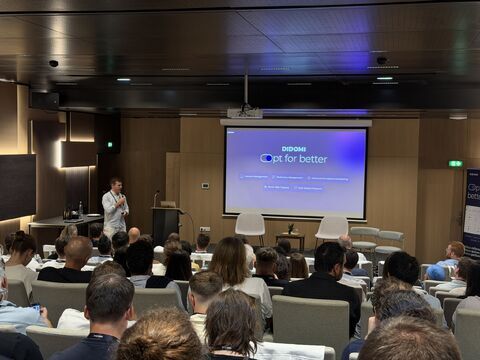

The 2026 edition of Meet Magento France confirmed one thing: e-commerce is entering a new phase of maturity.
For a long time, the key areas were relatively well defined: web performance, conversion, payment, product catalog, internationalization, logistics, customer acquisition, and omnichannel capabilities. These drivers obviously remain essential. But they are now undergoing a more profound transformation: the emergence of artificial intelligence in customer experiences, internal tools, purchasing journeys, e-commerce infrastructure, and organizational models.
E-commerce is no longer limited to improving an e-commerce site. It’s now about preparing the company for an environment where human customers will no longer be the only ones searching, comparing, and buying. AI agents, conversational assistants, generative engines, and automated interfaces will gradually change the way brands are discovered, evaluated, and chosen.
In this context, the presentations at Meet Magento France 2026 addressed several key aspects of this transformation: European sovereignty, agent-driven commerce, product data structuring, e-commerce performance, international dropshipping, AI in production, decision-making co-pilots, B2B transformation, conversational searchandising, and large-scale replatforming.
Each presentation shed light on a specific aspect. Together, they outline the contours of a retail sector that is smarter, more connected, more demanding, and also more strategic.

1. Decoding the Future: E-commerce, AI, and European Sovereignty
Cécile Vaute, Country Partnerships Lead for Southern Europe at Mollie, shared a clear vision of the major challenges that are reshaping e-commerce: artificial intelligence, agent-based commerce, and European sovereignty.
🤖 AI Is Already Making Its Way Into the Shopping Experience
The industry is advancing rapidly. AI agents are already beginning to influence the shopping experience by helping consumers compare products, find the best deals, or identify available options.
Two patterns are emerging.
The first is “co-pilot” mode, in which AI guides the consumer’s decision-making process. It helps the consumer clarify their needs, compare several options, and choose the most suitable product.
The second is “delegated checkout,” where the agent could go so far as to complete the purchase on the customer’s behalf. This prospect paves the way for a much more profound transformation, as it alters the very nature of the shopping experience.
Customers no longer necessarily browse an e-commerce site on their own; they can delegate part of the process to an intelligent agent.
🛒 Consumers are evolving more slowly than technology
But this technological transformation faces a significant reality: consumer habits change slowly.
In France, credit cards remain the preferred method of payment, and major sales events, such as the seasonal sales, continue to play a significant role in consumer purchasing behavior.
This tension between rapid innovation and gradual adoption is a key point. Retailers must prepare for new AI applications without compromising the current fundamentals of the customer experience.
🇪🇺 European sovereignty is becoming a strategic issue
In this context, European sovereignty becomes a central issue.
With Wero, Europe is seeking to build an alternative to the major payment networks dominated by U.S. companies. Backed by several major European banks, this solution aims to gradually establish itself in e-commerce as well as in brick-and-mortar stores.
For merchants, the message is clear: the fragmentation of usage patterns, markets, and payment methods is here to stay.
It is therefore essential to offer the right payment methods for each country, while also preparing for visibility in new AI-driven environments.
🧱 E-commerce infrastructure is becoming a key management issue
E-commerce infrastructure is no longer just a technical issue. This is now a strategic issue that must be addressed at the executive level.
Retailers who are able to maintain control over their infrastructure will be best positioned to adapt to the future of retail.
The main takeaway from this presentation is clear: companies must prepare to manage two realities simultaneously. Traditional shopping journeys will continue to exist, but AI agents will gradually create new shopping interfaces.

2. Adobe Commerce in the Age of Agentic Commerce: From Embedded AI to Autonomous Experiences
Régis QUINTIN, Head of Adobe Commerce for EMEA, presented Adobe Commerce’s vision in light of a new trend:“Agentic Commerce,” in which AI agents no longer merely assist users but can also interact with e-commerce platforms.
🔎 A New Reality for Brands: Being Visible to Both People and Bots
Artificial intelligence is already transforming the shopping experience.
Product searches via large language models (LLMs), responses generated by search engines, conversational assistants, and context-based recommendations: customers no longer always enter e-commerce through the same channels.
They identify a need, compare solutions, seek advice, and then sometimes arrive at an e-commerce site with a purchase intention that is already quite advanced.
The challenge, therefore, is no longer just about providing a good experience for human visitors. E-commerce platforms must now be able to cater to new intermediaries: LLMs, AI crawlers, and autonomous agents.
🧭 From SEO to GEO: A New Field of Visibility
For Adobe, this development requires a profound transformation of e-commerce architectures.
Product information needs to be more structured, more accessible, and more contextualized. SEO remains important, but a new discipline is gradually emerging: GEO, short for Generative Engine Optimization.
The goal is to optimize the visibility of brands and catalogs in AI-generated responses.
This shift represents both a threat and an opportunity. It is a threat because AI-powered platforms can come between brands and their customers. It is an opportunity because companies that are able to effectively showcase their content, catalogs, and product data will be able to capture a new source of traffic—one that is often more targeted.
☁️ Adobe Commerce as a Cloud Service: Reducing Technical Debt
In response to this trend, Adobe has accelerated the transformation of its e-commerce offerings around two major solutions.
Adobe Commerce as a Cloud Service offers a comprehensive SaaS platform that integrates B2C and B2B capabilities, merchandising services, a modern catalog, intelligent search, product recommendations, and an architecture designed to minimize technical debt.
This solution also integrates Adobe components such as AEM Assets, Adobe Firefly, and Adobe Express, enabling business teams to manage, edit, and publish assets directly from their e-commerce environment.
🧩 Adobe Commerce Optimizer: Modernize Without Replatforming
At the same time, Adobe Commerce Optimizer is designed for companies that do not necessarily want to migrate to a new platform.
This solution enables you to modernize the top-of-the-funnel experience, showcase a product catalog, and improve search, recommendations, and visibility to large language models (LLMs), all while retaining your existing backend—whether it’s Adobe Commerce, Magento, another platform, or an in-house system.
This approach addresses a very practical challenge: enabling companies to gradually modernize their retail experience without disrupting their entire information system.
💬 Semantic Search, Conversational Commerce, and AI Agents
One of the major updates presented relates to product search.
With Semantic Search, Adobe Commerce is no longer limited to keyword-based search. Search becomes vector-based and contextual: it understands the user’s intent and identifies the products best suited to their needs.
Adobe is also working on integrating Brand Concierge, an AI-powered chatbot designed for conversational commerce, to enable brands to offer experiences that more closely mirror the ways consumers are already using large language models (LLMs).
Another key component: the connectors and protocols that enable AI agents to interact with the commerce platform.
The goal is clear: to enable brands to be present in future agent-driven shopping experiences, whether they take place on their own websites or in third-party environments.
🧑💼 AI Tools for Merchants and Developers
AI isn’t just transforming the customer experience. It also changes the daily lives of e-commerce teams.
Adobe is developing a Merchant Center designed to streamline operations, centralize tasks, and make it easier for business teams to interact with the platform.
Page creation has also been redesigned. Adobe is exploring interfaces where teams can generate landing pages or campaign pages based on natural-language instructions, and then work with AI to add blocks, products, or cross-sell content.
For developers, Adobe highlights AI-powered assessment tools capable of analyzing existing code, identifying unused modules, and evaluating the effort required to migrate or modernize a platform.
📈 Accelerate growth while keeping TCO under control
Through this roadmap, Adobe Commerce aims to achieve two goals: to enable businesses to roll out new sites, countries, brands, or experiences more quickly, while reducing technical complexity and the total cost of ownership.
Agentic Commerce thus marks a new milestone for e-commerce.
Platforms must no longer be merely high-performing, personalized, and modular. They must become transparent, actionable, and interoperable with AI agents capable of guiding, comparing, recommending, and perhaps soon even making purchases.

3. Bergère de France: From Product Data to Models—A Driver of Sales Performance on Magento
Damien POZZI, e-commerce manager at Bergère de France, and Kevin CORTE, sales director at MAPS System, offered a behind-the-scenes look at a long-standing partnership centered on a key challenge: structuring and leveraging product data.
🏭 A family-owned business navigating the demands of the digital age
Founded in 1946 in Bar-le-Duc, Bergère de France is an iconic company in the knitting and crafts industry.
As France’s last remaining spinning mill, it manages the entire value chain—from raw yarn to the finished product—including product design, order fulfillment, and shipping.
Today, its product line extends far beyond knitting yarn. The company sells yarn, accessories, kits, and craft supplies, as well as products related to fashion and home decor.
This diversification is a response to changes in the do-it-yourself market, driven by growing demand for personalization and the resurgence of handmade items.
But this wide range of offerings leads to significant complexity: numerous product types, specific attributes, translations, currencies, editorial content, visuals, technical explanations, and product combinations.
🧵 The “model”: a full-fledged e-commerce product
What sets Bergère de France apart is what the company calls the “model.”
A pattern isn’t just a product. It’s a design created by the teams at Bergère de France, accompanied by all the information needed for customers to make it themselves.
The experience offered is similar to a “knitting kit ”: the customer chooses their size, selects the type of pattern they want—a printed sheet or a downloadable version—and then the site automatically suggests the items needed to complete the project: yarn, appropriate quantities, accessories, and instructions.
This approach is strategic. The designs play a major role in Bergère de France’s yarn sales. They help guide the purchasing process, inspire customers, and turn a product listing into a concrete project.
In Magento, this logic required custom development. The model does not correspond to a standard product type. This is a smart combination of components, made possible by Magento’s flexibility and the way data is structured in the MAPS System.
📦 Centralize data to improve the reliability of the experience
Before a structured governance framework was put in place, data management relied heavily on Excel spreadsheets, with the well-known limitations: duplicate entries, partial corrections, dependence on IT, a lack of automation, and difficulty maintaining consistent information across multiple channels.
With MAPS System, Bergère de France has centralized all of its product data in a PIM capable of managing the complexity of its catalog.
Descriptions, attributes, translations, currencies, media, documents, and template components: all of this information is now organized in a single source of truth.
This centralization allows product teams to become more self-sufficient. They can update product pages, verify that they are complete, correct errors, and distribute information across various channels without having to rely on technical teams every time.
This has a direct impact on the quality of the customer experience. Clear, comprehensive, and consistent product information reduces friction, reassures the buyer, and makes it easier to make a purchase decision.
🛍️ Magento as an omnichannel distribution platform
Bergère de France currently operates three e-commerce sites—in French, Dutch, and English—all on the same Magento platform.
This architecture makes it possible to manage multiple markets, multiple languages, and multiple business contexts using centralized data.
But distribution isn’t limited to digital channels. Data from the MAPS System also feeds into the print catalog, specialty magazines, internal tools, partners, fabric stores, and marketplaces such as Amazon.
Print and digital are not mutually exclusive: they both rely on the same reliable, structured, and up-to-date data.
⏱️ Measurable operational gains
The implementation of this data management system has enabled Bergère de France to achieve significant gains.
The company currently manages approximately 10,000 active items in its product database and several thousand models on its website.
Magazine production has been significantly streamlined, with an estimated time savings of 75% compared to the previous process, which relied on Excel files.
Data quality has also improved, with a significant reduction in errors on product pages. When information is corrected in the PIM, it is corrected at the source and then updated across the relevant channels.
🤝 A lasting partnership based on close ties
Beyond the technology, the testimonial highlights the importance of the relationship between Bergère de France and MAPS System.
The partnership has lasted sixteen years, which is rare in a digital ecosystem where tools and priorities change rapidly.
Bergère de France explored other options, but MAPS System’s ability to handle the specific complexity of the models, as well as the close relationship with the software vendor, were decisive factors.
For companies with rich and specialized product data, choosing a PIM goes beyond a mere comparison of features. It also involves selecting a partner capable of understanding the business, growing alongside it, and adapting to its unique characteristics.
🤖 AI as the Next Step
For Bergère de France, the future of product data will naturally involve artificial intelligence.
Upcoming projects will focus on automatically enriching product listings, generating or improving descriptions, computer-assisted translation, automating certain workflows, and strengthening quality control measures.
But AI can only generate value if it is based on reliable, structured, and well-managed data.
Without proper governance, it risks compounding errors. With a solid product foundation, however, it becomes a driver of productivity and quality.

4. E-commerce and Growth at Palais des Thés: Figures, Practical Strategies, and Digital Strategy
Constance De Pompignan, Director of Web and Client Marketing at Palais des Thés, shared the company’s key figures, the digital strategies implemented on a daily basis, and the omnichannel vision that guides the brand.
🌿 A growing brand that combines expertise, education, and an international focus
Palais des Thés now has more than 500 employees and over 150 stores. The brand also operates in 10 countries outside of France, a sign of a gradual but already well-established expansion into international markets.
Beyond its distribution network, Palais des Thés stands out for its strong culture of knowledge sharing.
The company operates its own Tea School, which trains both employees and B2B clients—including sommeliers, hotels, luxury hotels, and restaurants—as well as B2C clients who wish to deepen their knowledge of tea.
This expertise extends even to the stores, where sales associates are trained as tea sommeliers. Some even achieve the rank of master tea sommelier, an advanced level of expertise that enhances the quality of the advice offered to customers.
💻 A pioneering e-commerce site, launched as early as 1999
Palais des Thés is one of the French retail brands that entered the e-commerce market very early on. Its online store was launched in 1999, at a time when online sales were still in their infancy, particularly in the tea industry.
This initiative builds on an already well-established culture of distance selling.
Before the advent of e-commerce, Palais des Thés had developed a mail-order business to make its products available throughout France. The company even offered free shipping, believing that customers should not be penalized for not having a store nearby.
This focus on accessibility and customer service naturally paved the way for the transition to the Internet. Mail-order customers gradually made the switch to digital, building on their existing relationships and trust.
📈 A Sustainable Digital Edge Over the Competition
The decision to invest early in e-commerce allowed Palais des Thés to gain a significant lead.
According to Constance De Pompignan, it took some competitors several years to launch a full-fledged e-commerce site, with some offering nothing more than a simple home page with a phone number for a long time.
This head start is still evident today, particularly in SEO. The site’s long history, rich content, and extensive catalog help it maintain strong visibility in search engines.
For the past 12 years, e-commerce’s share of Palais des Thés’s revenue has never fallen below 15 percent, despite a threefold increase in the number of stores and the expansion into other channels.
👃 The Digital Challenge for a Sensory Product
Selling tea online presents a major challenge: how can you convey a deeply sensory experience on a screen?
In the store, customers are greeted by a tea sommelier; they can smell the teas, sample a cup, receive expert advice, and enjoy a rich sensory and social experience.
Digital technology does not yet allow us to fully reproduce this aspect.
Palais des Thés’s approach, therefore, is based first and foremost on the quality of its content. The website serves as the brand’s largest showcase for its catalog.
Each product page is very detailed: organoleptic description, serving suggestions (hot or cold), food and tea pairings, recipes, and tutorials for certain accessories.
The blog also plays an important educational role. It answers customers’ frequently asked questions, such as the differences between green tea and black tea, the effects of tea on sleep, tea consumption during pregnancy, the health benefits of tea, preparation methods, and tea cultivation.
🧭 Merchandising, finders, and customer journey support
One of the site’s key goals is to cater to a wide range of users: beginners, knowledgeable enthusiasts, experts, customers looking for a gift, and regular shoppers.
In a store, the sales associate quickly identifies the customer’s needs. Online, this understanding must be facilitated by navigation, search, and merchandising tools.
Palais des Thés is therefore constantly refining its menu, search engine, upselling and cross-selling features, as well as its decision-making tools.
Among them are a ” gift finder ” to help customers choose a gift, and a ” matcha finder ” to guide customers toward the matcha that best suits their tastes and needs.
These tools aren’t necessarily spectacular, but they address a key challenge: making the catalog more accessible and guiding customers through a rich, sometimes complex world.
📱 More engaging content formats to boost conversion
To go beyond the traditional product page, Palais des Thés also uses formats inspired by social media.
On some product pages, small content bubbles incorporate the style of Instagram Stories: short, creative, lively, and more emotional.
This content offers a fresh perspective on products, enhances the discovery experience, and helps drive conversions. It aligns the e-commerce experience with current digital trends while maintaining the brand’s editorial standards.
💬 In-house chat and AI assistant: bridging the gap between the website and in-store advice
Customer relations are another pillar of Palais des Thés’ digital strategy.
The online chat feature is directly linked to our customer service department, which is entirely in-house. Behind this tool, customers will find expert advisors who can provide accurate and personalized responses.
More recently, Palais des Thés has been testing an AI assistant on its product pages. Users can ask questions directly about a tea: Will it keep me awake? How does it differ from another tea? How should I prepare it?
There are two reasons for this. From the customer’s perspective, the response is immediate, context-specific, and helpful. From the company’s perspective, analyzing the questions asked becomes a valuable source of insights.
It helps identify areas of confusion, improve content, and even inspire new services or product innovations.
For Constance De Pompignan, this AI assistant may be the tool that does the most to bridge the gap between in-store salespeople and the website.
🧪 CRO and Continuous Improvement: Test Before Deploying
For the past three years, Palais des Thés has been further structuring its CRO strategy. An in-house employee is dedicated to these matters, with support from tools such as Contentsquare and external experts.
The company currently conducts about ten tests a year.
This approach marks a significant shift: no longer simply launching content online and then analyzing it afterward, but rather testing, observing, and optimizing before major launches.
A concrete example is the matcha campaign. To support the launch of a new collection, Palais des Thés created a dedicated landing page and a new template.
Before the media rollout, the page was tested with users. The teams observed how users navigated the page, gathered their feedback, and made adjustments before the campaign launched.
🏬 A Pragmatic Approach to Omnichannel
At Palais des Thés, omnichannel retailing is a reality: customers are recognized both on the website and in-store; the loyalty program is omnichannel; the CRM contact strategy is as well; and so is the gift card.
But the brand does not seek to artificially erase the differences between the channels.
Each channel should contribute what it does best.
The website serves as a platform for discovery, preparation, customer service, and recruitment. The store remains irreplaceable when it comes to smelling, tasting, interacting with others, and receiving personalized advice.
🌍 Upcoming priorities: user journeys, personalization, international expansion, and GEO
Over the coming months, Palais des Thés will focus on several priorities: continuously improving the customer experience, personalization, international expansion, and GEO.
The brand is beginning to seriously address the challenge of GEO—that is, optimizing its visibility in generative search and artificial intelligence environments.
Digital technology does not replace the in-store experience. It sets the stage for it, extends it, complements it, and often makes people want to have that experience.

5. How Lexon Managed Its Sales Drops and Traffic Spikes Using Adobe Commerce and Stripe
Boris BRAULT, CEO of BOW Group/Lexon, and Matthias Lecroix, Sales Director for France at Stripe, discussed Lexon’s digital transformation and the gradual implementation of an international dropshipping strategy.
🏬 From Traditional B2B to International E-commerce
Before accelerating its digital transformation, Lexon operated primarily under a B2B model, with a strong presence among retailers, concept stores, and museum stores.
The brand, known for its affordable designer items, conducted most of its business through its distribution network.
The turning point came, in particular, after the acquisition of Lexon in 2019, a few months before the pandemic. The sudden closure of physical retail locations then forced the company to quickly rethink its business model.
The digital catalog, which until now had served primarily as a showcase, is gradually becoming a real sales driver.
To support this new ambition, Lexon has chosen an e-commerce platform capable of supporting its international growth.
Adobe Commerce will serve as the foundation for this overhaul, while Stripe has been selected as the sole payment processor to handle multi-country, multi-currency payments and transaction security.
👾 The Space Invader drop: first full-scale test
The first major use case mentioned is the drop created with the artist Space Invader in 2022.
The goal: to transform an iconic work of art into engraved, numbered figurines available in limited quantities.
The challenge was twofold. On the one hand, Lexon had to handle a massive influx of visitors generated by the artist’s international community. On the other hand, it had to secure payments exceeding 500 euros per item, given the extreme scarcity of the items and intense pressure on inventory.
To manage this launch, Lexon is setting up a waiting room system.
Visitors are gradually allowed to enter the site, complete their orders, and then make way for new collectors.
This mechanism allows you to control the load, protect the user experience, and ensure that the checkout process remains smooth until payment is processed.
The result was spectacular: approximately 5,000 items sold, nearly 3 million euros in revenue generated in three hours, and a drop that went off without any major visible issues on the customer side.
🛡️ Secure payments, prevent fraud, and protect inventory
In a drop, success isn’t just about collecting payments.
We must also ensure that genuine collectors can make purchases, that bots are blocked, and that fraudulent transactions do not snap up inventory at the expense of legitimate customers.
This is where Stripe plays a key role.
In high-volume transactions, the challenge is not only the payment acceptance rate, but also the ability to identify suspicious behavior, reduce false positives, and protect both revenue and the customer experience.
Preventing fraud isn’t just about avoiding financial losses. It also means preserving inventory for legitimate customers, reducing frustration and complaints, and better protecting the brand’s reputation.
🐶 Jeff Koons: An International Drop, Spread Out Over Time
Following the success of Space Invader, Lexon is continuing its strategy with a major collaboration featuring Jeff Koons.
This time, the model has changed: it’s no longer a limited release of just a few thousand numbered pieces, but a time-limited edition available from June through December.
Lexon reimagines the famous Balloon Dog by incorporating its own technology: an LED light, a speaker, and sound and light effects.
The product becomes a collector’s item, a design piece, and a digital experience all at once.
This new launch brings with it additional challenges: international traffic, customers in the Asia-Pacific region, payments exceeding 750 euros, the location of payment methods, and enhanced fraud prevention.
Thanks to Stripe, Lexon can add local payment methods, such as KakaoPay in Korea, to improve conversion rates and offer an experience better tailored to the shopping habits of international customers.
🎟️ The raffle: a new mechanic inspired by sneakers
Lexon doesn’t stop at the classic drop.
To mark the first anniversary of its collaboration with Jeff Koons, the brand is launching a new edition of the Balloon Dog—larger, more striking, and this time limited to 3,000 numbered pieces, priced at 3,000 euros.
With demand expected to exceed supply, Lexon has opted for a system inspired by the world of sneakers: the raffle.
This concept completely transforms the payment experience.
Customers should be able to save their payment method and verify their ability to pay without being charged immediately. Only the collectors selected in the drawing will then be charged, several weeks after they register, without having to re-enter their information.
Here, payment becomes an integral part of the customer experience, brand appeal, product positioning, and brand relationship.
🧱 An infrastructure designed as a comprehensive project
One of the key takeaways from this conference is that the success of a product launch does not depend solely on marketing, nor solely on technology, nor solely on payment.
These three dimensions must be considered together from the outset.
Lexon has successfully combined a strong product offering, sought-after artistic collaborations, a robust e-commerce platform powered by Adobe Commerce, technical infrastructure designed to handle peak traffic, and a secure international payment infrastructure powered by Stripe.
🏪 Dropshipping as an Omnichannel Strategy
Beyond immediate revenue, drop shipping is also becoming a strategic tool for traditional distribution networks.
By demonstrating demand online, Lexon then strengthens its case with its retail partners.
Digital technology does not replace the physical network—it complements it.
It allows you to gauge market interest, build desire, secure sales volume, and then extend the in-store experience.

6. AI in Production: How Small Teams Are Now Making a Disproportionate Impact
Benjamin Calef, CTO of Zadig & Voltaire, shared very practical insights on integrating artificial intelligence into production.
⚙️ AI is no longer an experiment
This presentation highlighted a major shift: AI is no longer limited to experiments or marketing demonstrations.
It becomes a real operational asset for technical teams, even when they are small.
At Zadig & Voltaire, the facts are striking: three developers currently support 15 countries and a website that generates approximately 10 million page views per month.
In this context, AI is not merely a support tool. It has become a catalyst for productivity, a way to reduce the backlog, improve code quality, and expand a team’s capabilities without increasing headcount.
🚀 Small teams with a disproportionate impact
Benjamin Calef emphasized a paradigm shift: companies no longer necessarily need large teams of engineers to produce robust, scalable solutions that are truly useful to the business.
Thanks to advanced models and agent-based approaches, small teams can now prototype, develop, and deploy projects at a pace that was previously unattainable.
🧠 The role of the developer is evolving
One of the key takeaways from this presentation concerns the changing role of developers.
Their role is no longer limited to writing code, but also involves defining requirements, designing architectures, overseeing quality, and coordinating AI agents.
At Zadig & Voltaire, all of the digital service code is now developed using tools such as Claude Code, with a focus on semi-automation and even advanced automation.
🧾 Rethinking Project Methods
This transformation also requires a reevaluation of traditional project methods.
Benjamin Calef, in particular, questioned certain habits inherited from agile methodology, such as moving forward only in small iterations.
With models capable of reasoning about an entire target architecture, it becomes essential to clearly define the ultimate requirement from the outset.
The scoping process, the quality of the tickets, an understanding of the business context, and the definition of the expected outcome are therefore of strategic importance.
🛡️ Security, code reviews, and safeguards
AI also makes it possible to automate tasks that have traditionally been time-consuming, such as security, code review, and quality control.
At Zadig & Voltaire, these processes are now highly automated, with continuous code monitoring and mechanisms capable of quickly identifying vulnerabilities or necessary corrections.
In an environment where the volume of code being produced is increasing sharply, safeguards become essential.
🧩 Smaller, more specialized, and better-controlled models
Another key point: the future of AI in business does not depend solely on large, cutting-edge models.
For many business applications, smaller, deterministic, and specialized models are more than sufficient. They are less expensive, easier to integrate, and better suited to simple, repeatable tasks.
This approach paves the way for AI that is more controlled, more specialized, and better suited to the specific needs of organizations.
🖥️ The Gradual End of the Traditional Back Office
Benjamin Calef also discussed the gradual phase-out of the traditional back office.
According to him, static dashboards lose their value when they do not allow for immediate action.
The challenge now is to connect tools, APIs, CRMs, MCPs, and communication channels such as Slack, Teams, and email, in order to empower business teams to interact directly with agents who can take action.
🏢 An Expanded Role for the CTO
For Zadig & Voltaire, this trend now extends beyond the strict confines of digital media and e-commerce.
The CTO’s role is expanding to include the integration of AI into other areas of the business, such as retail, supply chain, accounting, and operations.
AI thus becomes a tool for aligning business needs with specific industry requirements and a means for companies to regain control of their own processes.

7. My AI Co-Pilot: How Artificial Intelligence Is Becoming the E-Commerce Manager’s Decision-Making Assistant
Christophe Denuziere, founder of the Sutunam agency, shared a practical approach to AI in e-commerce: not as a standalone gimmick, but as a core management tool.
🧱 Moving from occasional use to project-based use
The central message of this presentation is simple: to achieve real impact with AI, we must stop using it as a secondary tool.
The challenge is to place it at the heart of the project.
In a typical scenario, the user opens a tool such as ChatGPT, Claude, or another AI assistant, asks a question, receives an answer, and then returns to their line-of-business tools.
This approach can be useful, but it has its limitations. AI often lacks context, is unaware of the project’s history, and does not always retain important information.
Christophe Denuzière proposes a different approach: using AI as the backbone of a project.
This means providing him with the documents, meeting minutes, correspondence, business data, decisions made, and tasks to be completed.
🗂️ Context, persistence, and data: three keys to truly useful AI
One of the major limitations of AI assistants lies in context management.
As data is exchanged, the cache fills up, becomes compressed, and eventually loses some information.
To avoid this effect, persistence is essential. In other words, you need to document things.
AI should be used not only to respond, but also to store, organize, and structure important project information.
This can take the form of project documentation, an organized folder structure, a list of decisions, a business knowledge base, or task tracking.
AI thus becomes an excellent researcher: it organizes, summarizes, and connects pieces of information, and can access them at the right moment.
📊 Engaging with Your E-commerce Data
One of the most telling examples presented during the session involved the creation of a chatbot connected to a Magento database.
The goal: to enable an e-commerce manager to ask questions about their own data using natural language.
Instead of manually searching the back office, export files, or various reporting tools, the user can simply ask:
What is my revenue for 2025? What is the average order value at pickup locations? Which stores have the best Click & Collect performance? What is the actual usage rate of gift cards? Which sellers on my marketplace have the slowest shipping times? How many personalized products were ordered over a given period?
The point isn’t just to retrieve information. The benefit is being able to follow up immediately with an action.
If a marketplace seller has an average shipping time that is too long, the AI can generate an analysis, create a table, identify the affected orders, and then draft a tailored follow-up email.
📈 From a traditional dashboard to an actionable dashboard
The session also demonstrated how AI can help quickly build business dashboards.
Starting with read-only access to a database, the assistant can propose a technical structure, create an initial interface, add date pickers, generate charts, integrate specific metrics, and adapt the tool as needs arise.
But the true value becomes apparent when the dashboard becomes actionable.
A sales representative tracking dashboard can, for example, include a button that opens a sales representative profile, generates a draft email, or creates a personalized follow-up message.
AI no longer simply displays data—it helps turn that data into concrete action.
👩💼 An opportunity for professionals
One of the strengths of this approach is that it is not limited to technical teams.
Christophe Denuzière highlighted, in particular, the example of a UX analysis tool designed by an art director—who is not a developer—using a structured approach to AI.
Business users can now create or enhance tools tailored to their needs without having to wait for a traditional development cycle every time.
For e-commerce teams, this opens up numerous possibilities: after-sales service analysis, product enrichment, product page generation, marketplace monitoring, business reporting, assistance with responding to requests for proposals, catalog categorization, and improvement of visual content.
🧘 AI as a Productivity Assistant and Mental Load Reliever
Beyond technical performance, one of the most significant benefits is the mental relief it provides.
In project mode, the AI can maintain a to-do list, reorder priorities after a meeting, incorporate a video conference transcript, update documentation, or summarize email exchanges.
Three simple guidelines can already change the way things are done: consistently maintain a to-do list, document important decisions, and store information in an organized manner.
🔐 Essential safeguards
These new uses obviously need to be regulated.
Connecting an AI to e-commerce data, a Magento database, a customer service tool, or supplier data requires paying close attention to security, access rights, and costs.
The goal is not to automate everything without supervision, but to build a reliable, useful, and well-controlled co-pilot.

8. How Neut Revamped Its Business Strategy by Integrating E-commerce
A century-old family-owned business, Neut has built its reputation on rare craftsmanship, recognized industry expertise, and close relationships with its customers.
🏛️ A century-old company facing new customer expectations
Specializing in orthopedics since 1923, the company supports healthcare professionals through two main areas of business: the distribution of off-the-shelf orthopedic products and the manufacture of custom-made orthopedic devices.
For a long time, Neut’s business model has been based on relationships in the field.
Sales representatives played a central role in communications with pharmacies, medical supply stores, orthopedists, surgeons, and hospitals.
Print catalogs, customized price lists, phone calls, emails, and sales visits were the main sales tools.
But over time, customers began expressing new expectations: greater autonomy, immediate access to information, real-time inventory checks, the ability to view their personalized prices, and the option to save frequently ordered products as favorites.
Even the most robust models must evolve as customer behavior changes.
🔄 An e-commerce project, but above all, an internal transformation
At Neut, the project was never limited to simply creating an e-commerce site.
Above all, the goal was to transform the way we work.
At the same time, internal tools were reaching their limits: an aging website, systems that didn’t communicate with each other, scattered data, and duplicate data entry.
The introduction of a new ERP system, Sage X3, integrated with a WMS, served as the catalyst.
📦 Product data as the first priority
One of the first challenges was product data.
Before the project, information was scattered across several sources: a print catalog, technical data sheets, the old showcase website, the ERP system, and internal documents.
This fragmentation led to inconsistencies, duplicates, and complex updates.
To organize this product database, Neut implemented a PIM system using Akeneo.
The goal: to have a single, reliable, and standardized source of information.
This new tool now makes it possible to centralize more than 6,000 items divided into 33 categories.
It streamlines the process of enriching product listings, ensures data quality, and publishes the information to the e-commerce site only when all required information is complete.
This step was pivotal: it enabled the transition from a paper catalog approach to a digital one, which is much more structured and demanding.
🧩 A new connected ecosystem centered around Magento
Neut’s new digital ecosystem is now built on several interconnected components.
The Sage X3 ERP system centralizes business information: inventory, prices, product statuses, and customer-specific terms and conditions.
This data is fed into the Akeneo PIM, which enriches the product content with descriptions, technical specifications, and marketing materials.
The entire project is then sent to the Magento 2 front end, supported by Hyvä Commerce for the user experience and layout.
For customers, the change is tangible: more reliable information, up-to-date data, access to inventory, personalized pricing, and a smoother ordering process.
For internal teams, this is also a major step forward: the tools finally speak the same language.
⏳ Lessons Learned from an 18-Month Project
The project lasted 18 months, 12 of which were largely devoted to creating and updating the PIM.
This is one point that the Neut teams admit they underestimated.
The challenge was not merely technical. It was primarily cultural and organizational.
We had to learn to think in terms of e-commerce, involve all departments, review processes, question product logic, anticipate logistical impacts, and rebuild a dataset that could be used in a digital environment.
An e-commerce project requires planning well in advance. It isn’t just a matter for the digital or marketing departments. It involves logistics, sales, products, information systems, and customer relations.
📈 Very encouraging initial results
Neut’s e-commerce site was launched on February 18, 2026.
Initial results confirm the project’s success: more than 90 orders per day, 10,500 orders already fulfilled, and more than 900 active accounts since launch.
The 12-month revenue forecast is estimated at 2.7 million euros.
These figures show that customers were ready. They were looking for a solution that would give them more autonomy while maintaining the quality of service and personal touch that Neut is known for.
🤝 Digital Technology as an Extension of Our Heritage
The next phase of the project involves expanding the online product lineup, particularly with new product lines, small appliances, and professional equipment.
Neut also hopes to continue improving the customer experience by listening to feedback from the field.
Digital technology is not intended to replace human relationships, but to extend and strengthen them.
At Neut, Digital technology builds on that legacy. It does not replace it.

9. From Keywords to Conversations: 50 Years of Evolution in Searchandising
Romain Ruaud, the founder of ElasticSuite, looked back at the history of this field, from the earliest search algorithms to the conversational AI agents that are already transforming the way customers interact with e-commerce catalogs.
🧠 The Origins: Modeling Relevance
Searchandising has become one of the most strategic drivers of e-commerce.
At the intersection of internal research, merchandising, and business performance, he now plays a role similar to that of an in-store salesperson.
He must understand the customer’s request, direct the customer to the correct aisle, clarify the customer’s needs when they are vague, and then highlight the most relevant products in line with the retailer’s strategy.
The story begins nearly 50 years ago, long before the rise of generative artificial intelligence.
As early as the 1970s, researchers laid the mathematical foundations for probabilistic information retrieval. Their goal: to model what humans call “relevance.”
🧮 TF-IDF, inverted index, and modern search engines
It was in this context that the first concepts, such as TF-IDF, emerged, allowing words to be weighted based on their frequency in a corpus.
The idea is simple: when a user searches for a “red dress,” the search engine must understand that the key term is “dress,” not just the color “red.”
With the advent of the Internet in the 1990s, these algorithms found their first large-scale applications in search engines such as Yahoo and AltaVista.
The emergence of the first major e-commerce platforms, such as Amazon and eBay, then posed a new challenge: balancing relevant search results, inventory, pricing, and catalog updates.
A turning point came with the concept of an inverted index, which makes searches much faster.
This approach, popularized in particular by Lucene, remains at the heart of many modern search engines today, such as Elasticsearch and Solr.
🔁 Correct, rephrase, guide
Starting in the 2010s, usage patterns began to change with the rise of mobile devices.
Typos are becoming a major issue: returning zero results because a customer mistyped a word can lead to a direct loss of revenue.
Algorithms based on the Levenshtein distance can then detect data entry errors and suggest similar results.
The search engine is starting to play a smarter role: it no longer just looks for the exact terms that were typed; it’s starting to rephrase them.
🛍️ Searchandising: Combining Relevance and Business Strategy
Another key milestone is the introduction of function scoring in Elasticsearch.
This feature adds a business layer to linguistic relevance.
This allows the engine to take into account rules defined by the merchant: highlighting a brand, promoting certain products, demoting out-of-stock items, or prioritizing the most strategic products.
This is where searchandising really comes into its own: it’s no longer just about finding products, but about aligning the customer’s search with the retailer’s business strategy.
🧰 ElasticSuite: Putting Merchants Back in Control
It was against this backdrop that ElasticSuite was born.
The initial goal is to integrate Elasticsearch’s capabilities with Magento to provide a comprehensive merchandising and product discovery solution.
With Magento 2, ElasticSuite has been redesigned to give business teams greater autonomy.
The issue is no longer just technical: it’s about enabling merchants to adjust their own rules, move products around, manage promotions, or highlight certain items without having to rely on developers every time.
This open-source approach is very different from the SaaS solutions available on the market.
For Romain Ruaud, one of the major challenges is that of sovereignty: catalog data, customer data, and business rules constitute a strategic asset that must remain under the retailer’s control.
🧬 The Rise of Semantic Search
Starting in 2020, a new era is dawning with semantic and vector search.
The goal is to better understand the intent behind a query.
If a customer is searching for a “blouson,” the search engine must be able to understand that a “jacket” might also meet that need, even if this relationship has not been manually defined by a synonym rule.
Vector search converts words into mathematical representations in order to measure their semantic similarity.
The engine no longer just searches for identical words; it is beginning to understand related concepts.
However, this approach does not completely replace traditional algorithms. Highly specific searches—such as SKUs, technical references, or product codes—are still best handled by traditional approaches like BM25.
💬 Toward a Conversational Experience
The next evolution is already underway: the shift from keywords to conversations.
For a long time, customers spoke to search engines as if they were machines: “red dress,” “men’s shoes,” “winter jacket.”
With the use of AI assistants becoming more widespread, internet users are now phrasing their requests more naturally: “I’m looking for an elegant outfit for a summer wedding” or “I need a gift for someone who loves design.”
This trend is profoundly transforming the role of searchandising.
The engine must now be able to analyze a complex intent, translate it into a product query, apply the merchant’s business rules, and then provide a coherent response.
🤖 The New Challenge: AI-Powered Buying Agents
In 2026, a new paradigm is emerging: customers will no longer always be the only ones browsing e-commerce sites.
AI agents will be able to search for, compare, and select products on their behalf.
For merchants, this raises a crucial question: How can they properly present their product catalog to these agents? How can they ensure that the featured products adhere to the same rules as on the website? How can they prevent sensitive data, such as profit margins, from being visible while still allowing agents to understand which products to recommend?
Romain Ruaud outlines how the role of searchandising solutions is evolving toward that of a Product Intelligence Provider.
Their mission would be to organize, monitor, and present product information in a way that is understandable to AI agents, while maintaining control over business rules and data.
🔐 Take Back Control of Your Stack
Beyond the technology, this development raises a strategic question: Who controls the value?
SaaS solutions based on per-request or per-visit pricing models could come under pressure in a world where millions of automated agents crawl e-commerce sites.
In this context, mastering the technical stack, source code, catalog data, and customer data is once again becoming a key priority.
Searchandising has come a long way: from a simple engine capable of checking for the presence of a keyword, it is gradually evolving into an intelligent interface capable of understanding, rephrasing, recommending, and conversing.

10. Doubling Its Online Revenue in 4 Years: Lafreto Outdoor Overhauls Its E-Commerce Platform to Achieve This Goal
Stéphane Dom, Adobe Commerce Account Executive at Adobe, spoke with Frédéric Morel, Group Director at Lafreto Outdoor, about a key topic: how technology can become a driver of growth when it supports a clear entrepreneurial vision.
🏂 A French pioneer in outdoor e-commerce
The story of Lafreto Outdoor began nearly 30 years ago in Clermont-Ferrand with the opening of a store specializing in board sports.
As early as 1999, Frédéric Morel and his wife took a bold gamble: launching their first e-commerce site.
Back then, the Internet was still in its infancy, connections were 56K, Amazon France didn’t exist yet, and payment and delivery methods were nowhere near as advanced as they are today.
The initial goal is simple: to expand the physical store’s catchment area and reach customers beyond Clermont-Ferrand.
Before long, the first order came in. A customer bought a snowboard online.
For Frédéric Morel, this was the turning point: selling technical products online was possible.
🏌️ Three business lines, one shared culture of expertise
Today, Lafreto Outdoor is organized around three business segments:
Glisshop, the long-standing business specializing in winter sports, skiing, snowboarding, accessories, and apparel.
Monsieur Golf, a golf-focused retailer, was acquired 12 years ago while it was in bankruptcy.
Gliss Pro Shop, a retailer specializing in water sports, was acquired in 2021.
The group is guided by three core values: passion, expertise, and a commitment to its customers.
This advisory aspect is essential. Lafreto Outdoor sells technical products that require specific guidance.
Unlike some e-commerce sites that try to hide their phone number or email address, the group does exactly the opposite: it seeks to connect with its customers to provide them with the best possible advice, whether the purchase is made in-store or online.
📈 53 million euros in revenue and a goal of 100 million
Lafreto Outdoor closed its most recent fiscal year, ending March 31, with revenue of 53 million euros.
The group posted 22% growth over the past fiscal year and an average growth rate of 17% over the past five years.
Today, the company is largely digital: 92% of its revenue is generated online, compared with 8% from its two brick-and-mortar stores in Clermont-Ferrand.
Another key indicator: 35% of online revenue is already generated internationally.
However, business remains highly seasonal. Winter still accounts for 70% of business, compared with 30% for summer.
The goal set out in the Lafreto Outdoor 2030 plan is ambitious: to double revenue to 100 million euros by March 31, 2030.
This growth will be driven by several key areas: accelerating international expansion, achieving a 50% France / 50% international breakdown, reducing seasonality in the business to move toward a 60% winter / 40% summer model, and strengthening logistics.
📦 Rethinking Tools to Take the Next Step
To surpass the 100-million-euro mark, Lafreto Outdoor conducted an in-depth review of its tools.
The question posed by Frédéric Morel was simple: Do current solutions truly support the group’s growth ambitions?
The first project focused on logistics. In 2025, Lafreto Outdoor migrated to the Reflex WMS from Ardis.
This project led to a significant improvement in traffic flow, particularly during Black Friday.
Whereas shipments used to be made on Day 5, the new tool has made it possible to ship on Day 2, with a much more reliable delivery promise to customers.
The second project involves the e-commerce platform, with a replatforming scheduled for between 2026 and 2027.
The goals are clear: to implement a mobile-first platform, improve web performance, and scale up international development.
Mobile has become a key issue: 75% of Lafreto Outdoor’s audience now comes from mobile devices.
Finally, international expansion requires a platform capable of enabling the rapid launch of new sites. Lafreto Outdoor currently has 10 sites and hopes to double that number soon.
🧩 Why Adobe Commerce?
Between late 2024 and the first half of 2025, Lafreto Outdoor conducted an in-depth benchmarking study of e-commerce platforms.
The final shortlist pitted Adobe Commerce against Shopify.
Adobe Commerce was the obvious choice for several reasons.
The first is the ability to support growth. Lafreto Outdoor was looking for a platform capable of supporting a rise in revenue from 50 to 100 million euros, and then beyond.
The second is flexibility. The group has long had a culture of custom development, with an in-house CMS developed in 2009 and used for nearly 10 years.
This culture of customization remains important, particularly for managing industry-specific needs such as ski packages, which include skis, bindings, and sophisticated configuration systems.
The third reason relates to the industrialization of the group’s international operations. Adobe Commerce should enable the group to create new websites more quickly and accelerate its expansion.
The fourth is cost control. Adobe has provided a clear budget outlook spanning several years, with visibility for five, six, or seven years.
Finally, Frédéric Morel emphasizes the three-way partnership between the software company Adobe, the systems integrator Sinolia, and Lafreto Outdoor.
This type of project commits the partners for five, seven, or even ten years.
⚠️ Avoid the Big Bang
Drawing on his extensive experience with replatforming projects, Frédéric Morel shares a key lesson: avoid the “Big Bang” at all costs.
During a migration in 2019, Lafreto Outdoor switched overnight from its in-house platform to a new French platform.
The operation had gone poorly, with major performance issues and a 40% drop in search engine rankings.
For nearly six months, the teams had to work through the challenges, which had a significant impact on operations.
For the new replatforming initiative, the approach is therefore much more gradual. The migration will take place over the course of a year.
The first website to switch to Adobe Commerce is lunettes-de-soleil.fr, a brand that accounts for about 1% of revenue.
The next sites to be migrated will be Gliss Pro Shop, followed by Monsieur Golf, and finally Glisshop, the group’s flagship site, which accounts for nearly 70% of revenue.
This method helps ensure the project’s success, reduce risks, and allow for gradual learning before migrating the most strategic sites.
🤝 Build a team, delegate, and get the company on board
The second lesson concerns the human dimension.
Frédéric Morel explains that a leader must know how to take a step back, delegate, and surround himself with competent people.
According to him, the group’s current performance is largely due to the quality of its teams and executive committee.
Replatforming isn’t just a technical issue. It’s a company-wide initiative.
In 2019, the platform had been developed by a group that was too small, with little input from the teams. As a result, it was not well received internally.
This time, Lafreto Outdoor chose to involve employees from the very beginning, with key users in each department.
🧭 Technology as a tool, not an end in itself
The main message of this conference is clear: technology alone is not enough to ensure the success of a growth strategy.
At Lafreto Outdoor, it is neither a starting point nor an end goal.
It is a tool that supports an entrepreneurial vision, international ambition, a commitment to customers, and an organization capable of scaling up.
The replatforming to Adobe Commerce is therefore not simply a change in software.
It is a key driver for supporting a new phase of development.

Conclusion: Key Takeaways from Meet Magento France 2026
Several key takeaways emerge from these presentations.
🧭 1. E-commerce is becoming a top priority for senior management
Technology is no longer just a matter of tools.
It determines a company’s ability to grow, expand internationally, control costs, secure its data, adapt to new uses, and remain visible in AI environments.
Whether it’s Lafreto Outdoor, Neut, Lexon, Palais des Thés, or Bergère de France, the most successful e-commerce projects are those that are aligned with a corporate vision.
📦 2. Product data is becoming a strategic asset
Bergère de France, Neut, Adobe Commerce, and ElasticSuite all agree on one thing: without structured data, e-commerce quickly reaches its limits.
Product data powers product listings, print catalogs, marketplaces, internal search engines, AI assistants, autonomous agents, and future conversational interfaces.
It must therefore be reliable, comprehensive, well-managed, contextualized, and usable.
🤖 3. AI is moving from experimentation to production
Presentations by Zadig & Voltaire, Sutunam, Adobe Commerce, Palais des Thés, and ElasticSuite show that AI is no longer just a topic of innovation or demonstration.
It covers production, development, customer relations, product research, e-commerce management, page creation, project documentation, security, and decision support.
But the most mature approaches do not seek to automate everything blindly. They build co-pilots, safeguards, controlled access, and use cases rooted in real business needs.
🔎 4. Search and merchandising are becoming conversational
The shift from keywords to conversations is profoundly transforming product discovery.
Customers no longer just search for “red dress” or “men’s shoes.” They express more complex intentions.
Tomorrow, AI agents will even be able to formulate these requests on their behalf.
Retailers must therefore rethink how they present their product catalogs.
It will need to be understandable not only to humans, but also to generative engines and AI agents.
💳 5. Payment is becoming a strategic component of the experience
Mollie and Stripe have demonstrated this from two complementary perspectives.
On the one hand, European sovereignty and the fragmentation of payment methods force merchants to adapt their infrastructure to each market.
On the other hand, Lexon’s international releases show that Payment isn’t just a step in the checkout process. It can serve as a tool for security, enhancing appeal, inventory management, fraud prevention, and global performance.
🏬 6. Omnichannel doesn’t mean merging everything
Palais des Thés, Lexon, Bergère de France, Neut, and Lafreto Outdoor each remind us in their own way that digital does not necessarily replace traditional channels.
It complements, extends, and enriches them.
A mature omnichannel approach does not erase the differences between channels. It clarifies their roles.
🤝 7. Successful projects are gradual, well-managed, and people-centered
Lafreto Outdoor emphasizes the importance of avoiding the Big Bang.
Neut shows that the time required to prepare the data is often underestimated.
Bergère de France exemplifies the value of a lasting partnership.
Zadig & Voltaire points out that small teams can have a major impact if they are well-equipped.
Behind every successful technology project, therefore , there is an organization, teams, partners, governance, and the ability to get the company on board.
Technology is advancing rapidly. But it is always human choices that determine success.
✨ In summary
Meet Magento France 2026 showcased an e-commerce sector undergoing a major transformation.
Historical topics—performance, conversion, catalog, payment, international operations, and logistics—remain essential. But they take on a new dimension in the age of AI, autonomous agents, conversational search, and digital sovereignty.
The merchants who succeed will likely be those who can meet several requirements:
structure their data, manage their infrastructure, adapt their payment methods, make their catalog readable by both humans and AI agents, scale up operations without losing their uniqueness, test without suffering setbacks, automate without relinquishing control, and use technology as a tool to achieve a clear vision.
The e-commerce of tomorrow won’t just be smarter.
He’ll be more demanding.
And the best-prepared companies will be those that have realized that digital performance is no longer determined solely by the website, but by the entire commerce ecosystem: data, content, payments, platforms, teams, partners, AI, and customer experience.