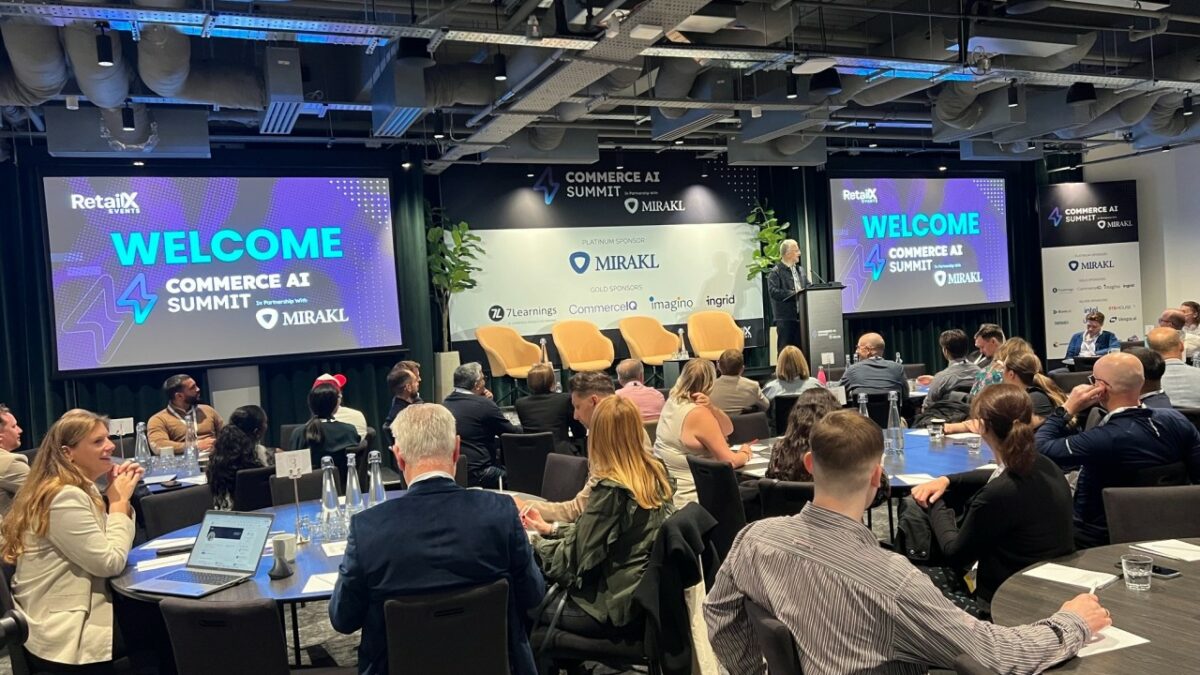
Nicolas Malo, CEOof Optimal Ways, was pleased to participate in the very first Commerce AI Summit in London on June 3, 2026. Here are the key takeaways from this day of lively discussion on the future of AI in retail and commerce.
This new event is being organized by Ian Jindal and the RetailX team. Ian had come to Lille in January 2026 to participate in a Franco-British debriefing on the NRF alongside Michel Koch.
The Commerce AI Summit was designed as an open, practical, and collaborative forum for discussion on how artificial intelligence is transforming retail and commerce.

The event was organized around four major themes drawn from the Commerce DNA framework: External AI, Experience AI, Capability AI, and Strategic AI. Each theme addressed a different aspect of AI’s impact, ranging from the AI-enhanced consumer to the AI-transformed enterprise.

For each topic, the format consisted of a 30-minute panel discussion with experts, followed by a 30-minute Q&A session. This allowed moderators and participants to delve deeper into the ideas discussed, share their experiences, and explore their practical implications for retailers, brands, and technology partners.
The discussions were held under the Chatham House Rule: participants may use the information shared, but may not reveal the identities of those who provided it. For this reason, this article does not contain any direct quotes attributed to the speakers.
This approach fostered particularly open discussions about the opportunities, challenges, and uncertainties associated with AI.

AI in Retail: From Executive Board Hype to Business Reality
At the opening of the RetailX Commerce AI Summit, Ian Jindal, editor-in-chief of RetailX, set the tone with a familiar observation: AI may seem new, but many of the conversations it sparks bear a striking resemblance to those from previous waves of digital transformation.
For many retail executives, the current enthusiasm surrounding AI is indeed reminiscent of other technological revolutions. The terminology may change, but the questions remain the same: Where does the value lie? How do you measure ROI? And how do you turn experimentation into business impact?
AI is no longer just a tool being tested by innovation teams. It is becoming part of the daily lives of executives, employees, customers, and competitors. CEOs are experimenting with tools like Claude, teams are building their own AI workflows, and consumers are arriving better informed, better equipped, and more demanding than ever.

AI and Retail: The Next Wave in Commerce
One message emerged clearly from the Commerce AI Summit: AI is not just a new technological trend. It is part of a more profound transformation in the way consumers discover, choose, and purchase products.
The retail industry has already gone through several waves: brick-and-mortar stores, e-commerce, marketplaces, and now agent-based commerce. AI agents, voice assistants, and conversational interfaces could soon influence—or even directly make—purchases on behalf of consumers.
These new models will not replace the existing channels overnight. Stores, websites, apps, and marketplaces will continue to play a major role. But retailers must prepare for a world in which AI is becoming a new gateway to customers.
🛒 The next channel might not look like a channel
AI agents could become powerful shopping intermediaries. Consumers may no longer need to visit an e-commerce site directly. They’ll simply be able to ask their assistant to recommend the best product, find a gift, or place a repeat order.
For retailers, the challenge will be to remain visible, reliable, and accessible within these new AI-driven environments.
But the experience with marketplaces should serve as a warning: retailers must avoid giving up too much control over their customer data, customer segmentation, and customer retention. AI agents present an opportunity, but they must not weaken the direct relationship with the customer.
🎯 Start with the problem, not the technology
We shouldn’t use AI just because it’s AI.
Retailers should start by asking three simple questions:
What problem are we trying to solve? What impact do we expect? How will we measure success?
AI delivers the most value when it addresses specific use cases: fraud prevention, customer service, product discovery, or operational efficiency.
Experimentation remains essential, but it must lead to the demonstration of a real business impact.
📊 Measuring AI is difficult, but essential
AI performance must be measured based on the use case.
For fraud detection, this might involve reducing false positives or losses. For customer service, it might involve reducing resolution time or improving satisfaction. For product discovery, it might involve increasing conversion rates, raising the average cart value, or reducing returns.
The key is to define the expected outcome before launching the project.
🧠 AI culture is becoming a key skill in retail
Transformation through AI is not just about technology. It also requires culture, training, and leadership.
Employees need to understand what AI can do, what it cannot do, and where human judgment remains essential.
The retail leader of tomorrow will likely need to combine expertise in several areas: data, products, customer experience, operations, governance, and AI workflows.
“Team manager” could soon also mean AI agent manager.
🚀 The Strategic Choice for Retailers
AI in retail spans many areas: automation, fraud prevention, customer service, product discovery, voice commands, agent-based commerce, and business transformation.
The challenge is to pinpoint specific opportunities. Retailers must identify where AI can solve concrete problems today, where it could transform consumer behavior tomorrow, and where it could revolutionize retail in the longer term.
The next wave is already on the horizon, but retailers still have time to prepare for it. The winners will be those who can identify the right use cases, clearly measure their impact, and stay close to their customers —even when the first point of contact is no longer a website, an app, or a store, but an intelligent agent.

🤖 External AI: The AI-Enhanced Consumer
External AI explores one of the most significant changes retailers must prepare for today: consumers no longer navigate their purchasing journey alone.
They are increasingly using AI-powered search, shopping bots, social discovery tools, and conversational assistants to search for products, compare options, and make decisions more quickly.
The fundamental question, then, becomes:
What is my client doing with AI, and how should I adapt to it?
🔄 A New Customer Journey
The traditional e-commerce journey:
search → click → buy
is beginning to evolve into:
ask → answer → buy
Instead of scrolling through numerous pages and sifting through extensive catalogs, consumers can ask an AI directly for a recommendation, a comparison, or a selection of products.
But the impact will vary by industry. In the luxury, beauty, and cosmetics sectors, the fastest response isn’t necessarily the best. Emotion, trust, inspiration, and the brand experience remain essential.
🔎 Visibility Is Becoming a Strategic Factor
Traffic from LLMs and AI assistants is growing, even though the revenue generated remains limited.
Brands must now understand how they are perceived not only by consumers but also by AI agents that read, interpret, and recommend their products.
Structured data, content, customer reviews, availability, promotions, and conversational language are therefore becoming strategic.
📊 AI Share of Voice
A new visibility metric is emerging: AI Share of Voice.
Retailers will need to assess how often, how accurately, and in what way their brands and products appear in the responses and recommendations generated by AI.
This is where GEO—Generative Engine Optimization— comes into its own.
Just as SEO helped optimize visibility on search engines, GEO will help improve visibility in the AI-guided discovery tours.
🛒 Shopping Agents and Trust
Shopping assistants could become true confidence-building tools: reading reviews, comparing products, summarizing customer feedback, and helping consumers make decisions.
This creates new requirements: accurate product data, relevant reviews, up-to-date promotions, and reliable availability.
The trust becomes central.
🚀 What Retailers Need to Do Now
The priorities are clear: improve content quality, structure product data, measure visibility in AI systems, test user experiences for agents, verify how promotions are interpreted by AI systems, and build consumer trust.
The AI-enhanced consumer is already emerging.

🛍️ Experience AI: Retail Enhanced by AI
Experience AI focuses on how retailers use artificial intelligence to improve the customer experience, increase conversion rates, and strengthen their competitive advantage.
This includes AI features on websites and apps, chatbots, personalization engines, and product experiences that remain under the retailer’s control.
The central question is:
How can AI make the customer experience more relevant, useful, and value-driven?
🧠 Personalization Gets a Second Chance
Personalization isn’t new. What’s changing with AI is the ability to understand intent, use new formats such as images or multimedia, and reduce friction all the way to conversion.
But personalization only works if the customer perceives real value in return.
📊 Data remains the foundation
AI does not replace the fundamentals.
Retailers always need data that is properly collected, organized, reliable, and used in accordance with consent.
Without solid data, AI-powered experiences risk becoming inconsistent, irrelevant, or impossible to scale up for industrial production.
🤝 Humans need authenticity; bots need efficiency
Retailers must now design their experiences for two audiences:
People need emotion, trust, and authenticity.
Bots need clarity, structure, and efficiency.
🔎 From Keywords to Conversation
E-commerce has long been built around keywords. AI is now pushing retailers toward a more conversational and intent-based approach .
Product descriptions, customer reviews, and the language actually used by consumers will become increasingly important.
⚙️ Build, Buy & Test
The question of ” build versus buy ” remains central.
Purchasing a solution allows retailers to quickly test a proof of concept, but they must plan ahead for scaling, costs, and dependence on suppliers.
The message is simple: Test before moving to mass production.
🧩 Flexible architecture is becoming essential
A composable architecture makes it easier for retailers to test, combine, and replace AI solutions.
This flexibility will be essential in an environment that will likely combine internal capabilities, external solutions, and human expertise.
🚀 AI-Enhanced Retail
Experience AI isn’t about using AI just for the sake of using AI. It’s about creating experiences that attract, convert, and retain customers.
The retailers that will succeed are those that can combine reliable data, a rigorous testing process, effective cost control, a flexible architecture, and the right balance between human creativity and AI-driven automation.

⚙️ Capability AI: The AI-Driven Organization
Capability AI focuses on how retailers can use artificial intelligence to improve their internal operations.
AI can transform teams, processes, and decision-making—from forecasting and planning to pricing, budgeting, marketing, and operational optimization.
The central question:
How can AI help the organization make better decisions, faster?
🧠 From Data to Intelligence
Machine learning, predictive models, and data science have been part of the retail industry for years.
What sets generative AI and agent-based AI apart is their ability to connect different sources of information, extract insights from unstructured data, and make intelligence more accessible throughout the company.
📊 Automate decisions, not just tasks
AI is beginning to automate decisions, not just repetitive tasks.
In areas such as pricing, marketing investments, and demand forecasting, retailers can shift from a rules-based approach to one based on business objectives.
This does not mean eliminating the human element, but rather providing it with better predictions, clearer explanations, and robust safeguards.
🛡️ Safety measures build trust
If a model recommends a price, a promotion, or a marketing campaign, teams need to be able to understand why: expected revenue, margin, return rate, impact on inventory, or consumer response.
The more explainable and well-defined the AI’s recommendations are, the more teams can trust them, challenge them, and help them improve.
🧩 Unlocking the Company’s Potential
AI can also help executives test their ideas much more quickly.
One example cited involved using AI agents to analyze public websites across multiple markets, identify recurring issues, and generate concrete recommendations. Rather than waiting several weeks for the results of a traditional audit, executives can quickly model a problem, test a hypothesis, and show teams what its implementation might look like.
This creates a new opportunity for leaders: rather than simply asking teams to explore AI, they can concretely demonstrate the behaviors, ways of thinking, and problem-solving approaches they wish to encourage.
💰 ROI Above All Else
The question comes up again and again:
What value does AI actually create?
The starting point should not be:
“How can we use this tool?”
but rather:
“Where are we making costly decisions today, and how could AI help us improve them?”
🔄 AI is a tool, not a mission
The goal is not to “do AI.”
The goal is to improve the company’s operations.
The AI-driven organization will be the one that uses it with Clear priorities, measurable value, robust safeguards, and teams capable of adopting, challenging, and improving decisions generated by machines.

🧭 Strategic AI: How AI Is Transforming Businesses
Strategic AI raises an even broader question:
How is AI transforming the business model itself?
Beyond operational efficiency and customer experience, AI is beginning to change how retailers create value, leverage their data, and build their long-term competitive advantage.
🧠 AI Unlocks Human Potential
One of the most powerful messages is that AI is fundamentally about people, not just technology.
It gives more employees the opportunity to think critically, use tools, access data, and turn their ideas into action, even without advanced technical skills.
📦 Turning Knowledge into a Product
In certain industries, AI makes it possible to transform deep domain expertise into a tangible product.
Years of expertise gained in delivery, pricing, marketing, or customer insights can be captured, organized, and industrialized thanks to AI.
📊 Data Is Becoming a Strategic Asset
Data and customer insights are becoming increasingly important sources of value.
The ability to understand customers’ behaviors, motivations, and needs could become just as important as the transaction margin.
In some cases, the data could even become the company’s true intellectual property.
This also serves as a warning: with the development of agent-based AI, retailers must avoid lose control of their customer data to the benefit of new intermediaries.
⚙️ Transformation starts with processes
A successful AI transformation starts with business problems, not tools.
Companies must map out their processes, identify pain points, understand where AI can create measurable value, and develop the business case with the relevant teams.
Technology is only part of the transformation.
The main challenge often involves people, adoption, training, governance, and the transformation of work practices.
🎨 Reinventing Creativity and Execution
AI is already transforming marketing, innovation, and content creation.
Tasks that used to take several weeks or months can now be completed much more quickly.
The opportunity lies in combining technology and creativity to make teams both more effective and more efficient.
🧩 The Future of Work
Over the next two to three years, a new organizational model could emerge:
Fewer repetitive tasks, more management of AI agents, more critical thinking, and more time devoted to insight, judgment, and decision-making.
This requires training employees in use AI tools, challenge their results, manage agents, and apply their business expertise in new ways.
🏗️ Retail still faces physical constraints
AI can transform many aspects of a business, but it will not eliminate all constraints.
Brick-and-mortar stores, the supply chain, sourcing, warehouses, and real estate cannot keep pace with the speed of software.
The competitive advantage will therefore come from the ability to Using AI Wisely, rather than the assumption that it will systematically lead to a tenfold increase in growth.
🚀 The Enterprise Transformed by AI
Strategic AI goes far beyond automation. It is about creating value, evolving business models, and the future role of employees within the company.
The companies that will succeed are those that can protect their customer data, turn their expertise into products, train their teams, rethink their processes, and use AI to build closer relationships with customers.
AI will not replace strategy. But it will transform the way strategy is executed, the way value is created, and the way organizations turn their knowledge into a competitive advantage.

✅ Key Takeaways
🎯 Start with the business problem
AI shouldn’t start with the tool, but with a clear business question:
What problem are we trying to solve? What value do we expect to achieve? How will we measure the impact?
📊 Data and content are becoming strategic assets
Structured data, customer insights, product content, reviews, and operational intelligence will determine retailers’ visibility, relevance, and competitiveness in a world increasingly shaped by AI.
🤝 Trust is becoming the new battleground
As consumers increasingly rely on AI-generated recommendations, retailers must build trust through transparency, accuracy, relevance, and reliability in the experiences they offer.
🧠 AI is as much about people as it is about technology
True transformation will come from training teams, evolving workflows, facilitating change, and the ability to use AI to think, decide, and act more effectively.
🧩 Flexibility will be key
Modular architectures, clear governance, and well-considered technology choices will enable retailers to test, scale, and adapt without becoming locked into a single solution.
🚀 Retailers still have time, but they can’t afford to wait
The next wave is already in sight.
Retailers who are experimenting today, learning quickly, and staying close to their customers will be best prepared for whatever happens.
🙏 Thank you
A big thank you to Ian Jindal, the RetailX team, and all the speakers, moderators, and participants who contributed to these enriching discussions.
The event was a wonderful opportunity to explore how AI is transforming commerce from every angle: the augmented consumer, the augmented retailer, the AI-powered organization, and the AI-transformed enterprise.
Thank you also to the organizing team for creating such a valuable space for open discussion, practical feedback, and collective learning.
One thing is clear from today:
AI in retail is no longer just a future disruption. It is already transforming the way retailers think, work, differentiate themselves, and create value.